Well, at last spring has arrived. Although this year’s winter seemed to be pretty mild, except for those ridiculous snowstorms, it still quickens the step and lightens the mood when the signs of an urban spring come. (As a school administrator it feels great if for no other reason than the moment approaches when we give your sons and daughters back to you and say “now, you figure out what to do with them for three months.”)
Now what are the particularly urban signs of spring? I could first point out that we no longer see snow plows on the roads, but that would presuppose that we saw them when it actually snowed this winter. (That’s a cheap shot I know—especially since my car was plowed into its parking space three times back in January.) Or I could say that there are no more college basketball games this year at the Arena, but well, never mind.
One sign of spring surely must be the people on my street who are out everyday now washing or waxing their cars (don’t they ever get the temptation to do my car?) One sign our son loves is the street cleaner with its huge brushes doing more sweeping in one day on our block than I will ever do in our kitchen.
Another sign that warm weather is on the way comes from the hammering and sawing that signifies that the season of home improvements is here for good. This can only mean that I have another year of feeling guilty and inadequate when after months of prodding, I finally agree to do something major like fixing a door knob.
As I emerge bloodied and hoarse from screaming, but full of testosterone and feeling like Bob Vila from putting two new screws in, I witness my neighbor putting in a new deck or doing some job so extensive that I feel overwhelmed thinking of how many hours I would need to spend at Smith Hardware to understand everything.
An aural sign of spring is that now everyone feels comfortable sharing the music from their car stereos with the immediate world; every year I know that I am getting older as the cacophony seems to grate on my nerves more. What once was charming now is just downright annoying as we try to put our son down for the night, and our windows literally shake from the emanations of a car stereo.
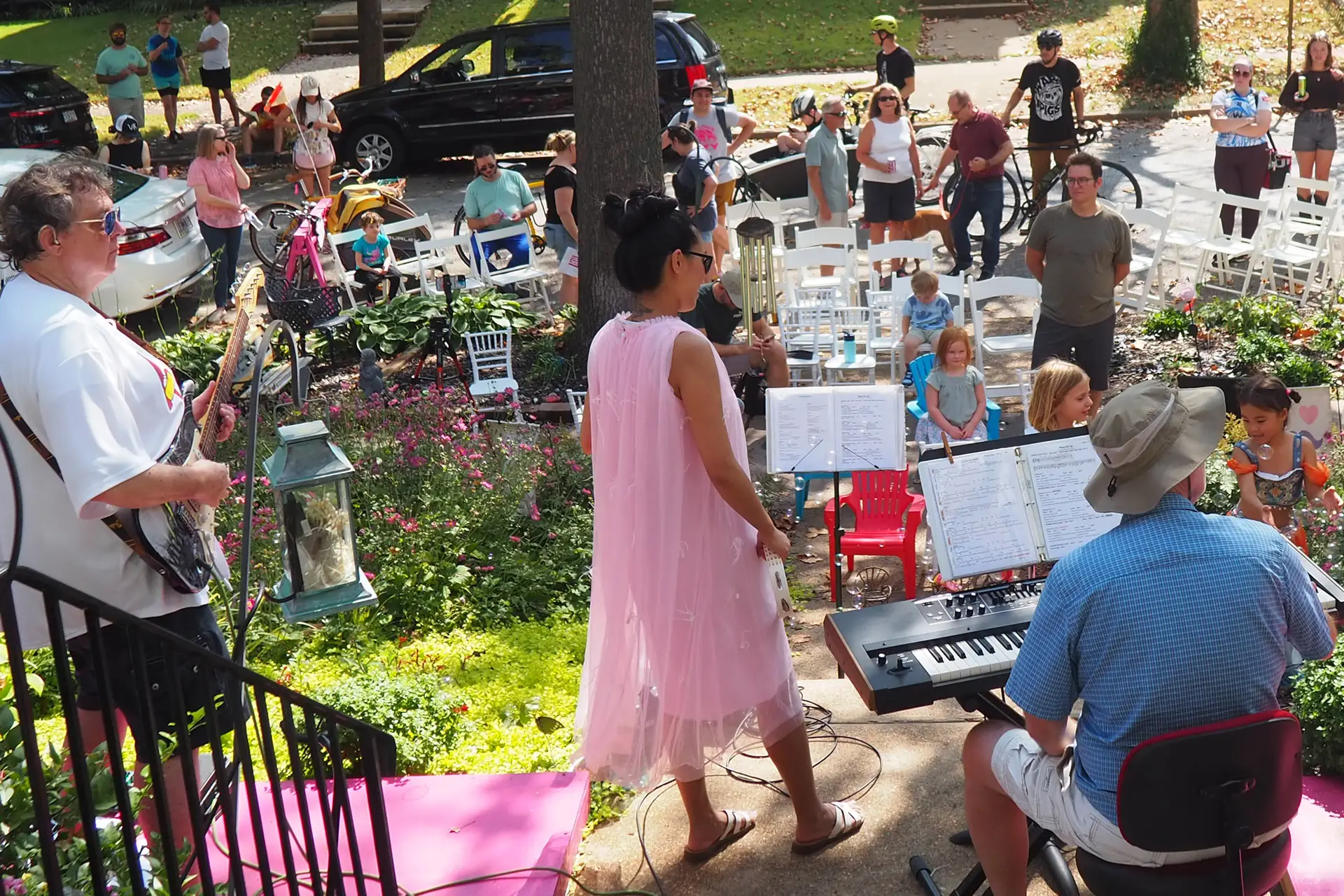
An aural indicator I love, though, comes in the conversations that one can overhear as the porch culture emerges. Surely one of the most inviting and enticing elements of city living comes when driving down the street in the evening and seeing people on their front porches just hanging out or visiting with their neighbors.
When people live out on their stoops and communicate with their neighbors, when we come down from our porches to converse with the friend walking the dog, we engage in the breaking down barriers that may prevent us from reaching our potential in a highly mechanized society.
Although this may be overstating the fact, doing no more than running from our car into our front door and back out again in the morning begins to resemble a futuristic dystopia where we get sucked through clear plastic tubes from work to house like those tubes where we deposit our money when we go through the automobile lines at the bank.
We have taken on a new identity as a neighbor rather than as a co-worker, or a harassed shopper or an enraged driver. In doing so, we have momentarily forged a connection with someone close to us in proximity, if not in emotion.
Porch life can also be one of the dearest signs of safety in our neighborhoods. A street with a vibrant porch or stoop culture may affirm that people don’t have air conditioning or that people are just so sick of each other that one person had to get out of the house. However, it also demonstrates that people feel secure enough to be out there, and in this way shows that threats to physical safety are not so great as to preclude our using this crucial component of our house.
I can remember the resentment and anger I felt two years ago when on a sunny weekday afternoon, one car after another sped down our block, and in the rear car a man leaned out the window and shot at the driver of the lead car.
I had come home from work for a couple of hours to see my family before returning to school for an evening event. I was sitting on the front porch doing some paper work and my wife and son had arrived two minutes earlier and had come in from the car. As she carried the snoring lad on her shoulder, I thought that like the old beer commercial, it does not get any better than this.
However, my domestic bliss was to be short lived as the gun fight broke out directly in front of our porch no more than two minutes after my wife and son had returned home. None of us was injured, but all of us were hurt. Was this really happening on our block at this time of day? This kind of thing occurs in other neighborhoods to other people, but not here.
Like other times when we put back on our shields so we can exist in an age of senseless violence, we went on, and the fear developed into a scar—always there, but not too noticeable.
However, for me what may have been most damaging was the sense that I had to be careful sitting on my porch or stoop in case a random bullet went awry. During the summers, I ride my bike through Forest Park every morning and return to drink my iced coffee and read the paper on the front step.
After this incident, I was angry and defiant—how dare someone attempt to take my morning and evening ritual away. This event brought home to me that one of the most damaging elements of urban crime is its ability to rob a neighborhood of its porch culture.
At this point, a street becomes nothing more than a thoroughfare or a way to move from one point to another without stopping. The sense of community that holds a neighborhood together disappears as people live in their fortresses isolated from one another.
“As long as whatever happens outside does not affect me, then I don’t really care about it” becomes the mode of thought that eventually culminates in people leaving the neighborhood for other places safer or more communal.
I visit friends in suburbs named Plainview or Bucolic Bliss or City Flight Estates (ok, so the last two names aren’t real), and I feel sad as I drive down the winding streets past houses that all look alike.
Granted, they have big houses with huge front yards, (and I hate mowing my front yard), but there are no sidewalks and no porches. The facades are solid and statuesque; with their front doors and four windows, they resemble the houses we drew in grade school.
However, unless individuals are out working on their yards, one would have no idea that people actually live here. The houses and cars are full of people, but there is no life.
Whether it’s our desire to feel like we live in a small town where everyone knows one another, or the almost tangible malaise in our rootless society, it seems like more and more people wish to communicate with other people.
As we spend more time on email, shopping via the web, and separating ourselves from others, we look for a way to experience what Norm did every time he entered the bar on Cheers and people greeted him.
We wish to be in a place where everyone knows our name, and spending time on our porches and front steps enables us to have this opportunity for connecting with others and being recognized. It’s one of the ways that a city becomes like a small town, and we learn to feel like we belong.
For this reason, it is imperative that we continue to fight street crime wherever and whenever it occurs. In addition to the property or human damage that accompanies crime, we cannot allow ourselves to be psychically robbed of our ability to forge ties with others.
We cannot permit our streets to become a line, that is the path of a moving point thought of as having length but not breadth. If we want to live in a one-dimensional space where there is no life, the Plainviews beckon us; I will take my front porch anyday.