Historical February 1999 article. Dates, prices, services and contacts describe the source period; current availability has not been established.
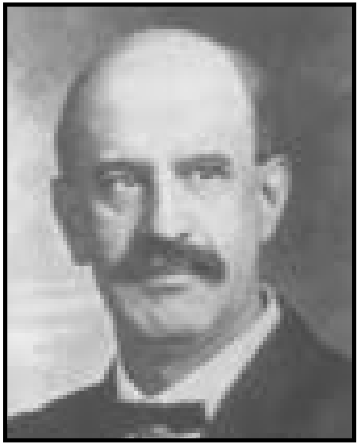
On January 17, a diverse group of neighbors gathered at Grace and Peace Fellowship to celebrate the life and ideas of civil rights leader Martin Luther King Jr. and the 1963 March on Washington and to also honor the late Virgil “Jack” Wright. Wright had chaired the committee putting on the annual King Commemoration for a number of years.
He was also a past president of the Skinker DeBaliviere Community Council and served on the board for several decades.
This year, Greg Freeman, Post-Dispatch columnist and DeGiverville neighbor, stepped in to chair the event. Cal Stuart and Dave Schmidt shared memories of Jack with the audience. Stuart noted that Jack Wright had been part of the group working to form the SDCC in 1966 and he initially represented St. Roch. Stuart joined the Council board as a Representative of the Rosedale Neighborhood Improvement Association and got to know Wright well. Their work together continued when Wright assumed the Council presidency and Stuart became executive director. Stuart felt that Wright played an important role in setting the Council’s goals and in trying to establish a neighborhood like King’s dream-racially and economically mixed and dedicated to a common cause. Wright never lost sight of his goal, even when many felt Skinker DeBaliviere would collapse.
His work helped to ensure that it did not. Dave Schmidt told the gathering that Jack Wright was his best friend whom he met over 30 years ago at the St. Roch gym at a guitar mass. Schmidt said that Wright helped to teach him that people are just really people; religion, skin color and ethnic origin don’t matter. Schmidt noted that the 70s and early 80s were very contentious times in Skinker DeBaliviere. Wright took a lot of abuse from some of the neighbors, black and white, who saw him as a token.
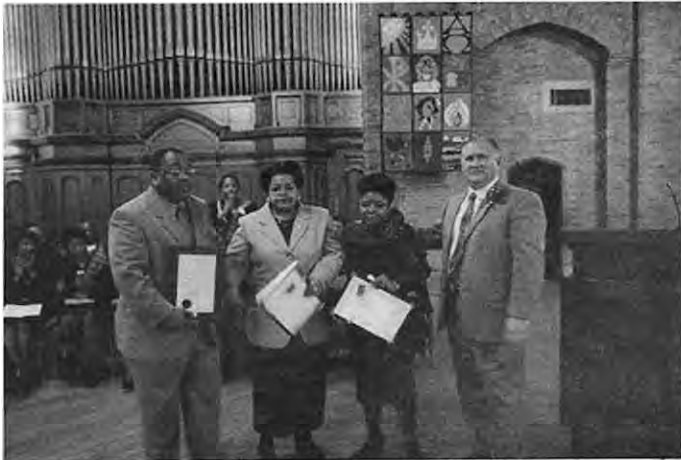
This hurt him a great deal. But, he was able to go on. And, now his work lives after him. Skinker DeBaliviere remains racially and economically diverse but has grown increasingly stable with crime down and property values up. Gary Hayes, current president of the SDCC, presented Wright’s three children with plaques celebrating their father’s 30 years of hard work ”through color blind eyes for his community.” The children, John, Martie, and Liz, each said a few words. Several school groups presented music and skits to illuminate the meaning of the King legacy.
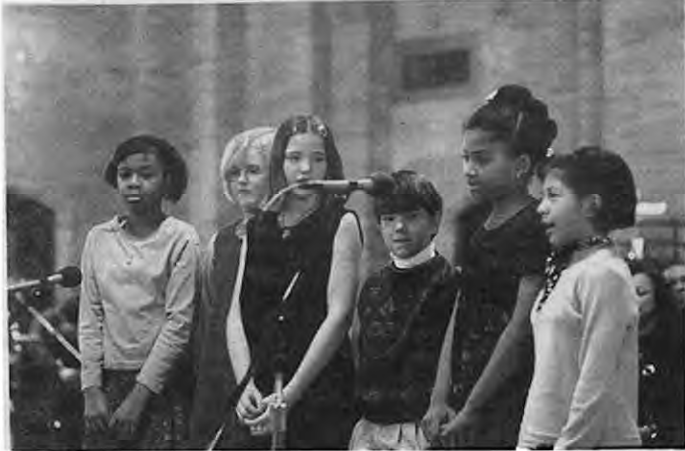
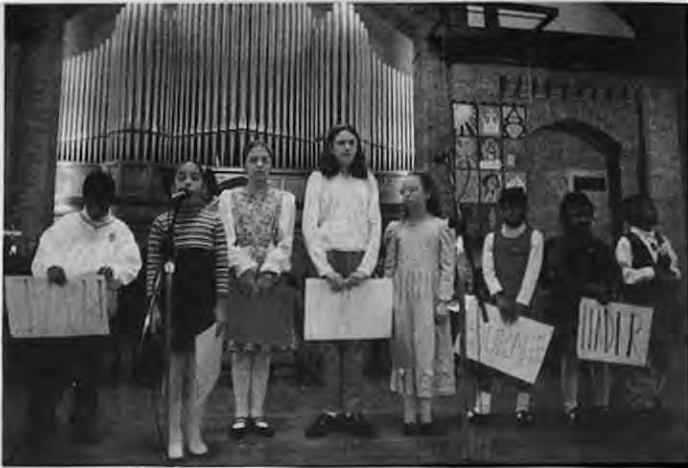
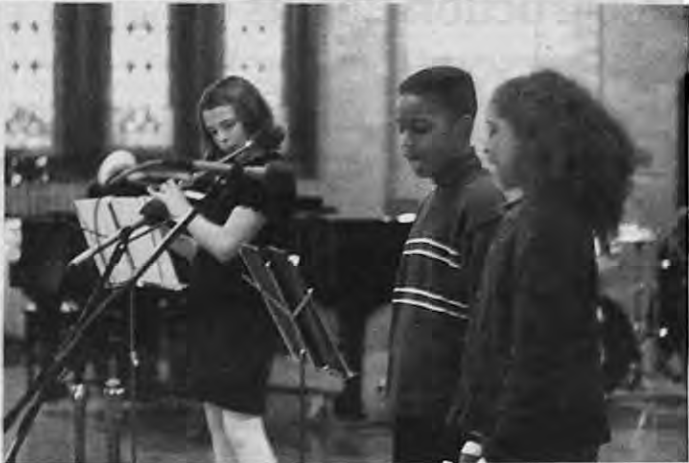
The Grace and Peace Youth presented a brief history of the March on Washington, coming only two months after the slaying of Medgar Evers. Speakers at that August 28, 1963, march demanded passage of the civil rights act then stalled in Congress. King made the speech he is most remembered for, “I Have a Dream.” Children from St. Roch School presented a Langston Hughes poem, “God Has Chosen Me.” Crossroads students made the point that King fought, fought for civil rights with nonviolent means. New City School had 3 students with considerable talent providing a vocal tribute to King. Bethel School also presented some of Dr. King’s ideas.
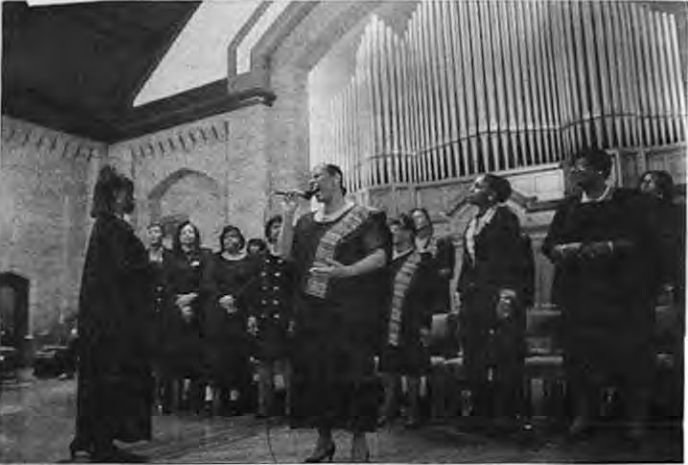
The New Cote Brilliante Church of God choir again graced the commemoration with its inspiring music.
They opened the program with “Lift Every Voice and Sing” and had everyone moving to a gospel hymn.
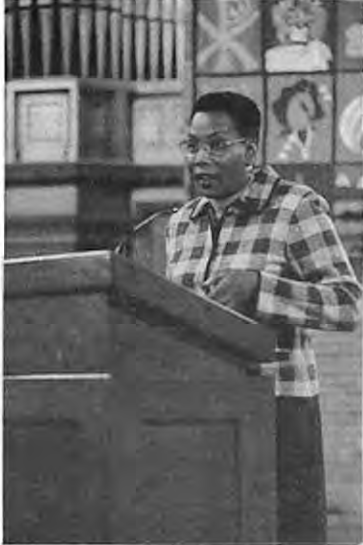
The keynote speaker was Bonita Cornute, She is a general assignment reporter for Channel 2 news and has made her home in Skinker DeBaliviere for about two decades.
In her remarks, Cornute raised the fact that the U.S. had mandated segregation and had had laws that encouraged racism and stereotypes.
The March on Washington grew out of the nation’s inability to pass a civil rights act and took place 10 weeks after Alabama Governor George Wallace stood in the school house door to block African Americans from attending the University of Alabama.
The march was designed by its leader, A. Philip Randolph, to draw attention to the civil rights cause, to see that civil rights legislation was enacted, to see. that schools were no longer segregated, and to prohibit job discrimination. Over 1/4 million people attended the march.
There were 60,000 whites present.
It was a coming together of church leaders, black activists, and white liberals. Eighteen days after the march, four little girls were killed in a bombing at a church in Birmingham, Alabama.
The hope of the march could not endure for long. Cornute noted that she was 10 years old when the march occurred.
She grew up in a housing project in Milwaukee.
She said that she still sees situations today that show that racism remains alive. Civil rights bills were enacted.
She attends a biracial church and lives in a biracial neighborhood. But, she still gets angry at the racism she sees. Racism affects blacks’ ability to compete in the global economy. Cornute wishes that corporate leaders would assist minority entrepreneurship.
She said that African Americans have come a long way but there is a lot more to do. “We must demand excellence from schools, the school board and students.
We cannot allow these children to continue to fail.” Cornute remarked that Skinker DeBaliviere can be the catalyst for change.
We already live next door to one another here.
She said that we should try to be more influential in this region.
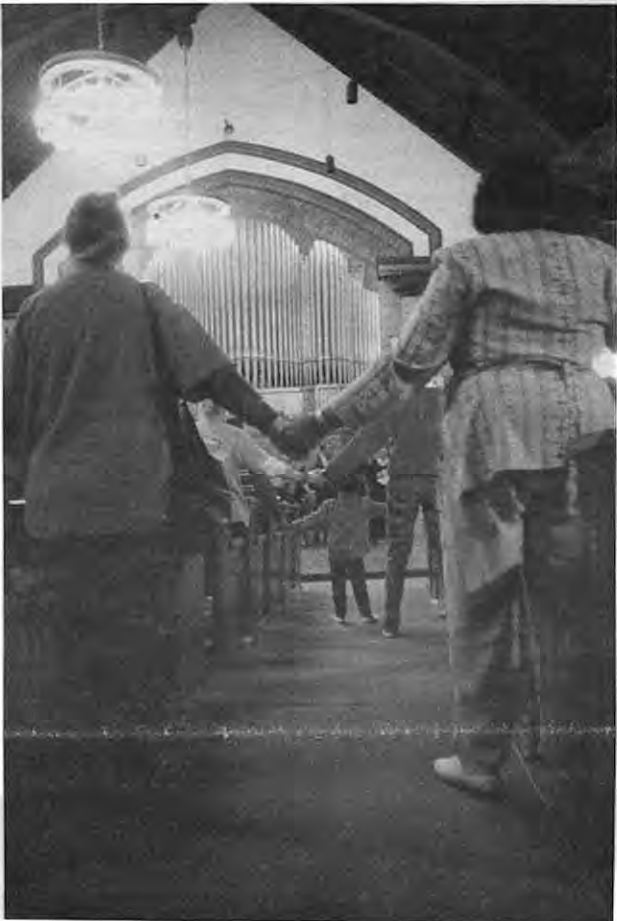
After concluding remarks by the Rev. Miki Merritt of New Cote Brilliante Church of God, everyone joined hands and sang ‘We Shall Overcome.” It was a day of thanks to Dr. King and to neighbor Jack Wright that ended on a note that there was still a great deal more to be done to create the colorblind society both believed in. SDCC Director Laure Porterfield as well as representatives of each participating school helped put together this commemoration.
A committee of neighbors chaired by Greg Freeman coordinated the event and chose the theme and speakers.
The neighbors on the committee included Ruth Johnson, Ronie Haliburton, Gwen Lazard, Shirley Polk, Ann Smith Carr, and myself. Rev. Merritt’s church helped to fund the refreshments for the gathering that members of Grace and Peace put together. Jack Wright’s children were also active in planning an event their father helped to create and sustain.
Original photograph caption
The service closed with the singing of We Shall Overcome. Photo by King Schoenfeld.
Originally published in The Times of Skinker-DeBaliviere, February 1999.
Read this article in the original newspaper issue.
Original source: SD_Times1999_02.pdf, printed page(s) 1, 4; PDF page(s) 1, 4.