Historical June 1998 article. Dates, prices, services and contacts describe the source period; current availability has not been established.
On May 27, several residents of Skinker DeBaliviere journeyed to northern California to examine light rail in San Jose, San Francisco, and Sacramento.
They included SDCC president Gary Hayes, SDCC vice president and Parkview resident Ann Smith Carr, Paul Hohmann, chair of the MetroLink Advisory Committee, and Dan Schesch, newly elected SDCC board member from Rosedale. Schesch paid his own way; the other three received scholarships from Washington University. SDCC executive director Laure Porterfield also made the trip.
The council paid for half of her expense and Wash U covered the other. At the SDCC meeting on June 8, they gave their impressions of the trip. Those impressions, as well as a later interview with Hohmann, provide Skinker DeBaliviere with new ways in which to view the light rail proposed to run along Forest Park Parkway, either at grade, below grade uncovered, or below grade covered. Hohmann spoke for everyone when he described the trip as well-planned and thought out.
Some of what they saw was applicable to our situation but some was not.
Most of what they saw was surface light rail. Hohmann particularly wanted to see first hand what it would like when the trains ran at grade.
They had a pretty good variety of exposures: 1) through industrial areas at 55 m.p.h. 2) through somewhat residential areas at 35 m.p.h. 3) traversing downtown areas at 10-15 m.p.h.
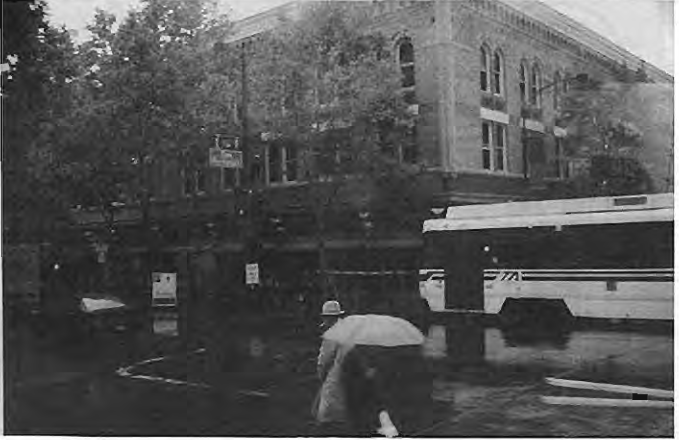
In San Francisco, the train runs in the midst of traffic and that really slows the train down.
The train there stopped at every stop sign. Hayes said that he found that trains running above ground could be tastefully done.
The noise had been reduced.
It was quite a bit less than with the trains that run through our neighborhood now. Our noise problem stems from the fact that BiState used old pitted track. Hayes also toured the Siemens plant that made our cars.
They seemed less noisy than Italian cars also in use out there. Hohmann mentioned seeing a train running in a trench in San Jose. That train had to pass under existing freight rail tracks.
He said it was not attractive—an open concrete pit and a fence.
He wondered how that would work here where we would have little room to take aesthetic considerations into account. Many of the train tracks he saw had considerable landscaping though, something made more possible by the California climate. Carr focused on the quality of the professional planning staffs in California.
She and Porterfield were both impressed by their sophistication and expertise. Schesch spent time talking to the train drivers and learned there were recurrent problems with motorists trying to beat the gates at intersections. Accidents that occurred were not the fault of the train drivers but of pedestrians or motorists. Hohmann also hoped to see the transit-oriented development that light rail made possible in these communities.
He did not see as much as he wished.
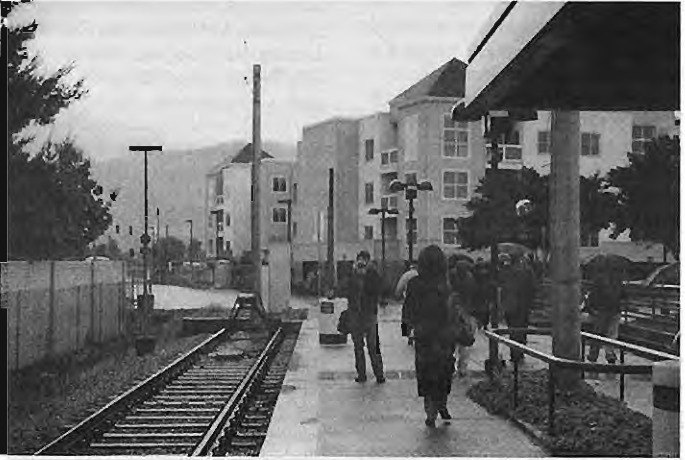
In one area, dense housing and apartments were built by a station.
However, there was not a great deal of mixed use development (commercial) around the stations they saw.
However, it was clear to him that light rail in San Jose and Sacramento helped downtown renewal and new residential growth there. Schesch commented that some on the trip had really been impressed by the downtown transit mall in San Jose.
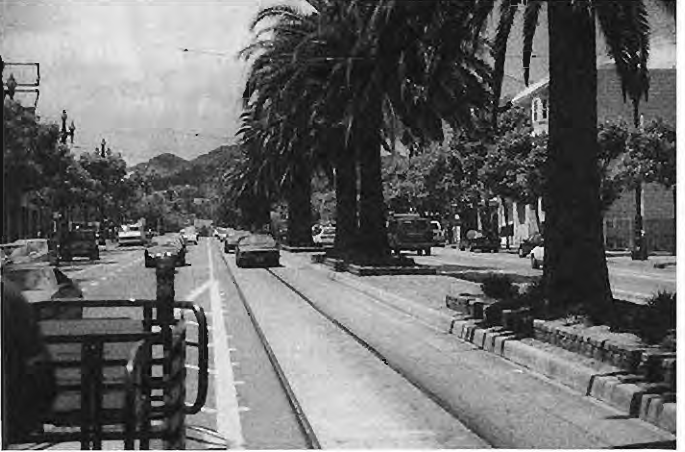
In an area near downtown San Jose, the train goes down the middle of a roadway that has several lanes of traffic on either side. Trees have been planted right by the track.
This train preempts regular traffic signals: The light turns green when the train approaches the intersection. Hayes corn mented that traffic kept flowing except at big intersections. Porterfield and Hayes both mentioned a neighborhood in Sacramento that had resisted light rail and even when it passed through they opted not to have a station. Subsequently, they petitioned to be allowed to reverse their previous position. Their neighborhood now has two stations. Hohmann offered some food for thought for Skinker DeBaliviere residents.
We might worry about how slow trains at grade would be in well-developed areas.
He noted that there is so much congestion in California that light rail, even at grade. makes it better.
We don’t have that degree of congestion.
He feels that light rail at grade can be safe if people are careful.
His biggest concern regarding light rail at grade here is horns.
In California, horns are almost never sounded. Missouri law dictates that the driver blow the horn at intersections. Many have noted how loud that can be and can even hear the hour when it is sounded now in Wellston. Hohmann is also fearful regarding the DesPeres intersection.
With light rail at grade, vehicular traffic may not be able to travel to Lindell on DesPeres. Hohmann felt that light rail could be integrated if landscaped and if the right type of track bed was laid.
A floating slab could control vibration and noise.
A trench is poured first.
An isolating element is added and then the slab.
There were examples on the trip of where light rail is unobtrusive. Hohmann understands that the consultants to East/West Gateway are putting together a plan for a committee with representatives of each area along the proposed new MetroLink route.
A first meeting would take place in August if East/West Gateway okays this plan.
To continue its mission of providing information to the neighborhood regarding MetroLink, the advisory committee has been reconstituted as a standing committee of the SDCC, the Transportation Committee. Hohmann will continue as chair and this committee will also monitor BiState’s plan to redo the DeBaliviere parking lot and perhaps add other development.
The Transportation Committee will meet on July 6.
A major item on the agenda will be viewing video footage Dan Schesch took in California.
All neighbors are welcome to attend Transportation Committee meetings and learn more about what is planned for our neighborhood.
Call SDCC at 862- 5122 for more information.
Original photograph caption
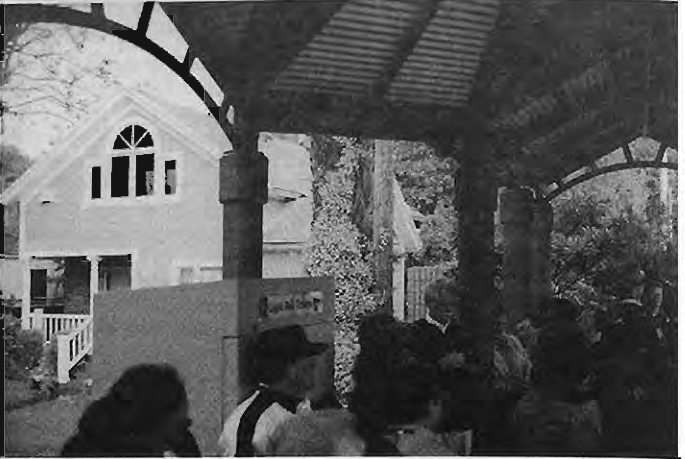
48thStreet Station,Sacramento;house shows proximity to residential neighborhood. Photographer not credited.
Originally published in The Times of Skinker-DeBaliviere, June 1998.
Read this article in the original newspaper issue.
Original source: SD_Times1998_06.pdf, printed page(s) 4; PDF page(s) 4.





