Historical April 1997 article. Dates, prices, services and contacts describe the source period; current availability has not been established.
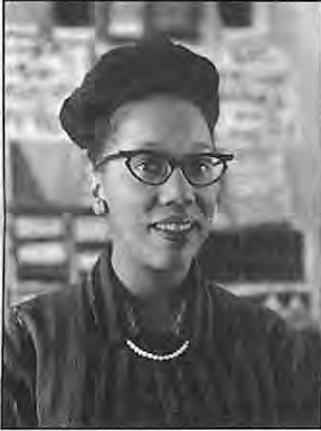
Priscilla Dowden moved to 61xx Westminster with her husband and daughter about a year ago.
She is a member of the faculty of the Department of History at the University of Missouri-St. Louis.
She is a native of this city, growing up on Kennerly and Labadie in North St. Louis and graduating from Beaumont High School in 1980.
She received her B.A. in history from UMSL and then an M.A. in African and African American Studies from Cornell University.
She went on to Indiana University at Bloomington and recently received her doctorate from there.
Her dissertation, hopefully to be a book in the near future, is a study of social movements advocating for the expansion of services and institutions in public health care and public education for African Americans in St. Louis from 1910 to 1949. Dowden’s work is particularly important because relatively little has been written about the history of St. Louis or about its African-American population.
She has also looked at a lot of larger issues during this period of entrenched institutional racial segregation in our city.
She has been most intrigued with How African Americans manipulated the public culture to get what government owed them as citizens. One facet is that in many circles in the black community, people say that “We were better off before 1954.” Dowden can kind of see this but thought it odd because people had fought so hard to tear segregation down and then they couldn’t enjoy it.
It is obvious to her that there was more cohesion among African Americans in the interwar period but it was artificial in part. People wanted to strive together but certainly part of it was the race restrictive covenants and institutional racism that African Americans couldn’t get around.
Also intriguing is the fact that St. Louis crosses so many different regional patterns. African Americans in St. Louis tried to alleviate segregation and overturn laws.
But the system was not as entrenched here as in the south.
In some northeastern cities, public schools had been integrated and then, in the interwar period, there was a push to segregate them.
Here in St. Louis, schools were always segregated and in the interwar period the push was for more segregation. St. Louis’s African-American community has a strong tradition of learning how to manipulate that system. Dowden’s work focuses two of the most prominent organizations of the time: The Urban League and the League of Women Voters.
She became very impressed with the large role the Urban League played in assisting the African-American community.
The League had a strong handson approach and did its work very well. John T. Clark was its executive director.
His philosophy was that “We do what we do because there is no one else to do it.
In the 1950s and 1960s the federal government took over some of the projects that had been handled by the Urban League.
It seems to her that the federal government has not done as good a job as the League.
The League had worked on neighborhood beautification and had set up block units and neighborhood clubs.
There was a very high level of racial cooperation in St. Louis in the Urban League and the League of Women Voters during a period of entrenched segregation. African Americans then had a clearer idea of where they were going and how to get there. John T. Clark has written in his memoirs of what happened when he went to meet with a wealthy white man by appointment in the Central West End.
A maid answered and she slammed the door in his face when he asked to enter.
According to Dowden, he understood what had happened.
He knew they would have to meet somewhere else.
He endured it in order to carry on his work.
In this aspect, things have changed. Dowden noted that the League of Women Voters had a Colored Committee.
The name was changed in the 1940s to the Interracial Committee.
The League always had an AfricanAmerican women on its board.
It placed African-American concerns on its agenda.
There was social segregation too but health care and education were addressed by the League of Women Voters. Dowden’s work is fascinating and she is an addition to the complement of academics who reside in Skinker DeBaliviere.
She and her family enjoy the neighborhood.
She likes being close to the Loop, Forest Park, and Washington University and also enjoys the multidimensional diversity here.
She wanted an older home and a neighborhood where the houses were closer together.
Her final comments concerned St. Louis’s notable inferiority complex.
She feels that people misunderstand why earlier generations chose to settle here.
The press often says that people were passing through, ran short on money, and stayed.
In the period she looked at people like Roger Baldwin, Susan Paul Vashon, and John Clark decided to settle here.
They could have gone anywhere. Clark had founded the Urban League in Pittsburgh and had worked for years in New York City.
He was very attracted by St. Louis and saw opportunities to exploit the public culture.
He found St. Louis to be a vibrant community. Of course, it was highly segregated but there was a strong sense of civic responsibility and a rich cultural life. Clark did note St. Louis’s leisurely life style which he linked to the summer heat but he was that residents were laid-back and that they really liked this city.
Original photograph caption
Priscilla Dowden. Photographer not credited.
Originally published in The Times of Skinker-DeBaliviere, April 1997.
Read this article in the original newspaper issue.
Archival transcription note: Closing source sentence prints “but he was that residents were laid-back”; apparent missing wording retained without invention.
Original source: SD_Times1997_04.pdf, printed page(s) 1, 7; PDF page(s) 1, 7.
