Historical October 1994 article. Dates, prices, services and contacts describe the source period; current availability has not been established.
Just before Labor Day, Caroline Early found a dog in her back yard.
She lives on one of the nearby private streets. “Vincent” as we later called him, was in sorry shape.
He was a small cream colored poodle mix , about 23 lb., freshly groomed, wearing a chain choke collar with a light chain lead attached, but, no identification tags. Unfortunately, he had likely just been in a fight; his ears were gashed, and dried blood and burrs held one of his ears over his head stuck to the other ear.
He was frightened and in pain, ready to snap if approached too fast or if his ears bumped a nearby object or friendly hand reaching to pet him. Caroline was very concerned; her family was going to be out of town for the holiday weekend.
She was sure Vincent belonged to someone and because he was injured, did not want to take him to a shelter.
We took him in and tended to his wounds which were not more than 48 hours old, and luckily not too severe.
He had an infection which would respond to antibiotic therapy.
After 24 hours of antibiotics and a stay at the hospital he was feeling much better, still leery, but starting to seek affection. Rather than leave him alone at the hospital all weekend, I decided to take him home with me for the holiday.
It would be easier to care for him and he would enjoy not being kenneled. Besides, Hugh, my significant other, missed the family dog he left behind in England and I knew he would enjoy having Vincent for the weekend. Well, to get to the point of this article and to wrap it up in reasonable space, we enjoyed having Vincent for the weekend. I’m not sure Pussmins, our cat, would agree. Because Caroline had not located an owner by the following Tuesday, Vincent went to the Animal Protection Agency.
I am pleased to report, he was adopted: happy ending.
However, the ending could have been much happier and simpler if Vincent had just had proper identification; a sturdy collar with a name tag and phone number or address. Even a current rabies tag is traceable. Even if your pet rarely sets foot outside, they should wear identification. Accidents happen, and they get out or away from you.
If you lose your pet, call the Humane Society (647-8800), the Animal Protective Association (645-4610), City Rabies Control (353-5838), County Rabies Control (726-6655) and give them a description of your pet.
Also talk to your postal delivery person, they are acutely aware of the dog population in the neighborhood and often are helpful. Above all, have your pet wear identification.
Original photograph caption
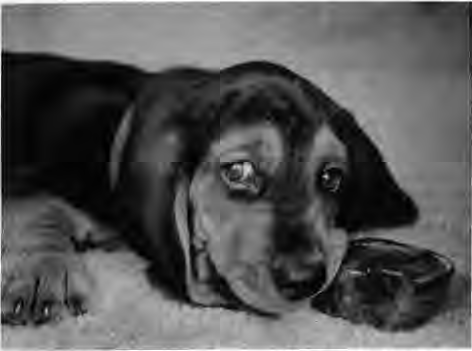
Arlo, a basset hound puppy. Photographer not credited.
Originally published in The Times of Skinker-DeBaliviere, October 1994.
Read this article in the original newspaper issue.
Original source: SD_Times1994_10.pdf, printed page(s) 7; PDF page(s) 7.





