Historical April 1994 article. Dates, prices, services and contacts describe the source period; current availability has not been established.
Last month’s column detailed information about rodenticide, lead and antifreeze poisoning. Choke chain collars, garbage, flies, overthe-counter medications, thread, yarn and string are also potentially hazardous to pets. Choke chain collars are only meant to be worn when a dog is on a leash and accompanied by a human.
They are designed to get the dog’s attention and give the person a control advantage; they are often used as a training tool.
A choke collar left on an unattended pet is potentially a way for the pet to strangulate. Several years ago a neighborhood pet strangled because the loose end of her choke chain slipped through the space between the boards on the porch deck. Struggling to free herself, she fell off the edge of the deck and was hung by her choke collar. Occasionally, an owner will place a chain collar on a young puppy; sometimes the collar is not visible under the dog’s fur.
If the dog grows too large for the collar, the collar will slowly cut into the skin, burying itself deeper the larger the dog becomes. Although any collar has the potential for causing this problem, chain collars are more dangerous.
A dog should wear a leather or nylon collar loose enough to allow two fingers to be slipped between it and the dog’s neck, but tight enough not to slip over the dog’s head.
A choke chain should only be worn in special situations, it should fit loosely, and it should never be left on an unattended pet. Garbage ingestion can make a dog, “as sick as a dog”. Pancreatitis, a life threatening inflammation of the pancreas, may be triggered by a dog eating high fat content food scraps. Romeo Meat bones are quickly chewed into small pieces, pass quickly through a dog’s intestinal tract and create stools that are extremely painful, sometimes impossible, to pass. Plastic, aluminum foil, and cloth can become stuck in a pets’ intestinal tract. Toxins from spoiled food scraps cause food poisoning with the expected results on an owner’s carpets.
During July and August, flies will damage a dog’s ears by constantly biting the part of the ear highest on the dog’s head: fly strike.
The ear bleeds, the dog scratches traumatizing the area further and a large scab develops. Eventually, a portion of the ear flap is eaten away. Housedogs do not usually have this problem; they are not outdoors long enough.
An ointment is available to repel the flies. Acetomenaphin (Tylenol) poisons cats. Never give a cat tylenol and ask your veterinarian before ever giving a cat aspirin.
It too can be toxic at the wrong dosage. Dogs may take both drugs, but should do so at the direction of a veterinarian. Cat’s love to play with strings, yarn and other linear objects; cats also like to eat these objects.
The string will lodge in the intestinal tract causing the cat to vomit repeatedly. Surgery is usually required to remove the string and any damaged sections of intestines.
All such string-like objects should be kept securely hidden from a cat unless the owner is present.
Original photograph caption
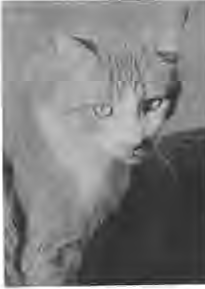
Romeo. Photo by King Schoenfeld.
Originally published in The Times of Skinker-DeBaliviere, April 1994.
Read this article in the original newspaper issue.
Original source: SD_Times1994_04.pdf, printed page(s) 4; PDF page(s) 4.
