Historical March 1992 article. Dates, prices, services and contacts describe the source period; current availability has not been established.
1992 promises to be the most important year in the history of Forest Park since the Louisiana Purchase Exposition in 1904. Voters in the City and County will have a once in a lifetime opportunity to ensure the successful future of our Forest Park, and City voters will be asked by an ad hoc special interest group to sign a petition forcing a special election to overturn years of planning and negotiations to improve the area adjacent to the Art Museum. “Proposition P” would establish a Metropolitan Park Commission and impose a City/County property tax for the day-to-day operations of Forest Park and a major capital improvement program.
This Proposition has my strongest possible recommendation and endorsement. Conversely, I sincerely ask you not to support the referendum petition drive to void the Art Museum’s capital improvement plan recently approved by the City, which would also assist in implementing the City’s long range goals for the southwest section of Forest Park. Proposition P is a two pronged measure on the April 7, 1992 ballot submitted by a rarely convened City/ County Board of Electors.
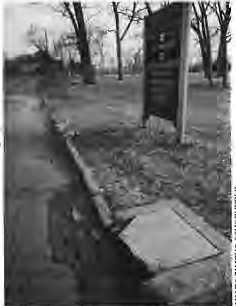
In addition Crumbing curbs and pavement at Des Peres entrance to Forest Park to creating the Metropolitan Park Commission and raising property taxes 6 cents per $100 of assessed valuation for Forest Park, it would levy a two percent non-residential utility tax to pay for joint City/County economic development programs.
The property tax increase would cost the owner of a house worth $100,000 only $11.40 more per year in real estate tax. Under the provisions of the Missouri Constitution, both questions must be voted on as a single proposal, which needs approval by separate voting majorities in the City and County to pass.
The creation of the Metropolitan Park Commission would relieve the City from the operational costs of Forest Park and free up about $2 million in the City’s budget This revenue potentially could be directed toward improvements in our 100 or so other City parks. Forest Park would become jointly owned by the City and County and remain “forever free” for general park use.
The park would be operated by a new 10 member Board of Park Commissioners (five City residents and five County residents appointed by the Mayor and County Executive with the approval of the Board of Aldermen and County Council, respectively).
This Board would be very similar to the governing bodies of the Art Museum, Botanical Garden, History, Science Center and Zoo Subdistricts.
The day-to-day operations of Forest Park would be funded in perpetuity by two cents of the property tax.
These moneys could not be used for other purposes and therefore the park will be protected from future budget cuts due to the City’s troubled financial condition.
The additional four cents of the levy will be used for restoration of the infrastructure of Forest Park and has a 20 year “sunset* provision. Even more important, this four cent tax will cease to be collected if the Commission and the Board of Aldermen and the County Council fail to adopt a revised Master Plan for Forest Park by June 1, 1996 to guide the expenditure of these funds. Copies of the complete Board of Elector’s Proposition P are available at all City, County, college and university libraries, the Boards of Election Commissioners at 41 S. Central in Clayton and 208 S. Tucker Downtown, and at the League of Women Voters Office at 6665 Delmar, Suite 304 in University City.
In all honesty, I can think of no valid reason for a City resident to vote against this proposition. It’s a “win/win” solution on all counts.•.The very small increase in our property tax is well worth the cost, since it will supplement an even greater infusion of County tax dollars into Forest Park, allows a reappropriation of almost $2 million a year in existing City funds for other purposes, and of paramount importance, it will guarantee that our great regional park will be restored and maintained for the future use of the general public, our children and grandchildren. Similarly, County voters should also support this proposal not only to restore Forest Park, that tarnished “crown” which holds our – region’s cultural “crown jewels” in place, but also to protect the County’s continuing sizable tax dollar investment in the Zoo, the Science Center, and the History and Art Museums.
The City’s budget continues to shrink, and unfortunately the Parks Department, being labor intensive, is always the first to feel the ax.
If the Commission is established, it would equitably assess everyone in the City and County and provide County residents justifiable equal standing in the day-to-day operations and future of what truly is our premier regional park. Conversely, I sincerely and strongly urge you not to support the current petition drive to nullity the privately funded capital improvement plan for the Art Museum area. Opponents would have you believe that this plan is an ill- conceived, poorly planned blitzkrieg to create a “sea of asphalt” and destroy half of Kennedy Forest; but this is patently not true!
This 31 page legal agreement, which reflects existing park planning goals, years of negotiations and public discussion, and would benefit the park as a whole, should not be reduced to a disinformation “bumper sticker” campaign issue. Our great urban park serves us all, not only as a preserve for “open space” but also as a greatly needed site for active and structured recreation.
It is the home for some of the greatest cultural institutions in our region.
These varied and equally important public uses can and should be accommodated within the park’s over 1200 acres.
In 1900 the City -of St. Louis dedicated by ordinance the area on top of what is now “Art Hill,” for the erection of a building which “together with the site upon which it is located, shall be devoted to the use of this institution forever for the exhibition of pictures and sculpture…and the education of the public in art…to be open free to the public…” As we all know, the Art Museum was eventually built on this site, being the first such museum in the United States funded by public dollars, “dedicated to art and free to all.” I am extremely proud and eternally grateful that our civic leadership at that time had the insight, vision and political courage to undertake and fund this endeavor.
It is now our turn to maintain, improve and provide for the future of the Art Museum for those who come after us, but for the first time also taking into consideration the needs of Forest Park as a whole. Meaningful strategic planning for Forest Park began in 1976 and culminated in 1983 with the adoption of a master plan for the park by the City’s Community Development Commission.
A citizen task force had been assembled and many public discussions, meetings and reviews were conducted during this time.
The result was not a detailed blueprint with the force of law, but a group of documents incorporating the CDC Master Plan and concomitant recommendations by the Community Development Agency, park institutions, and other interested groups providing general planning and guidance for the City, the Parks Department and the institutions in the park.
The major components of the “plan” for the southwest corner of the park include the following: 1) Implementation of a “loop road” system around the edges of the park to allow certain roads in the central “core area” to be removed, and the land restored for passive park purposes; 2) Expansion of Kennedy Forest, construction of a nature trail and better management of this important urban wooded area; • 3) Removal of parking and traffic from the top of Art Hill in front of the Art Museum and construction of a • pedestrian plaza; 4) Restoration and landscaping of the pedestrian promenade along the crest of Art Hill; 5) Restoration and continued maintenance of the Statue of St Louis and its immediate area 6) Insistence that there be no net loss of green space in the park; 7) Development and implementation of a detailed landscape plan for the park; 8) Shifting ongoing maintenance costs from the dwindling City budget to other public revenue sources like the Art Museum Subdistrict and eventually to a regional parks commission as is now pending with Proposition P; and yes, 9) Increased parking at the Art Museum! • The recently adopted Art Museum plan incorporates all of these goals, and at no cost to the City.
It is not simply a “parking lot” development!
While it is true that, except for expanded parking, the 1983 draft master plan suggested no future growth of the Art Museum in Forest Park, it must be noted that at Aldermanic hearings in the months following the CDC adoption of the plan, the Art Museum publicly announced its dream to someday build additional wings to the east and west of the original building to echo the grand scheme of the Palace of Fine Arts buildings at the 1904 World’s Fair and this goal has been incorporated into planning for the park. Indeed, while some criticize the Museum’s long range plan to enlarge its exhibition space in the park, I support it.
The Art Museum will expand, the question is where.
I firmly believe this growth should be in the City and if need be, in Forest Park.
The wealthy and well-educated will always have access to the Fine Arts.
But what about the poor and under-educated who truly need and enjoy the respite, beauty, spiritual uplift and inspiration that such art can provide? Our public cultural institutions must remain accessible to these citizens and remain “free to all!” A new “branch” of our Art Museum in Ballwin or Ellisville could not possibly be as accessible to all our neighbors or our schoolchildren.
The Art Museum’s current proposal is sensitive to, and supportive of, the needs of Forest Park.
There has been no new precedent set for other institutions to seek more parking or space for expansion. That precedent was set decades ago.
The precedent this plan sets is that any such future proposal must be able to withstand the heat of the public crucible and be supportive of the needs of the park as a whole, not just those of the institution. Land is no longer free” in Forest Park.
The Art Museum plan will allow no net loss of greenspace.
It will landscape and improve the crest of Art Hill and relocate existing parking lots, creating a pedestrian promenade and plaza along Fine Arts Drive to provide easy public access to one of the most beautiful vistas the City has to offer.
It mandates that the Subdistrict will care for the Statue of St. Louis forever and place additional monumental art on the promenade and perhaps elsewhere in the area.
The Art Museum will construct that portion of the proposed loop road system” joining Valley Drive with Fine Arts Drive to the northwest of the Art Museum.
The Subdistrict will maintain all the greenspace within the area at no cost to the City.
It will decrease the width of roads around the Art Museum and entirely remove portions of certain roads for their conversion back to open space.
The proposed south parking lot and the relocated bike path will encroach not one square inch into the wooded area with canopy and understory to the southwest of the Art Museum.
All of the approved improvements will involve areas that are currently mowed grass with relatively few trees. Healthy trees will be saved and a minimum of 500 new trees and 1200 new shrubs will be planted.
The plan has been developed by world class landscape architect Dan Kiley, who also -landscaped our Gateway Arch grounds for Eero Saarinen, and recently presided over a charrette on Forest Park convened by our local chapter of the American Institute of Architects.
Most importantly, over 126,000 square feet of concrete and asphalt will be removed from the middle of Kennedy Forest by the elimination of Government Drive from its western intersection with Valley Drive to the edge of the north Zoo parking lot.
The positive and dramatic impact of returning this fourlane street to passive wooded growth and allowing the two main areas of Kennedy Forest to grow together, by itself, more than compensates for any encroachment by the proposed south parking lot on park land next to the eastern edge of the Forest The plan will also provide additional well-lit, safe, convenient and needed parking for the Art Museum and Zoo, and other visitors to Art Hill and Kennedy Forest The successful implementation of this plan, especially the removal of Government Drive, finally sets the stage for the Missouri Department of Conservation to assist the City, or hopefully the new Board of Park Commissioners, with the construction of a nature trail and the restoration, management and expansion of that portion of the Forest bounded by Wells Drive on the south, Skinker Boulevard on the west, the golf course on the north (which boundary is generally a line projected from the alley west of Skinker between Northwood and Arundel) and the Zoo and Art Museum grounds on the east.
The Art Museum needs our support for their ambitious, privately funded, well planned, environmentally and aesthetically pleasing plan…not the brickbats of a well meaning-but misinformed and vocal few with tunnel vision. Forest Park needs our votes and our dedicated tax dollars not only to survive for the remaining years of this century, but to serve our children and grandchildren in the 21st Century. •
Original photograph caption
Crumbling curbs and pavement at Des Peres entrance to Forest Park. Photo by King Schoenfeld.
Originally published in The Times of Skinker-DeBaliviere, March 1992.
Read this article in the original newspaper issue.
Original source: SD_Times1992_03.pdf, printed page(s) 4, 5; PDF page(s) 4, 5.
