Historical October 1990 earthquake supplement. Original predictions, insurance prices and safety guidance are reproduced as period reporting, not current forecasts or instructions.
Anything that can move, fall, or break when your home starts to shake is a home earthquake hazard. Falling objects and debris are the most common causes of injury during an earthquake. You and your family can reduce the risk of being injured in your home by reducing earthquake hazards.
A Home Hazard Hunt will help you identify potential hazards that can be reduced or eliminated with little effort and little or no cost.
In an earthquake . the first thing you may notice is the swaying of hanging plants or light fixtures, or you may hear the sound of objects wobbling on shelves.
As the shaking grows stronger. hanging plants may swing free of their hooks. bang against walls or windows, or crash to the floor. Objects will fall from shelves, furniture will move about or topple over. ceiling plaster may fall and windows (particularly large window panes and glass doors) may shatter.
During a moderate shake. objects may topple from shelves and fall in a vertical path.
During a violent shake, heavy objects may be propelled to fall in a diagonal path.
The Home Hazard Hunt All family members should participate in the Hunt. Foresight and common sense are all that’s required as you go from room to room and imagine what would happen when the earth and house start shaking.
Look for potential hazards in each room and discuss how you can reduce or eliminate these hazards. • Do any rooms contain tall bookcases or bookshelves? • How many things are likely to fall? • Which items are heavy enough to cause injury? What Should You Do? • Anchor bookcases and other top heavy furniture to wall studs using metal angle braces and lag screws. Be sure that shelf brackets are fixed to the shelves. Additional safety measures include applying strips along the front edge of shelves to hold light weight objects in place.
The easiest thing to do is remove all heavy objects from shelves above the head level of the shortest family member. • How are hanging plants or hanging light fixtures fastened? Could they swing loose or hit a window?
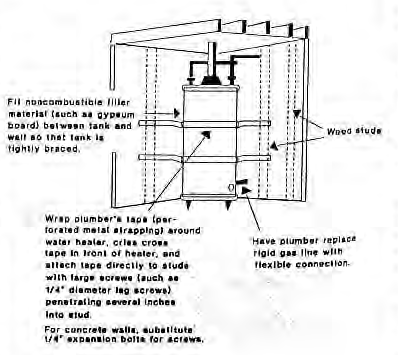
As a minimum precaution. transfer hanging plants from heavy clay pots to lighter plastic ones and used closed hooks on all hanging items. • Is there a heavy picture frame or bookshelf over your bed or next to that favorite chair? Do a little rearranging to ensure your safety. • Consider replacing magnetic latches on kitchen cabinets with ones that will hold the cabinet door shut during an earthquake. • Replace glass bottles in your medicine cabinet or above or around your tub with plastic containers or relocate to low cabinets (use child-proof latches if toddlers are about.) Potential hazards in your garage and basement • Move flammable products far away from any heat sources. • Is your hot water heater secured for earthquake country? Thin metal tape can be used to fasten your hot water heater to the wood studs of the nearest wall. (Neighborhood homes with stone foundation walls will need to strap their heaters to a 2-by-4 frame attached to any secure part of the structure (e.g.. ceiling joists. Ed.). Check the Outside of Your Home • Masonry chimneys are highly susceptible to earthquake damage.
If you have chimneys. determine where those bricks are likely to fall—through your roof and into a bedroom or family room? Consider adding a plywood shield over ceiling joists in the attic to protect occupants in the rooms below. Hazard Hunt At Work With your powers of perception now finely tuned, conduct your own hazard hunt at your place of work.
If you have little or no control overyour work environment, at least check to determine if your company has an earthquake safety plan. Preparation Is Reassuring When family members are separated during an earthquake or any disaster, each needs to hold on to the assurance that other members can cope and keep safe.
Original photograph caption
Original historical water-heater bracing illustration and instructions. From the earthquake supplement prepared and designed by King Schoenfeld, with assistance from Sue Rothschild, American Red Cross and Farmers Insurance Group. The Times of Skinker-DeBaliviere, October 1990. Individual artist not credited.
Originally published in The Times of Skinker-DeBaliviere, October 1990.
Read this article in the original newspaper issue.
Original source: SD_Times1990_10.pdf, printed page(s) 4; PDF page(s) 4.