Historical April 1990 report or notice. Original dates, prices and contacts describe the source period; current availability has not been established.
The quality of education holds a direct correlation to the quality of our lives.
The quality of our people, our businesses, our property, and our services are all linked to the strength of our school systems. Currently, the St. Louis City School District is fraught with problems which keep it from being competitive with others in the metropolitan area.
Many of these problems may be traced to the structure of the school board itself.
The present system calls for 12 board members elected in citywide elections.
This has resulted in a board paralyzed by indecision and factionalism.
Most of the board members do not even live in the area where the majority of the district’s children reside.
I have introduced legislation in the House this session (HB 1273) which would correct this situation.
This bill has already been approved by the House and is now under consideration by the Senate. Under the terms of my measure, the board would be reduced to nine members.
This odd number would greatly assist the decision-making process by eliminating any possibility of tie votes. Seven of these members would be elected from subdistricts, which means they would live in the area which they represent and be elected by voters to whom they are directly responsible.
This revision would provide members who are more knowledgeable of the subdistrict they represent as well as designated members that parents may contact with their concerns.
In addition, the new structure of the board would create two at-large districts, representing both the northern and southern sections of the city, so that the board would not lose its over-all perspective. Critics of my proposal have stated that subdistrict representation would lead to parochialism.
If this argument were to hold true, all of our current board members elected at-large have a biased interest in particular facilities since all of them live near specific schools.
In fact, parochialism should be even more deep-rooted since the majority of them live near the same facilities.
With my re-structuring, six other subdistrict members are certainly sufficient balance to offset any factionalism.
As for the charge that my plan would institutionalize racial antagonism, actually the opposite would be the case.
My proposition would lessen racial resentment since subdistricting would encourage a more racially balanced composition on the board.
The voters would also benefit from my proposal because school board members would be elected every four years instead of the present six year terms.
By this function, board positions would come up for review by the public more frequently.
Until the St. Louis City School Board is organized to provide better representation to the whole community and members who are directly responsible to specific neighborhoods and school patrons, we will continue to struggle as a district.
An old adage states: “No man with four aces demands a new deal!” For too long, only a few people have held the trump cards in our school district.
The time has come to reshuffle the deck and give all of our citizens a fair stake in the game.
Original photograph caption
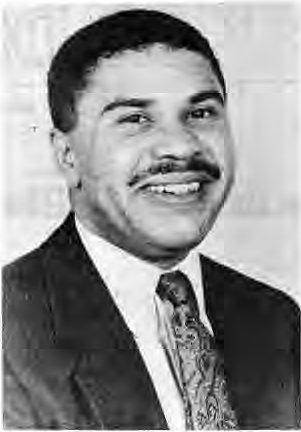
State Representative William L.Clay,Jr. The Times of Skinker-DeBaliviere, April1990, page2. Photographer not credited.
Originally published in The Times of Skinker-DeBaliviere, April 1990.
Read this article in the original newspaper issue.
Original source: SD_Times1990_04.pdf, printed page(s) 2; PDF page(s) 2.
