Historical October 1989 report or notice. Original dates, prices and contacts describe the source period; current availability has not been established.
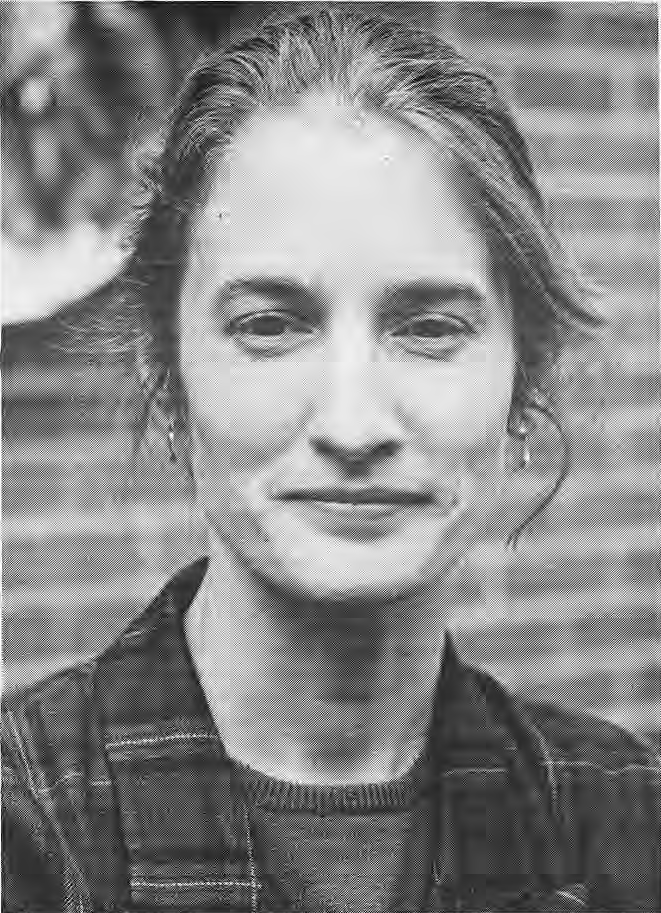
Can you imagine getting a loan to pay for your post-high school education, and only having to repay the principle? “Preposterous:: you say? Then you haven’t talked to Faith Sandler, a new resident of Skinker-DeBaliviere and the Executive Director of the Scholarship Foundation. Has she got a deal for you! Faith has just moved to the 6000 block of Westminster.
She and her husband, Mike Holohan, live there with their two cats, Rosseau and Esther. Esther is named after a synchronized swimmer; Rosseau is not.
Mike is the Artistic Director of PROART located on Pershing, just east of DeBaliviere.
He selects art for the exhibits and determines which artists will be exhibited there. Faith grew up in University City.
Her parents work at Bethel Lutheran School, just west of us on Big Bend and Forsyth. Talk about local girl goes away, sees the world, and returns, Faith holds a BA degree in sociology from the University of Redlands, in Southern California, 60 miles east of L.A.
She returned to go to grad school at Washington University, planning to receive a doctorate in Anthropology, with her areas of interest being urban studies and schools. Faith says, “The department was too conservative for me. I spent two years defending urban areas of the U.S. and schools as a proper subject for anthropology!’ Instead, she worked for Harvard University in a study of the St. Louis voluntary inter-district desegregation plan and wound up with a master’s degree in Cultural Anthropology. But, back to Faith and these interest-free loans! No, this isn’t the annual April Fool’s issue of The Times; this is true. Summon all of your friends and neighbors who would be post-secondary students if they could afford it, and begin to read aloud: The Scholarship Foundation, a 70-year-old St. Louis institution, began as an effort to aid Jewish children.
The Foundation became non-denominational in 1960; it began accepting black applicants in the 1950’s.
Last year the Scholarship Foundation distributed $1,025,000 in interest-free loans.
The funds are generated from sales at the Scholarshop (located at 8215 Clayton Road, just north of the Galleria), repayment of previous loans, and through donations. Of the 730 students receiving loans for the 1989-90 school year, 80% were undergraduates (25% of whom were freshmen). Faith points out that students who received loans attended colleges, universities, trade schools, and community colleges.
The loan amount is based on the financial need of the student.
A student can receive a loan of up to $3,000 per year for as many as five years (a total of $15,000).
The recipients must be from St. Louis.
The decisions about who receives a loan are made by Faith and the entire board; it’s definitely a “working board:’ she notes.
Since the pool of applicants is larger than the pool of money to be distributed in any one year, the decisions are not easy ones.
The board looks at the applicant’s work experiences, goals, character, and volunteer experiences. Applicants submit a paragraph, talking about their goals, and include references. Faith points out that the program “…is not just for straight A students:’ The loans are interest-free—honest!—and are due six years after the graduation date. Given all of the bad publicity we’ve heard about government loan programs, Faith notes with justified pride that 95% of the Scholarship Foundation loans are repaid!
To date, over 8,000 St. Louisians have attended colleges, trade schools, univer- sities, or junior colleges with the Scholarship Foundation’s help. Faith says that The Scholarship Foundation program has grown enormously since 1980, largely because of its move to the present location (it formerly was south of the then-Stix store at Clayton and Brentwood).
She was also quick to point out that the endowment of over $1,000,000 has been very well managed by the board.
In addition to the loan program, the Scholarship Foundation also works with Ranken Technical School and has another program that helps individuals wanting to go into nursing. Both of these programs are designed to help minorities. Faith gave an extra big smile when she talked about the nursing and the Ranken Tech. programs, because of their focus on helping minorities.
This thrust continues an important part of her life. Prior to joining the Scholarship Foundation, Faith worked for the court-appointed Committee For Quality Education in NonIntegrated Schools.
This Committee was established by the Federal Court to ensure that the minority students remaining in City schools (those not transferring to County districts) receive a quality education. Faith worked for CQ, as it is called, for four years, first as an Evaluation Assistant, then as Associate Director, Interim Executive Director, and again as Associate Director.
Her work with CQ began in spring of 1985.
As she put it, she “had become very concerned with the kids who were left behind in the City, particularly at the north side schools. I felt that those schools could become less successful as those parents got their kids on busses!’ In describing her work with CQ, Faith says, “It was a real education in how the judicial system works—or doesn’t work— in this country. I felt like I spent four years working hard to tell the truth, but it didn’t matter:’ When asked if she has any messages for Judge Limbaugh, the Federal Judge who oversees the City-County desegregation plan, Faith pauses and replies, “Things are not going to get any better for minority kids until the court develops a more active role. It’s too soon to close up shop, to call the system `unified: ” She left her position with CQ in 1989 because she became frustrated with her efforts. Faith’s work with the Scholarship Foundation is much more rewarding.
She has a staff of three, but notes that “every board member works!’ She continues, “The thing is, it’s true!
They stuff envelopes, they push paper, they file.
They do all the things that are necessary!’ Faith spends a good deal of time working with the board, developing procedures and policies.
She also spends time dealing directly with students, helping them figure out how to apply and where else to get additional funds.
She says, “I do whatever research the board needs regarding higher education or higher education in St. Louis. I try to be the conduit for all of this:’ While there’s no interest on the loans that the Scholarship Foundation makes, Faith has more than enough other interests to make up for this (sorry, I couldn’t resist!).
In addition to painting and sprucing up their new home, Faith and Mike enjoy riding bikes and cooking Mexican food. Faith says that she was attracted to Skinker-DeBaliviere by “the mix of ages, races, and incomes:’ She liked “the price of the housing, what we got for our dollars” and “the architectural integrity of the neighborhood:’ In her secret life, Faith, ever the cultural anthropologist, collects Elvis Presley postcards and memorabilia.
In discussing a recent vacation, Faith says, “I went to New Mexico for my college reunion.
All of my friends have liberal arts degrees and they’re all incredibly socially conscious.
Even if they’re selling vacuum cleaners, they look at it in a way that it helps the social good!’ That’s an encouraging thought! Who knows, the promise of the 1960’s may come true, after all! (If you’re interested in obtaining more information about the Scholarship Foundation or its interest-free loan programs, call 725-7990. Faith notes that all the funds for the 1989-90 school year have already been allocated.
The application deadline for 1990-91 loans is April 15.)
Original photograph caption
Faith Sandler. Photo by King Schoenfeld. The Times of Skinker-DeBaliviere, October1989, page7.
Originally published in The Times of Skinker-DeBaliviere, October 1989.
Read this article in the original newspaper issue.
Original source: SD_Times1989_10.pdf, printed page(s) 7; PDF page(s) 7.





