This feature highlights our neighbors—the famous, semi-famous, not-so-famous, infamous and anonymous.
Melva Ware
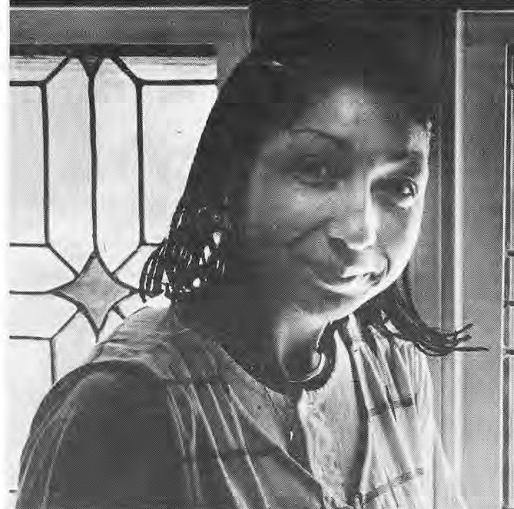
"St. Louis has been good to me," says Melva Ware. Melva is a Research Associate and Administrative Coordinator for the University of Missouri-St. Louis. She lives on Washington in Parkview with her husband, Leland, and their son, Leland Jr. The family moved to St. Louis from Washington, D.C. just a couple of years ago. Leland is an assistant professor at the St. Louis University School of Law. "There are lots of opportunities here," Melva continues, "for a person who knows Washington and knows fund-raising."
Melva's pleasure with her accomplishments in St. Louis is warranted. She's responsible for UM-St. Louis receiving $5,000,000 over a five year period from the National Science Foundation. This money will be used to increase the numbers of underrepresented youth who go into science and technology. The program—one of seven across the country—creates a consortium with Harris-Stowe State College, the Community College System, UM-Rolla, and the St. Louis Public Schools.
Things haven't always been this rosy for Melva, however. She vividly describes attending high school in 1964 in Atlanta, in a middle class area, and being one of seven students to integrate the high school. She recalls having milk thrown on her and having her hair set on fire. Her sister is permanently scarred from being hit by a pipe that was thrown from a passing car. "And," says Melva with no small touch of irony, "we were going to the closest school to our home. Every night I went home angry and cried. Our community, our ministers, could only tell us that somebody had to do it, and we were that somebody."
From high school in Atlanta, Melva went to Spelman College. "It was wonderful, it gave me confidence, self-esteem, and let me be in control of my life," she relates. She graduated with a degree in English and Secondary Education. "I wanted to be a teacher because I wanted to be in charge," she says with a slight smile that can come from only truly understanding oneself.
After college, Melva taught in Atlanta, Boston, and Washington, D.C. She also directed Head Start and Family Development Programs in Alexandria. After this she worked at the national office for the League of Women Voters as a Senior Specialist for Management and Training Services. She was also the Assistant Director of Minority Affairs for Georgetown University. If her face looks familiar from the 1984 Presidential and Vice-Presidential debates, it's because she was the Special Assistant to the Director of Debates! She was responsible for everything from seating to media access. She also worked as a consultant for Southland (the 7-11 Corporation) and was responsible for developing child care as part of their employee benefits program. Whew! This is one busy and active lady!
In response to how she handles racism today, Melva says, "All of the -isms are the problems of the people who have them; they're not my problem and not my problem to resolve. Anger would be counterproductive for me. Some of us have been lucky; some of us are born with positive spirits. I'm able to focus on the positive!"
Melva has given much thought to the issue of race in our society and the world. It's an important issue for her, and one that has special significance for her with her son, Leland Jr., an eighth grader at St. Roch's School. "We all have to take responsibility for telling the truth. As a parent I have a responsibility to my child to make sure that the educational environments in which he participates are responsive." Acting on this belief, Melva arranged to have Alice Windom visit the children at St. Roch's. Alice lived in Africa for ten years, and has been instrumental with the Egyptian Foundation for Western Civilization. Melva and her husband also like to take their son traveling with them outside of the continental U.S. It's important, she believes, to put her son in situations where he can see how various races act and interact in other cultures.
One doesn't have to be with Melva long before she begins to talk about her trip to Africa last summer. She spent three weeks in Egypt and traced the Nile down to the Nubian homeland, the area where black Egyptians originated. "I looked at the drawings and inscriptions on the walls," Melva says, "and I saw my friends and myself, black people who had been drawn thousands of years ago!" Melva smiled and quickly agreed with the comment that Liz Taylor was racially miscast for the role of Cleopatra, saying, "It's incumbent on black people to rediscover our past. We need to help black youth, for whom we feel much despair, to know that they're a part of the world!"
Melva talks about how the Greeks built upon the culture of the Africans and how the Europeans then built from the culture of the Greeks. African history has been lost and ignored for too long she says, "it's important to recognize that it's a united effort that got us to this point (in time). Once we've all bought in, we can all move forward."
"There are some people writing now who understand where we've come from, that no one race or culture is superior. They know that progress comes when the cultures mix." Melva cited a number of interesting books that explain the African legacy: Black Athena by Martin Bernal; The Afroasiatic Roots of Classical Civilization; The African Presence in Ancient America: They Came Before Columbus by Ivan Van Sertima; and The African Origin of Civilization by Cheikh Anta Diop. "Black youth need to see connections to the past and present and to be in control of their future," Melva continues. "The historical context is critical; it's the missing link!" She believes that once black children connect to the past, we will be able to see some changes in behavior.
Melva has some strong thoughts about her role in bringing about change in our society: "I'm in control of this life. Given challenges and opportunities, what I do with that depends on me. That works well individually, it works well for me, but I also know that I can't discount group problems and group discrimination.
"Leland and I have certain advantages—we were both born to middle-class parents—and we are responsible to make sure that we take every opportunity to use those advantages not only for ourselves, but for our people."
Melva does this through her professional work, her work as a wife and a mother, and her role in the community, talking and guiding at every opportunity. "I've built relationships between institutions and individuals," she says with pride. Her sorority, Alpha Kappa Alpha, has adopted a village in Africa and is working on a public health project. She believes that taking the initiative is important: "Black people need to be in control of the things that shape their communities!"
It's a nice symbiotic relationship: St. Louis has been good to Melva and she's been good for St. Louis. She says, "St. Louis is a nice town for raising a teenager, and we live in the best area to do that." Still, her east coast roots are evident when she says, "The Loop is wonderful. It's the closest thing to Georgetown and Adams Morgan!"
Original newspaper source
Originally published in The Times of Skinker-DeBaliviere, June 1989.
Read this article in the original newspaper issue.