Historical March 1989 report or notice. Original dates, prices and contacts describe the source period; current availability has not been established.
Establishing a profitable fur trading center—and enjoying the fruits of their labors—occupied the attentions of the French creole settlers who laid out the streets of St. Louis 225 years ago.
These early St. Louisans frequently had to buy food from the Indians or their pioneer neighbors who farmed the surrounding land.
The village earned the name, “Pain Court,” or “short of bread,” and that is the title of the exhibition that opens in the history Museum’s Lionberger Gallery the weekend of March 3-5, 1989. Richly illustrated with artifacts and drawings, “La Ville de Pain Court: St. Louis 1764-1820” tells the story of the beginnings of the city by introducing twelve individuals who saw the trading post grow into a thriving community. Among these is Auguste Chouteau, who at age 14 headed the work party that began construction of the first buildings on a site chosen by Pierre Laclede.
In November, 1763, Laclede had located a bluff overlooking the Mississippi River, just below the confluence with the Missouri, that offered protection from flooding but easy access to the waterways that would carry the business of the Maxtent. Laclede and Company. Led by the young Chouteau, the fur company’s employees arrived at the site on February 15, 1764 (often given as the date of the founding of the city).
They followed Laclede’s plan and made three streets running parallel to the river, with a few shorter avenues intersecting at right angles to form a gridiron and a focal point. the Place d’Armes, an open plaza facing the river. Within the first year, French creoles living east of the Mississippi, frightened by the pending transfer of this land from France to England, moved across the river to Laclede’s town.
By 1773 the population had grown to 444 white settlers with 193 black and Indian slaves.
The Louisiana Territory was now owned by Spain, with a Spanish governor, but the early city enjoyed a French flavor. Early residents included fur merchants and their families, trappers and craftsmen who contributed to the economic growth of the village.
The exhibition will depict the diversity of cultures and traditions by focusing on the experiences of people who lived and worked in St. Louis between 1764 and 1820. “La ‘Ville de Pain Court” will use letters, diaries and artifacts from the museum’s collections to create an understanding of family and community life, social customs, entertainments, conflicts and work. Early residents who will appear in “Pain Court” include: William Clark, co-captain of the Lewis and Clark expedition mapping the Louisiana Territory, and a territorial governor of Missouri; J.B.C. Lucas, who built his wealth through extensive land holdings; Swiss-born Charles Gratiot, whose St. Louis-based business took him to New Orleans, Montreal. Paris and London, and who witnessed the transfer of Upper Louisiana to the United States; Mary Hempstead Keeney, who married Manuel Lisa, a Spanish creole fur trader; and Jeannete Fourchet and Pierre Ignace, free blacks who lived in restricted freedom in St. Louis.
The lives and experiences of these individuals will be the basis for programs that will be given on Sunday afternoons throughout the year. Music, dance, drama and slide-illustrated lectures will depict the multi-cultural community during this era. “La Ville de Pain Court” will open to the public in an afternoon celebration on Sunday, March 5 at 2 p.m. Actors from Theater Factory St. Louis will perform music and dance showing the multicultural life of early St. Louis, and birthday cake and cider will be served. “La Ville de Pain Court: St. Louis 1764- 1820” will be on view through December. 1989 during museum hours.
The History Museum in Forest Park is open Tuesday through Sunday, 9:30 a.m. to 4:45 p.m. and there is no admission charge.
Original photograph caption
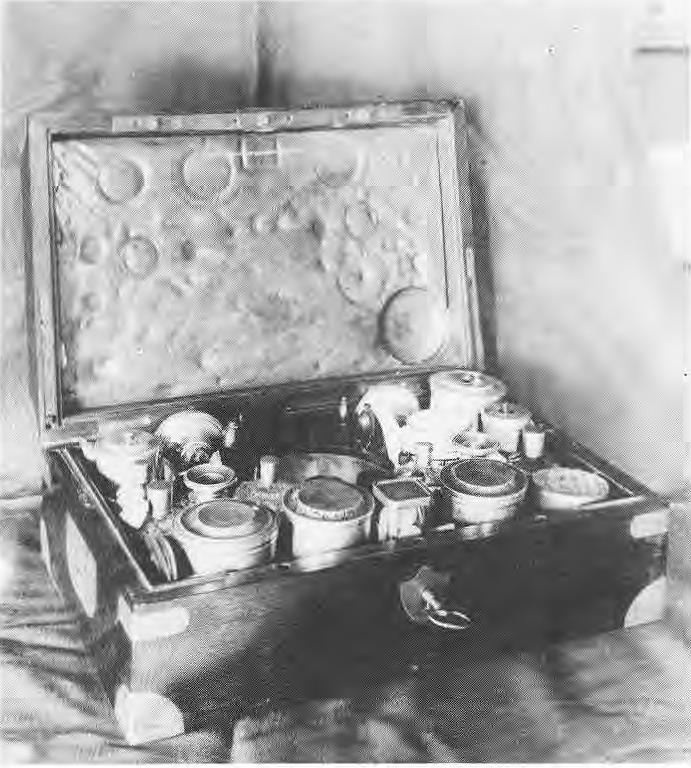
Camp chest, presented to William Clark by the Marquis de Lafayette in 1825, will be exhibited in “La Ville de Pain Court: St. Louis 1764-1820” at the History Museum in Forest Park. The trunk contains 35 individual pieces fitted into a leather interior and dates to c. 1789. The Times of Skinker-DeBaliviere, March 1989, page 4. Photographer not credited.
Originally published in The Times of Skinker-DeBaliviere, March 1989.
Read this article in the original newspaper issue.
Archival transcription note: 1773 population and early-city historical interpretations remain the exhibition announcement’s attributed period account; not a new independently verified demographic series.
Original source: SD_Times1989_03.pdf, printed page(s) 4, 5; PDF page(s) 4, 5.





