Historical May 1987 report or notice. Original dates, prices and contacts describe the source period; current availability has not been established.
The following article was written before the Heritage and Urban Design Commission meeting on April 23, 1987 At that meeting, the Commission voted to defer action on an application for demolition of Garavelli’s and other buildings on DeBaliviere, to make way for a strip shopping development.
This action gives the neighborhood an opportunity to make an impact upon the plans being proposed by Mestman Realty, possible buyers of the property.
The Commission’s action was taken because of the significant number of residents who were concerned about:
• the landmark Garavelli’s building
• the proximity of the project to Forest Park
• the lack of information about the proposed buildings Attending the hearing were Fr. Sal Polizzi, Georgie Fox, Paul Repetto, Chris Smith, Al and Shirley Polk, Ed Jones, Lu and Sam Green, Nancy Farmer, Melanie Harvey, and unidentified others. Testifying for deferral until the neighborhood had opportunity for input were Alderman Dan McGuire, Jo Ann Vatcha, and another resident of the neighborhood. by Jo Ann Vatcha The Skinker-DeBaliviere neighborhood has spent the better part of the last decade working — and enjoying — the rebuilding of our neighborhood. Excited by each new Pantheon renovation on Pershing and Waterman, and later Delmar, we savored the restoration of the Dorr and Zeller/CWE building.
We also upheld the “western front” of the neighborhood with work on our own homes throughout the neighborhood.
By 1986, we were ready for the patiently awaited renovations to DeBaliviere Strip.
But reviving the centerpiece of the DeBaliviere development has hit a snag.
Pantheon Renovation Plan
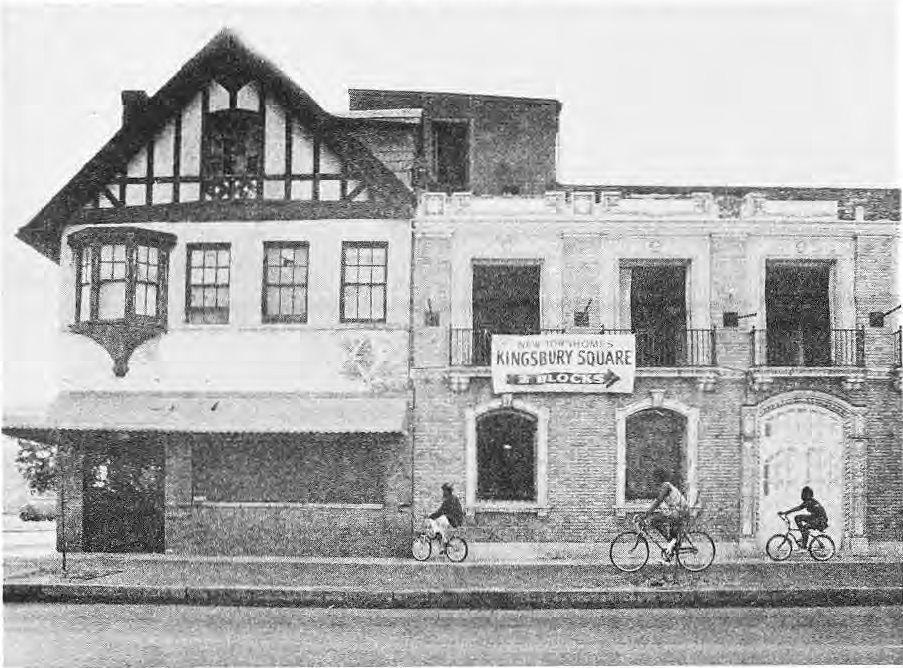
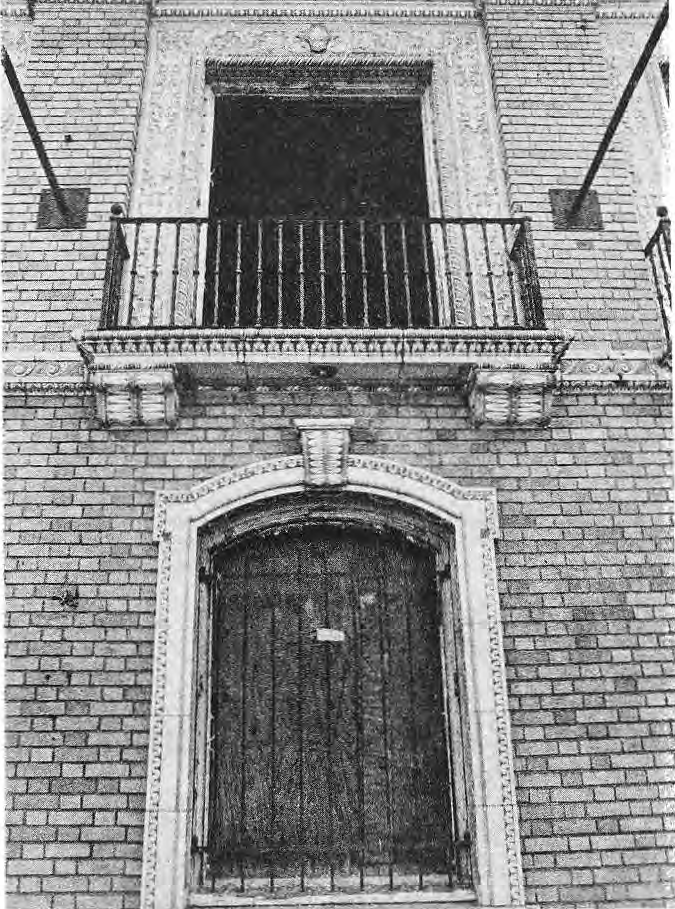
Pantheon’s magnificent rehabilitations were well complemented by a plan presented to the neighborhood a little more than a year ago. Readers of the Feb. 86 Times will recall Alderman McGuire’s text and the artist’s rendering that showed a renovated Garavelli’s, a restored facade replete with tile and wrought iron of the building next door, and then some newer buildings to complete what was to be called the “DeBaliviere Arcade.” Ample parking was envisioned, across from and adjacent to the south end of the arcade.
The plans, in fact, generated enthusiasm and anticipation.
Recent Announcement
On March 27, we learned from the Central West End Journal that Pantheon had not only abandoned its own plans to rebuild DeBaliviere, it had new plans: to demolish the site and sell to Mestman Realty, which intends to build a shopping strip reminiscent of the strip at Forest Park and Taylor.
No specifics were available or promised.
The news came out due to the fact that Pantheon had applied for a demolition permit, automatically calling into play a Heritage and Urban Design Commission hearing.
Thus, although new plans are not automatically subject to the Commission’s authority and since the strip is not a part of either the Skinker-DeBaliviere Historic District or Central West End Historic District, the request to demolish brings up the issue for this single opportunity to look at the entire picture.
Questions About Financing
The Central West End Journal quotes Pantheon as saying “changes in the federal tax code eliminate historic district tax shelters and make the project economically unfeasible.” A second article quotes John Roach, of Pantheon, as saying “changes in federal tax laws had made finding investors nearly impossible.” What changes? Why is a new strip feasible and rehab is not? Why isn’t the combination approach favored a year ago possible?
Appearance
Central issues seem to be: Will the strip be compatible with the painstakingly restored DeBaliviere neighborhood? Will the strip be appropriate to the site, a vista toward Forest Park and the Jefferson Memorial?
The draft plans to be presented at the Heritage and Urban Design Commission meeting indicate a strip of shops to be built with its back to Forest Park Blvd., thereby allowing parking in front of the strip in the lot currently used for parking, at the DeGiverville cul de sac.
This would appear to eliminate the previously planned alley connection to DeGiverville.
In addition, the appearance of the rear of the strip as viewed from Forest Park Blvd. and the adjoining Jefferson Memorial is called into serious question.
Coordination with Light Rail
According to earlier plans, the Light Rail system DeBaliviere station will also be at this intersection. How and how well do the plans fit together? Is there any long-range planning being done?
Residents’ Concerns
The plans unveiled one year ago suggest the importance of keeping activities at the arcade compatible with residential life. Theatre and restaurant plans in the interior of the arcade satisfied this need and parking across the street was appropriate as well. Are these concerns to be met in the new plan? Recent residents’ opinions expressed to the Skinker-DeBaliviere Community Council Director Nancy Farmer, in response to the Journal newspaper article, include the following:
• Hope the buildings can be saved, they follow the set back and scale — keeping in character with the neighborhood.
• Maintain the exterior as is.
• Too deteriorated to save … too expensive.
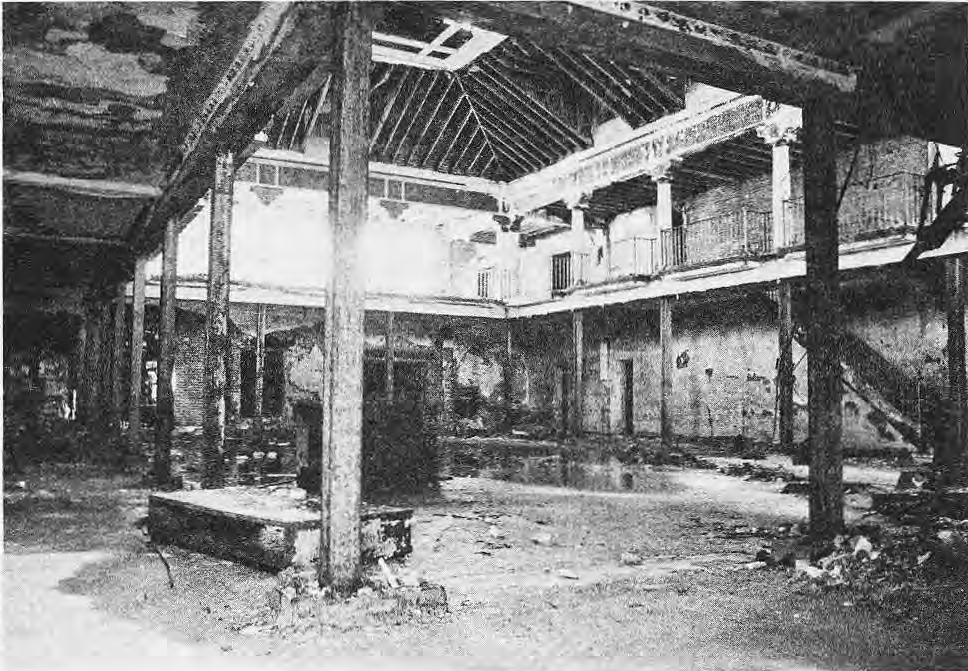
• Questions whether or not they need to be torn down . . . hopes renovation possibilities will be explored further … what is the condition of the buildings?
• Safety hazard . . . unattractive . . . raze them.
• Not one with architectural significance.
• Prefers renovation . .. but under the circumstances, strongly prefers razing and new construction.
• 5700 block of Waterman Block Unit meeting — concerned with what would be built on the site . . . in favor of saving them.
• Wish they would not tear down … have renovated others just as bad … still renovation in other parts of City . . . something like Forest Park-Taylor design is unacceptable.
• “As a resident, I would like to see the return of the so-called DeBaliviere strip to an attractive, productive commercial area.
However, I do not now support the wholesale destruction of the buildings now there to make way for new construction.
The present buildings, as delapidated as they are, reflect the history and architecture of the neighborhood. I doubt that ‘economical’ new construction could do the same, tax laws or no. — Bob Dogwillo Expressions of these and many other residents indicate a shared concern for what was here, what will be built in its place, and the good that a thoughtful review would do.
Neighborhood History
Of some relevance is the reason this spot has any importance whatsoever. Quoting the book St. Louis, Its Neighborhoods and Neighbors, Landmarks and Milestones, published by the Regional Commerce and Growth Association, 1986: “The renowned Garavelli’s restaurant on DeBaliviere Avenue at DeGiverville Avenue was a commercial anchor of the Kingsbury area . . . (this neighborhood) embraces the once-bustling DeBaliviere commercial area and the west portion of Forest Park where the 1904 World’s Fair sparkled.” One might add that, just as many current residents have no memory of the “Winter Garden” and the “Continental Cars Building,” many do not have any emotional attachment to Garavelli’s.
But Pantheon recognized, in its renovations, the importance of historical anchors, which still applies. Just as relevant is the more recent history of the neighborhood people.
In the struggles of the 70’s, three neighborhood residents researched and wrote The Neighborhood: A History of Skinker-DeBaliviere, Tepas, Harleman, Stuart, published in 1973.
A quotation near the end suggests the tone of many debates which helped define this as an activist neighborhood, producing leaders and success: As our neighborhood entered the 70’s, cooperation among the various organizations was so effective that Ralston Purina was convinced by residents that it would be detrimental to our neighborhood to have a “Jack-in-the-Box” restaurant located at Skinker and Delmar.
The action taken against this large corporation indicated the determination of residents to exercise some control over the fate of the neighborhood. (p. 43) The Heritage and Urban Design Commission will weigh the merits of the proposal.
In its review of the demolition permit, the commission will ask about the: 1) architectural significance, 2) condition, 3) cost of renovation, 4) compatibility with existing buildings, 5) concerns of neighbors.
After this review, Alderman McGuire plans to review the architectural and site plans and discuss them with the community. (Central West End Journal, 3/27/87).
The Times urges residents with concerns about this issue to attend the SDCC meeting on May 4.
For more information, call 862-5122.
Original photograph caption
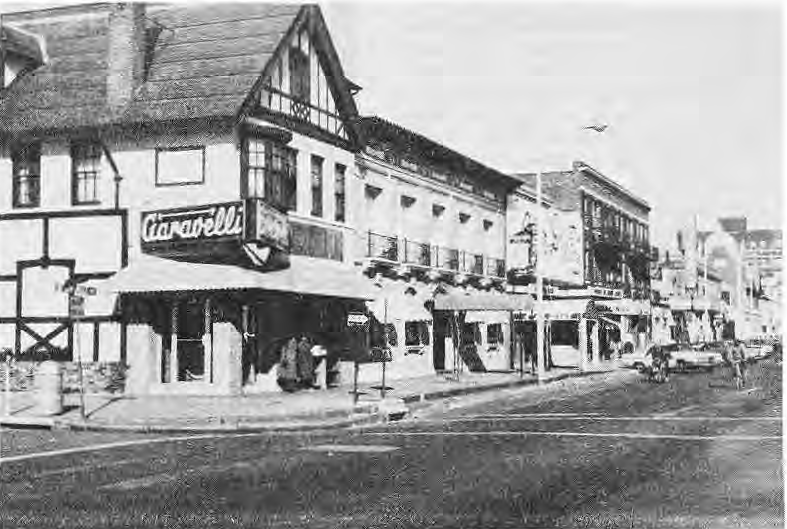
DeBaliviere Strip as it appeared during the 60’s. Garavelli’s is the landmark, along with the Stardust Club, where “Evelyn West and her $50,000 Treasure Chest” appeared, and farther north were Saracino’s Club, the Little Las Vegas and Apollo Art Theatre, which showed primarily foreign films such as those of Ingmar Bergman. The photo was taken by a former resident of the 5600 block of Waterman, Bob Whitener, who has lived in France since then. The Times of Skinker-DeBaliviere, May 1987, page 1.
Originally published in The Times of Skinker-DeBaliviere, May 1987.
Read this article in the original newspaper issue.
Original source: SD_Times1987_05.pdf, printed page(s) 1, 4; PDF page(s) 1, 4.
