Historical September 1986 report or notice. Original dates, prices and contacts describe the source period; current availability has not been established.
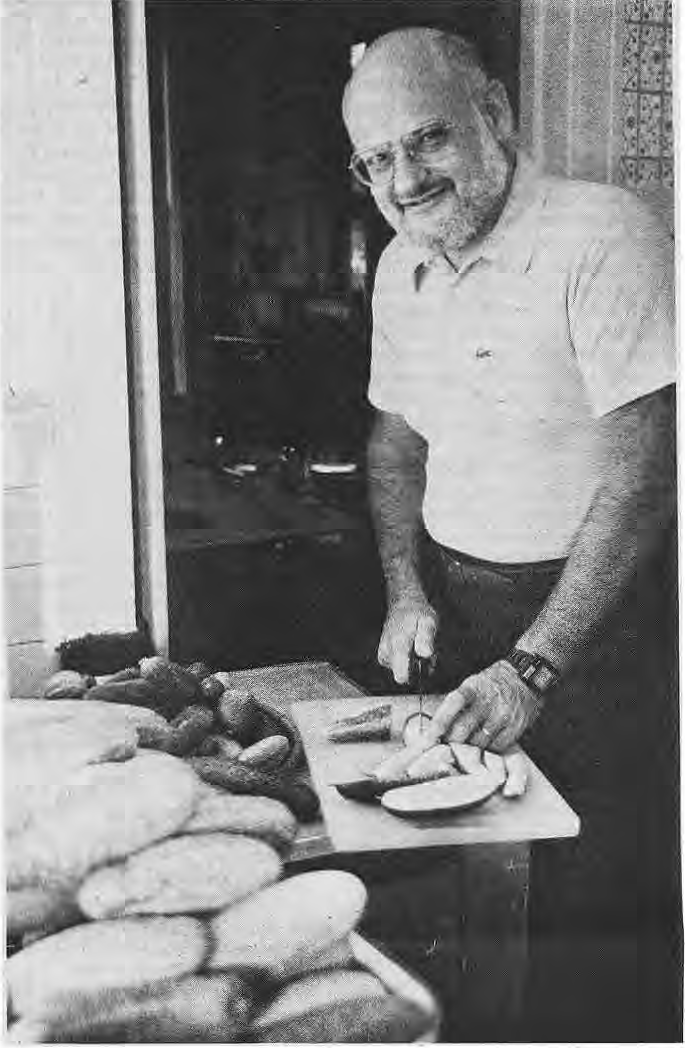
(Editor’s Note: September’s chef is Eli Shuter who, with his wife Renni and four daughters, has lived in Parkview for close to twenty years. Eli is a physician whose hobbies include gardening — especially vegetables and dahlias — and bicycling.) by Eli Shuter I started out as a Sunday gardener — a few flowers, a few vegetables.
The vegetable patch grew larger and more productive, especially of tomatoes and cucumbers.
My wife was willing to deal with the tomatoes but drew the line at pickling mounds of cucumbers.
This recipe is the result of several years experimentation in making crisp, slightly sour pickled cucumbers similar to those found in a bowl on a delicatessen’s table, or served with a corned beef sandwich.
It has the advantage of being fast, requiring no cooking, special equipment, or exotic ingredients. , You can use this method for any quantity; I have used it to make from one quart to five gallons of pickles.
The only disadvantage is that, since the pickles are not sterilized, they have to be kept refrigerated.
After three or four weeks they get too soft for my taste. Don’t make more than you can eat, or give away, in that time.
The pickling can be done in any non-metallic vessel. I usually use a five gallon plastic pail bought at a restaurant supply store.
A plastic bucket, a one gallon-wide-mouthed mustard jar cadged from the company cafeteria, or a large plastic or glass mixing bowl are all great.
The most important ingredient is the cucumbers. Usually the smaller the cuke, the fewer the seeds. Use only firm cucumbers. First cut off any remaining stems and blossoms from the ends; these are supposed to contain an enzyme which will cause the pickles to soften rapidly. Scrub the skins.
This is done most quickly with a vegetable brush but you can use any type of brush or cloth. Next cut the cucumbers into pieces or slices. I usually cut small ones in half, and large ones into quarters.
If the cucumber is more than five inches long, it is easier to handle if cut in half crosswise. Prepare the pickling brine by dissolving one-third cup salt in a gallon of tap water.
A plastic milk jug is a good vessel for this. Ordinary table salt works well.
If you wish, use canning salt which does not contain sodium iodide (placed in table salt to prevent goiter in the Great Lakes region where tap water is deficient in iodide), or calcium chloride (which is a drying agent to keep salt from clumping in the salt shaker). Canning salt, also, gives a clearer solution. Your cucumber pieces will take up about half the volume of your pickling container; you will need enough brine to fill the other half.
For each gallon of brine you will need three tablespoons of pickling spice (a mixture found on the spice shelves of local supermarkets), eight heads of fresh dill, and eight peeled and crushed garlic cloves. Put half the required amount of pickling spice, dill heads, and garlic on the bottom of the pickling container. Add cucumber pieces nearly to the top, and cover with the rest of the pickling spices, dill heads, and garlic. Fill the container with brine: You’ll need to keep the cucumbers from floating out of the brine.
If your container has a top, put it on loosely; some carbon dioxide forms during fermentation and has to escape If you use a bowl or pail, an old dinner plate works well.
If the plate is not heavy enough, a rock, or small jar filled with water, will keep it in place. Put your container in a corner of your kitchen. Taste the pickles twice a day.
When they are not quite as sour as you think would be perfect, pack them in clean jars, or plastic storage boxes. Use a ladle to fill the container to the top with the pickling brine. . Put the containers in the refrigerator.
If you did your pickling in a large jar, or small enough bowl or pail, you could put that in the refrigerator without repacking. I find that the cucumbers turn into pickles in two to three days but during this past hot July the process only took thirty-six hours.
While the pickling is going on, an unappetizing white foam forms on the top. Skim this off daily, or your spouse and children will make unprintable comments; however, this will not prevent them from pigging out on your pickles.
Original photograph caption
Eli Shuter preparing cucumbers for pickles. The Times of Skinker-DeBaliviere, September 1986, page 7. Descriptive archival caption; photographer not credited.
Originally published in The Times of Skinker-DeBaliviere, September 1986.
Read this article in the original newspaper issue.
Original source: SD_Times1986_09.pdf, printed page(s) 7; PDF page(s) 7.





