Historical May 1985 report or notice. Original dates, prices and contacts describe the source period; current availability has not been established.
Of the five children of Madame Chouteau, four were by her paramour, Pierre Laclede, after she left her husband, Rene Chouteau, because of his physical abuse. Three were girls, including the youngest, Victoire, who was born on March 3, 1764 —less than one month after Laclede founded St. Louis and two months before Madame Chouteau left New Orleans for the trading post her lover said would be a great city. Victoire, at age 17, married Charles Gratiot, twelve years her senior.
This marriage was one of the most important alliances the Laclede/Chouteau family cemented as they built their frontier empire. Born in Lausanne, Switzerland, in 1752, Charles Gratiot was the descendant of French Huguenots who had fled Normandy when the Edict of Nantes was revoked by Louis XIV precipitating the St. Bartholomew’s Day Massacre. Educated in Lausanne and London, and finally entering the fur trade business in Montreal, Charles Gratiot I was witty enough to see the irony in his moving to a trading post named for the line of kings which had persecuted his ancestors in order to marry into a Catholic family with typical French imperial desires.
He arrived in Canada in 1769 at the age of 17. Five years later he was part of a trading expedition to Illinois Country where he decided to stay.
At this time-1774—the British were the rulers of the eastern half of the continent and the American Revolution was about to start.
In 1777, Gratiot I severed all ties with his uncle’s business in Montreal and began to support the American cause.
He clearly had the anti-royalist strain typical of merchants and entrepreneurs.
He befriended George Rogers Clark; assisting him with supplies and funds as well as advice on taking the British forts along the Wabash, Ohio, and Mississippi Rivers. About this time he sought aid for the Americans from other French merchants, meeting the Chouteaus from St. Louis in this quest.
It is probable he and Victoire met during these events. Gratiot I moved to St. Louis and married Victoire all in the same year-1781.
Until his death in 1817, Gratiot I was one of the most influential and amalgamating forces in St. Louis.
He was president of the September, 1804, assembly in St. Louis which directly addressed President Jefferson about the grievances of the citizens of the Louisiana Territory and their aspirations for the future of the country and their lands.
He was elected to numerous political positions, traveled extensively throughout the United States and Europe, and managed to overcome of the animosities prevalent between the French and Americans on the Mississippi frontier.
His early death left a vacuum in St. Louis society which was never really filled. Charles Gratiot I and Victoire Chouteau Gratiot had thirteen children, three dying in infancy.
The third child was Charles Gratiot II. Born in 1786, Gratiot II was the first boy born to the couple and clearly had his fathers gifts for leadership and learning.
He was sent to West Point in 1804 and graduated in 1806. Assigned to the Corps of Engineers, he superintended the construction of numerous forts in the midwest, eventually reaching the rank of Brigadier General and command of the entire Corps.
In the mid-1830s, the Mississippi at St. Louis was cutting a new channel east of the port of St. Louis. Already in 1819, Captain Stephen Long reported in the journal of his expedition into the West that St. Louis was loosing the advantage of its river facilities as the river silted up along the shore.
With the political clout of Senator Thomas Hart Benton, the city went to Washington for help. General Charles Gratiot II sent one of his brightest young engineers, Lt. Robert E. Lee, to St. Louis with the task of solving the problem at the least cost.
In 1837, Lt. Lee proposed a system of dikes from Bloody Island to the Illinois shore.
He oversaw the construction of the southern dike which went directly east from the end of the Bloody Island.
The second dike, proposed to run north to the Illinois Shore about 2500 feet, was very expensive and the federal government balked at the cost and to further complicate the situation the people of Brooklyn, Illinois, brought out canon to sink the dike-building boats during the process. Eventually St. Louis had to pay the cost, oversee the project, defeat the Illinois interests in court, and save their own riverfront. Lt. Lee was recalled to Washington before the project was finished, but it was finished in exactly the plan he prescribed according to the instructions of General Gratiot. Charles Gratiot II married Ann Belin of Philadelphia in 1819.
They had two daughters, one of whom married the Marquis de Montholon and became a lady of honor of the Empress Carlotta in Mexico.
The second daughter married a cousin in the Pierre Chouteau line, Charles Pierre Chouteau, and returned to St. Louis.
They named their seventh child Charles Gratiot Chouteau. Charles Gratiot II died in St. Louis in 1868.
Original photograph caption
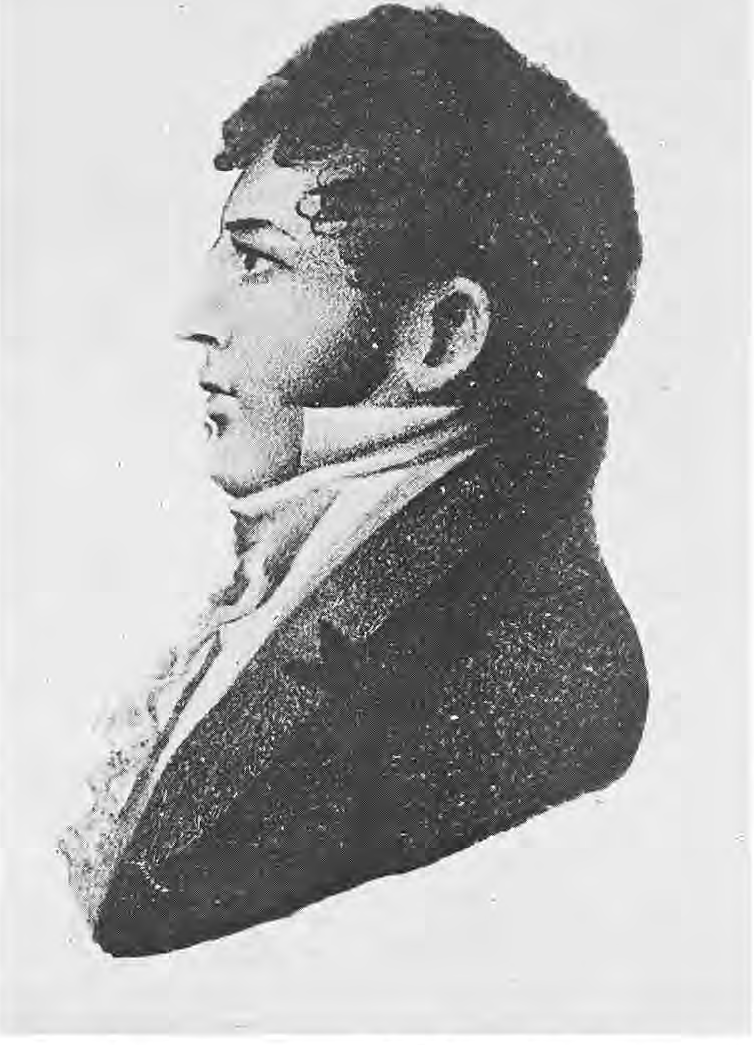
Charles Gratiot I. Photo courtesy Missouri Historical Society. The Times of Skinker-DeBaliviere, May 1985, page 7.
Originally published in The Times of Skinker-DeBaliviere, May 1985.
Read this article in the original newspaper issue.
Archival transcription note: Original account links revocation of the Edict of Nantes and St. Bartholomew’s Day Massacre; chronology requires independent historical review. Original text retained, not presented as newly verified scholarship.
Original source: SD_Times1985_05.pdf, printed page(s) 7; PDF page(s) 7.