Historical April 1985 report or notice. Original dates, prices and contacts describe the source period; current availability has not been established.
The Times of Skinker-DeBaliviere—The Paper, as it was fondly if confusedly known for many years—celebrates this month its 15th Anniversary.
It has, to our knowledge, lasted longer than any other neighborhood newspaper in St. Louis. Like the neighborhood itself, it is truly a success story.
The topics covered in every issue of the last fifteen years are constants in city life: crime and grime, solid (and later, historic) houses, institutions and organizations, politics and people. THE TIMES/THE PAPER The Paper began with a controversy in the neighborhood in April 1970.
It was NOT a hastily conceived sensationalist tract, however.
The first issue was typeset, had photos, a food editor (Jane Davis), and news of schools, the upcoming Art Fair, Police, Black Nationalists Culture Center, a Bill Kohn art show, area clean-up plans —and twenty paid advertisements.
The big stories were the “Jack in the Box Conflict” and a new policy of “Open Enrollment at St. Roch’s,” which was to admit nonCatholics for the first time in the fall of 1970. That first issue established the high standards which The Paper has always tried to meet. Facts, figures, fairness—these have often defused rumors and clarified important issues (redevelopment in DeBaliviere, the Historic District designation, etc.). Plus, the forum for expressing ideas has resulted in many ideas for improving the community. Note, for example, “The Giant Brain Drain Contest” of March 1971, which asked readers: “What would be the best improvement for our neighborhood?” The winners were: Mrs. H.J. Cantwell: “… the replanting of trees.” Jane Hart: “use of the west end of Forest Park for families .. . close off Grand Drive between Jefferson Memorial and Skinker.” Debbie Wilmering: “better trash can holders.” Debbie also wrote, “I’d get it so everybody knew everybody.” The Paper has been innovative, publishing a crossword (Rich and Venita Lake), poems (Cal Stuart wrote a memorable one), book and restaurant reviews, recipes, cartoons (Mike Magrath once did one on trash in the alleys), and numerous stories of and by the people who have contributed constantly to Skinker-DeBaliviere. Remember, for example, “Pot Shots”—Joe Lange’s reviews of the food and drink at neighborhood gatherings. Writing of the “rot gut booze” at one party just may have sealed its fate—that column only lasted two issues! Lasting considerably longer has been Vicissitudes, which began in April of 1973, penned by Marj Weir, who handed it over to the mysterious “P” for two issues in 1974 (“P” was the very active Pat Kohn), supplanted by the not so mysterious “J” in February 1975. “J” survived until February 1980, when Marcia Kerz and Lisa Horner joined forces. Lisa has now been The Times/The Paper’s longest lasting regular columnist! Vicissitudes, now a dozen years old, records the everyday important events of individual people in the area.
Fond memories of working on The Paper flood back—along with the hard work was the camaraderie of intelligent companions (often while the not so intelligent sounds of two- and three-year olds wafted from another room).
Most frequently in the seventies, the setting was the 3rd floor of the Weirs. Marj Weir, co-editor with Chris Lange, then sole editor from 1972-1976, brought to the job a real joy in reporting the news accurately, as well as in bringing together others to participate in the news-gathering and in the neighborhood.
The urban mid-70’s may have been tumultous, but with Marj at The Paper’s helm, it seemed we were in total control—our mission: making sense of it all!
As Marj wrote on the 10th Anniversary, April 1980: We who are. or have been. part of the staff of The Paper have special reason to remember the contributions of Jody Creighton.
Mary Parker. Jean Eberle. Chris Lange. Karen Bynum, JoAnn Vatcha: of the days when typesetting was not in the budget and The Paper had to be typed: of fund-raisers and fund-losers.
It has always been a struggle for no pay except stars in that heavenly crown. but the cause has always been a good one.
The Paper is an ingredient in the glue that holds this neighborhood together and helps it care about itself.
Since then have come Pat McLafferty, Peggy Hermes, King Schoenfeld, Venita Lake, Katie Kurtz. Many, many other people have been involved just as heavily throughout the years: reporters, advertising solicitors, layout helpers, distributors (some have been faithfully doing that job for the entire fifteen years!).
There are our advertisers—four of the originals are still our neighbors: Schoemehl Painting and Paperhanging, Colonial Rug, Delmar Cleaners, Able Key.
Speaking of advertisers brings us to another arena of fame for THE PAPER: MONEY—or the lack of it—has been a constant woe . . . er, opportunity. Consider the following: THE LAST ISSUE? THE PAPER, despite its new look (thanks to artists, Pat & Bill Kohn), is in a state of crisis.
Our ads are not enough to pay the costs, $360, of this issue.
We have struggled along for some time now barely meeting our costs, cutting the size of the paper to four pages, It’s not that the advertising support is not there in our business community; it’s just that we need someone, or several people with the energy to go out and get it.
In other words, we need MANPOWER.
The mechanics are all set up – ad rate sheets, cards on each business – we need some volunteer to coordinate it all. It’s a big job, but it’s essential.
We have no future unless an ad manager is forthcoming by the next issue.
There will be no paper at a time when the community needs it the most.
We are all financed by our ads.
However, we will accept contributions.
So if you can’t contribute your body and time. we’ll take your money.
But in order to survive, we repeat, we need an AD MANAGER or a group of people who are willing to take a certain number of businesses and solicit. Call the Council office, 862-5122, and leave your name and phone number , or call 863-3037 in the evenings.
But we’ve published nearly every month—and leaned heavily on each other, on our business friends, and on the endurance of Nordman Printing.
Our salvation, of course, has been the fund raisers: the Pancake Breakfasts at the Art Fair (remember the “Fat Crepe Cafe”?), the “Paper Route” (The Run of 1980— won by a male Wonder Woman—was the brainchild of Tom Hoerr, “the sinister character who masterminded the whole event.” This successful event forced the staff to allow his creative efforts into print, and “In Your Ear” was born—way back in 1980!
Another fabulous fund raiser was also spurred on by Hoerr creativity, “The Prom,” in September 1977, a fantastic effort featuring strapless gowns and crinoline petticoats, tuxedos and ties . . . clouds in the “sky” created in St. Roch’s gym . .. Gee Stuart, prom queen . . . the Now ‘N Then orchestra .. . newly wed Dick and Arline Webb coming from their wedding reception to join the fun.
An evening to remember —all in the cause of THE PAPER!
An earlier, more modest fund raising activity in the early 70’s was doing market research. Volunteers were “paid” a modest donation to test new products.
Sometimes we raised as much as $25 in one afternoon!
The more recent “Chocolate Chip Cookie Contest” has continued the great tradition, enabling us to keep going financially and journalistically.
Original early masthead reproduced in the retrospective:
THE PAPER, a non-profit monthly newspaper published by the residents living in the community bounded by DeBaliviere to the city limits, Lindell to Delmar. EDITOR: Mrs. Sharon Mier (725-0102) CO-EDITORS: Mrs. Jody Creighton (863-3037), Ed Schaeffer (863-1537) PRODUCTION MANAGER: Miss Dorothea Katzenstein; BUSINESS MANAGER: Dick Vaughn; ART EDITOR: Mrs. Loretta Lewis; CIRCULATION MANAGER: Mrs. Jo Ann Budde; PHOTOGRAPHERS: Mrs. Creighton, Bob Moore; CONTRIBUTORS IN THIS ISSUE: Mrs. Jean Eberly, Dempster Holland, Joe Meyer, Mrs. Jane Davis, Mrs. Pat Kohn, Jim Hitchcock, Mrs. Joan Bender, Mrs. Susie Roach, Mrs. Dorothy Santen, Mrs. Bobby Walker, Vince Schoemehl, Joe Boyts, Mrs. Jenny Meininger, Mrs. Betty Klinefelder, Jim Rick. (Anyone with news to report, mail the information to Mrs. Sharon Mier, 6112 Waterman, or call one of the three editors.)
In May of 1974 editors Marj Weir and Chris Lange organized what has probably never been duplicated, a city-wide conference on neighborhood newspapers in St. Louis, held at the Mayfair Hotel. Such an event underscores the importance of The Paper in maintaining the ties of this neighborhood, as well as its contribution to the lifeblood of the entire City. Its standards of reporting have remained high, and we count among our current staff such professionals as Elizabeth Freeman and Ellen Matthews, Ray Bruen, and many more.
But how the times have changed! CRIME Of obvious interest to every neighborhood resident, The Paper has covered the crime beat well.
In Dec. of 1972, Jim Hitchcock wrote this account, entitled, incredibly, “Crime Down”! (This is what people mean when they say “urban pioneers.”)
Crime Down — By Jim Hitchcock, December 1972
The incidence of crime in the Skinker-DeBaliviere area followed an irregular pattern from May to October of this year, with no clear evidence of long-range increase or decrease except in home burglaries.
There were three murders in August and one in October, but none in May, June, July or September.
There were no reported rapes during the summer but two in September and one in October. Assaults reached a high of seven in May and have since fluctuated, with five each in September and October. Residential burglaries reached a high of 33 in September and dipped sharply to 17 in October. Summer totals had fluctuated between 24 and 32. Thefts of more than $50. reached their peak in May – twelve.
There were five each in September and October, which was close to the low for the entire period. Auto thefts were at a high of 15 in July and have since declined steadily – 14 in August, 11 in September, and ten in October.
There were eight business burglaries in October, the high for the six-month period.
The low was two in August. Other categories of robbery and burglary showed no consistent pattern.
During the summer months, the latest period for which figures are available, the Skinker-DeBaliviere area accounted for only a small minority of the crimes committed in the Seventh Police District – 14 per cent of the murders, 20 per cent of thefts over $50 – 10 per cent of residential burglaries, less than one per cent of rapes, assaults, and auto thefts.
During the same summer period the number of crimes in most categories decreased in the Seventh District over the same period in 1971, and the total number of crimes decreased by nine per cent.
Blockwatchers/Police Community Relations/Team Policing—throughout the 70’s these were important subjects of stories in The Paper, which consistently filled the need to feel a togetherness in the fight against crime.
The Women’s Crusade Against Crime, led by Suzanne Hart, contributed a regular column. Still an issue, of course, the most recent ‘crime’ stories have somewhat lesser numbers and a different slant, but the controversies covered in The Times about the barricades and the successes of Operation Safestreet demonstrate the lasting importance of the topic and having appropriate, not sensationalist, coverage of crime.
GRIME
Dirt and dogs rank right next to crime as a constant story idea in The Paper. Consider this 1972 editorial by none other than editor Marj Weir: Editor’s column A MODEST PROPOSAL I propose that we admit defeat as soon as possible. I speak not of Viet Nam, but of our neighborhood.
We humans are engaged in a “no-win” war with a canine guerrilla force which has tactical superiority, excellent Mobility, and grim determination.
Our apathy and ambivalence have doomed us to ultimate annihilation. Why not face it, withdraw gracefully, and leave the dogs to work out their own destinies.
It is the grossest kind of paternalism to subject man’s BEST friend to a leash, a fenced backyard, a rabies shot, a distemper shot, a dish of food and a pan of water, and (indignity of indignities:) a BATH: How can we in good conscience impose our bourgeois values on these innocents? Do we want to domesticate them?
There are those in our community who do, but many evidently believe in the dog’s right to be wild, to roam free, to eat all the garbage his heart desires, to bite with impunity any man, woman or child he pleases, to grow sick and die at liberty.
Since the Dog’s resolve to preserve these freedoms exceeds our desire to protect our own, it is manifest that our destiny must be worked out elsewhere. Therefore, let us withdraw and diplomatically recognize the new borough of Dogtown. Marj Weir From THE PAPER Oct.-Nov. 1972: And who can forget “The Fox”? THE FOX’S POX The Fox, champion of the environment and defender of clean alleys, has struck again.
A large Pig Pen Award poster is affixed to the rear of property particularly deserving of the Fox’s attention. Those who are inconsiderate enough to receive the Award would do well by spending several moments in serene contemplation over the public nuisance and health hazard for which they have been honored.
The Award is suitable for framing.
In the spring of 1980 came the never equalled “Raiders of the Lost Parkway,” spearheaded by another ardent Paper supporter, Roy Bell. Stories of “Operation Neat,” Big Sweep, Clean Sweep—all precursers, to the gigantic success of “Operation Brightside” and all big stories in The Paper/The Times.
HOUSING
Oh, the tales of rehabbing we could tell. Remember Susie Roch’s “Strippers”? and then there was the Residential Service, an incredible effort to sell the neighborhood to people, bit by bit breaking the “block-busters” and their scare tactics.
The Residential Service even ran ads, and succeeded in attracting a reputable real estate co. into the area—the ever stalwart Feinberg! Working closely with SDCC chieftain Cal Stuart, the Residential Service was tireless. Consider the emotion produced when one of its key players, Suzanne Hart, left in 1977 to become a Police Commissioner
From The Paper, April 1977 — To Suzanne, or Ode to the Lady of Westminster Who Hast Found Need to Respond to the Call of Our Great Leader in the City of Jefferson
A tall and graceful figure,
Through rain and slush and mud
She would always roam;
Our Suzanne,
Showing thousands the joy
Of owning a fine city home.
But now with pistol and badge in hand,
She stands tall and fine,
Set to rid the world of crime;
Alas tho,
No more to roam,
Nor more to show a home.
My soul cries out from my aging body,
My God! What will become of it all?
The world seems hidden by a graying pall.
Has it all been punctured as if by a dart?
For after
Our strength has always been THE HART!
Her smile could make even the derelict glow,
Through her eyes the young see,
Not decay and bulging walls,
But rather,
220 wiring and freshly stripped wood.
A deep, dark luster in magnificent halls.
Oh people, do not your garments rend.
Our noble task has yet to end.
And, yes, our sister must other roads roam,
No more to travel through rain and mire,
For now,
She must challenge
The world of Camp and Jacobsmeyer.
Oh! See her astride her mounted policeperson steed
With saber and billy club held high,
Off she rides like white clouds fleecing.
To the challenge
She goes with a mighty cry of
“Up! Up! Team Policing!”
So, if we must, to the world we give her;
Knowing with pride that, she still indeed lives here.
But still — Oh, alas!
Never more to roam,
Now to miss the job
Of bringing people to their new home.
From Cal Stuart or The Lament of An Aging Neighborhood Executive Director CONCLUSION Going through the years of The Paper/The Times brings the history of Skinker-DeBaliviere to life in a way nothing else can.
From the Residential Service to the Art Fair/House Tours, to the unending tales of politics, it has provided a forum for the best in people as well as a chronicle of the changing times. Happy 15th Anniversary to us!
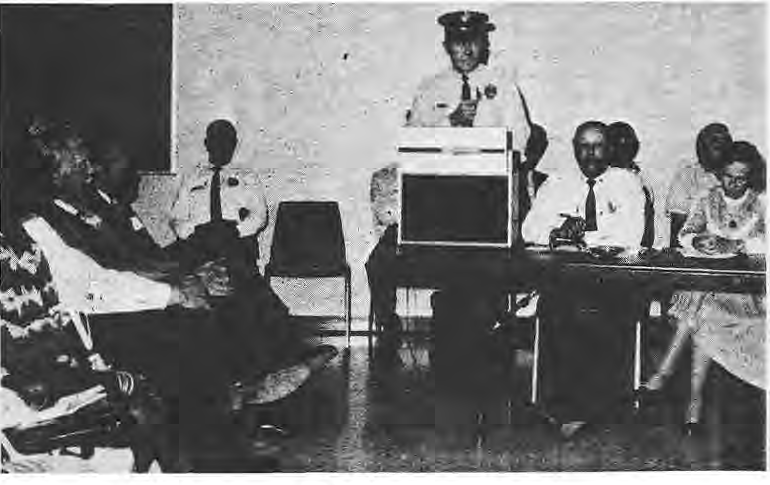
Original photograph caption
From The Paper, June 1977: original historical photograph reproduced in the fifteenth-anniversary retrospective. The Times of Skinker-DeBaliviere, April 1985, page 4. Photographer and subjects not identified in printed caption.
Originally published in The Times of Skinker-DeBaliviere, April 1985.
Read this article in the original newspaper issue.
Original source: SD_Times1985_04.pdf, printed page(s) 1, 4, 5; PDF page(s) 1, 4, 5.
