Historical November 1984 report or notice. Original dates, prices and contacts describe the source period; current availability has not been established.
In recent years, St. Louis has become a national leader in the rehabilitation of historic and older structures; in fact, our city has been responsible for a full 10 percent of the entire number of tax incentives provided by the federal government for commercial and mixed-use rehabilitation projects.
The total amount from 1977 through Sept. 30 has been in excess of 382 million dollars for a total of 777 projects. Almost 80 percent has been since 1982 when the Economic Recovery Action of 1981 went into effect.
By increasing the profit margin for the rehabilitation of older structures and reducing the previous tax bias toward new construction, the purpose of the legislation was to stimulate investment in older buildings and encourage the revitalization of historic neighborhoods. Under this law, a three-tiered investment tax credit (ITC) combined with an 18-year cost recovery period became available for the substantial rehabilitation of older, income-producing property. Of the three credits available, the most favorable is the 25 percent ITC for certified historic structures. Lesser credits are available for the renovation of old, but non-historic buildings: 20 percent for buildings at least 40 years old and 15 percent for those 30 years old.
The 20 and 30 percent credits are allowed on commercial or industrial buildings only; the 25 percent credit is available for those structures as well as rental residential property. Single-family, owner-occupied houses do not qualify for any credit as they are not income-producing depreciable property. (An issue which might need clarification is the difference between a tax credit and a tax deduction.
A credit is applied against the amount of taxes owed.
This is a more favorable tax benefit than a deduction which is a subtraction from income.) There are three important reasons why St. Louis has experienced this rehabilitation boom, according to an article in Commercial Renovation last February.
The city has a truly outstanding supply of architecturally significant and structurally sound buildings; a city government that has made rehabilitation a priority; and the revitalization of the city as a residential center.
The vast majority of certified rehabilitations have occurred in the city’s neighborhoods, which are nationally recognized for their architectural and social diversity.
With support from the Schoemehl administration, many of these neighborhoods have either been listed in the National Register of Historic Places, or as local historic districts, been certified by the Secretary of the Interior as meeting National Register criteria.
In order for residential property to be eligible for the 25 percent ITC. it must be located in one or the other type of district.
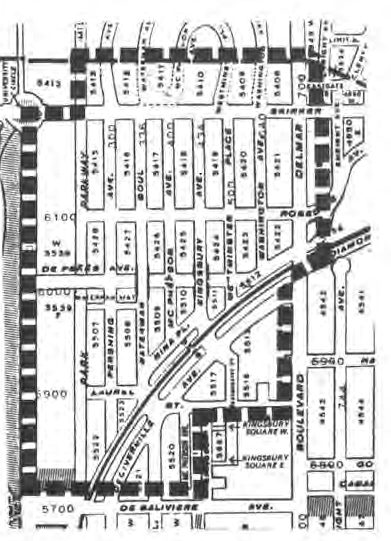
The Skinker-DeBaliviere Local Historic District (designated by the Board of Aldermen in 1978: the boundaries were amended in 1983) was so certified in August of 1984 and joins neighborhoods such as Soulard, Hyde Park, Lafayette Square, Compton Heights, and MurphyBlair. Owning property in a certified historic district will only affect those owners who are seeking the ITC, although all owners and lessees who make improvements requiring building permits must have the proposed work approved by the city’s Heritage & Urban Design Commission. Those property owners who seek the ITC must meet the following criteria: —A building must be certified as contributing to the historic significance of the district. Such a structure is one which by location, design, setting, materials, workmanship, feeling, and association adds to the district’s sense of time and place and historic development. —The quality of the rehabilitation work to be performed must be certified.
This certification is based on the Secretary of the Interior’s “Standards for Rehabilitation.” These standards are broadly worded to guide the rehabilitation of all historic buildings, residences, and other structures.
The underlying concern expressed is the preservation of the significant historical and architectural characteristics of a structure in the process of rehabilitation.
The certification of the rehabilitation is in addition to having building permits approved by the Heritage & Urban Design Commission, although the information required by both governments is often the same and complimentary. —In order to qualify for any of the tax credits, a rehabilitation must be “substantial,” i.e. the cost of the rehab must exceed the greater of $5,000.00 or the adjusted basis of the property (adjusted basis = cost in the building minus any depreciation already taken).
This monetary requirement must be met within two years; however, a five-year period is allowed for phased projects.
These three criteria are substantiated by the property owner filling a three-part application with the Department of the Interior. Part 1 certifies the structure; Part 2 applies for certification of the proposed work; the last form is filled out when work is complete and final certification is requested. Certification and therefore the eligibility of an owner to use the Investment Tax Credit is not given until all work has been complete and approved by the Secretary of the Interior.
To receive forms and instructions, write: Technical Services Division, Historic Preservation Program, Missouri Department of Natural Resources, P.O. Box 176, Jefferson City, MO 65102.
This article is meant to briefly outline the Investment Tax Credit.
There are other details and aspects of the Economic Recovery Act which could affect owners of property in registered historic districts: however, they are more specific in nature and the services of an attorney or accountant are recommended.
The positive effects of the Investment Tax Credit upon Skinker-DeBaliviere as well as other neighborhoods can be profound.
According to figures provided by the Missouri Department of Natural Resources, over five million dollars have already been spent on twenty-five projects in the neighborhood. Such investment in Skinker-DeBaliviere has greatly improved —and will continue to improve—multifamily and commercial buildings, some of which had deteriorated to state of economic and physical obsolescence. Often the rehabilitation of such structures is economically impractical.
By allowing investors the opportunity to reduce their tax liabilities, more money can be made available for the renovation of depressed property.
With the substantial renovation requirement, only buildings requiring major rehabilitation are eligible.
Thus, the potential loss of tax revenue is offset by large labor and construction material expenditures and the return of buildings to economic utility.
The productive ongoing use of the built environment is a major economic, social, and aesthetic benefit to all neighborhoods and the city.
Original photograph caption
Skinker-DeBaliviere Historic District boundaries as amended. Original map accompanying the article. The Times of Skinker-DeBaliviere, November 1984, page 6. Mapmaker not credited.
Originally published in The Times of Skinker-DeBaliviere, November 1984.
Read this article in the original newspaper issue.
Archival transcription note: Source first lists 25%, 20% and 15% tax credits, then says “20 and 30 percent credits.” Printed inconsistency retained; this is historical reporting, not current tax advice.
Original source: SD_Times1984_11.pdf, printed page(s) 1, 6; PDF page(s) 1, 6.