Historical June 1984 report or notice. Original dates, prices and contacts describe the source period; current availability has not been established.
Ward Political Committees The first level of political involvement and also of official party structure is in the ward.
At the August primary in presidential election years, voters in each ward elect a committeeman and a committeewoman for each recognized political party.
These committeepersons make up the St. Louis City Central Committees for their party.
They also serve on the legislative, senatorial and congressional district committees for their area.
These committees are called for by Missouri law.
The committeepersons, who serve without pay, are responsible for all local party operations. Their chief responsibility is managing the party organization in their ward or township, to help party candidates get elected.
They coordinate fund-raising activities, see to it that potential voters are registered and informed about candidates, and advise candidates on campaign strategy. Depending on the strength of their party within their ward, committeepeople may have considerable political influence and may get patronage appointments for their loyal local party supporters. Obviously, to be effective, committeepersons need an ongoing organization with many interested and active members.
The political clubs that form at the ward level are the true “grass roots” of the American political system.
These clubs elect officers, hold regular meetings throughout the year, sponsor fund-raising events, and generally try to build up a strong group of informed, committed party supporters.
Before a primary election the clubs meet with candidates and usually issue endorsements.
Since the backing of the party organization can often spell the difference between the success or failure on election day, the power of endorsement represents a very important aspect of active party membership. Ideally each political party would have such an organization in every ward and township.
In reality, as one might expect, the vitality of a party organization within an area corresponds to the strength of the party in that area.
A ward in a heavily Democratic area is not apt to have a large, active Republican club—and vice-versa.
There are also instances where an established club has split into two organizations over a controversial issue. Generally speaking, ward and township clubs are open to anyone who declares himself/herself to be a supporter of the appropriate political party.
To find out when and where the political clubs in your area meet, contact the committeeman or committeewoman. Precinct Organization Each ward and township is made up of several voting districts called precincts.
The Committeeperson’s success depends on the proper organization and use of these precincts. Precinct captains, appointed by committeepersons, are responsible for organizing voters in their district, seeing to it that they vote on election day and arranging transportation to the polls if necessary.
The precinct captain and his or her workers canvass neighborhoods before the election to inform the voters of their party’s views and candidates. Central Party Committee Each political party maintains a central party committee to coordinate party functions and activities.
The main purpose of the central committee is to elect the local party ticket and help with the state and national ticket.
In the city of St. Louis each political party’s central committee is made up of the two committeepeople from each of the city’s twenty-eight wards.
By state law, the committee meets on the third Tuesday in August after the primary election.
At this meeting the members of the committee elect officers for a two-year term.
The chairman and vicechairman, who must be of opposite sex, are elected from the committee membership.
The secretary and treasurer, who must also be of opposite sex, may or may not be committee members.
The central committee is one of the most important parts of the party structure in the state. Its chairperson is frequently influential in local government when his/ her party is in power.
The above text is from Get Involved, 1984, a publication of the Citizens Information Resource Center, a service of the League of Women Voters, 6665 Delmar, Suite 304, St. Louis MO 63130. 727-VOTE.
The Democratic committeepersons in the 28th Ward, who form the nucleus of the 28th Ward Regular Democratic Club, are J. Kim Tucci (11 Aberdeen, St. Louis MO 63105, 664-9622) and Dee Suda (7027 Nasville, St. Louis MO 63117, 647-4977).
During the 1970s the club’s hall was at 1900 McCausland.
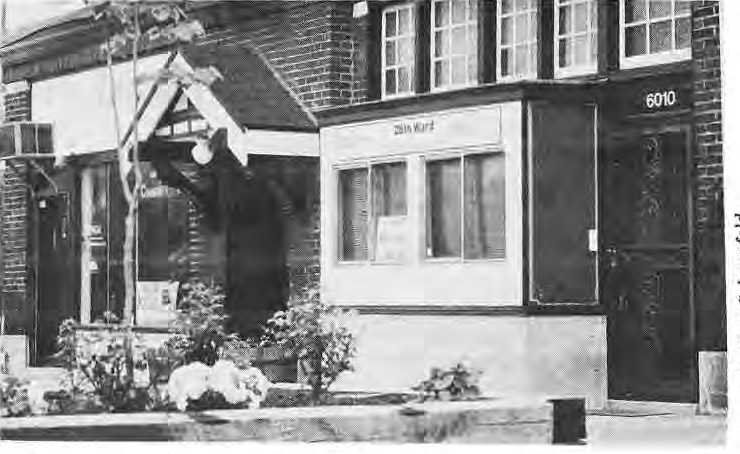
However, after the sale of the building, in 1982, it moved to 350 N. Skinker for a year. Suda and Tucci recently opened their beautifully renovated headquarters in the Skinker-DeBaliviere neighborhood at 6010 Kingsbury at Des Peres (862-0229). Regular office hours are on Wednesdays from 6 p.m. to 9 p.m. Club membership is open to all Democrats who are registered to vote or own a business or rental property in the 28th Ward. Dues are $5 a year.
Before each municipal, state and national election, the club conducts an advisory endorsement election for its members to endorse candidates for public office.
To be eligible to vote at an endorsement election you have to be a voting member for at least sixty (60) days and attended two (2) meetings prior to the endorsement election within the last year. Suda and Tucci are very proud of the 28th Ward Democrats’ tradition of fair and open politics and invite everyone to join the club and maximize your power as a voter in the 28th Ward!
Original photograph caption
28th Ward Democratic headquarters at 6010 Kingsbury. Photo by King Schoenfeld. The Times of Skinker-DeBaliviere, June 1984, page 12.
Originally published in The Times of Skinker-DeBaliviere, June 1984.
Read this article in the original newspaper issue.
Original source: SD_Times1984_06.pdf, printed page(s) 7, 12; PDF page(s) 7, 12.





