Historical June 1984 report or notice. Original dates, prices and contacts describe the source period; current availability has not been established.
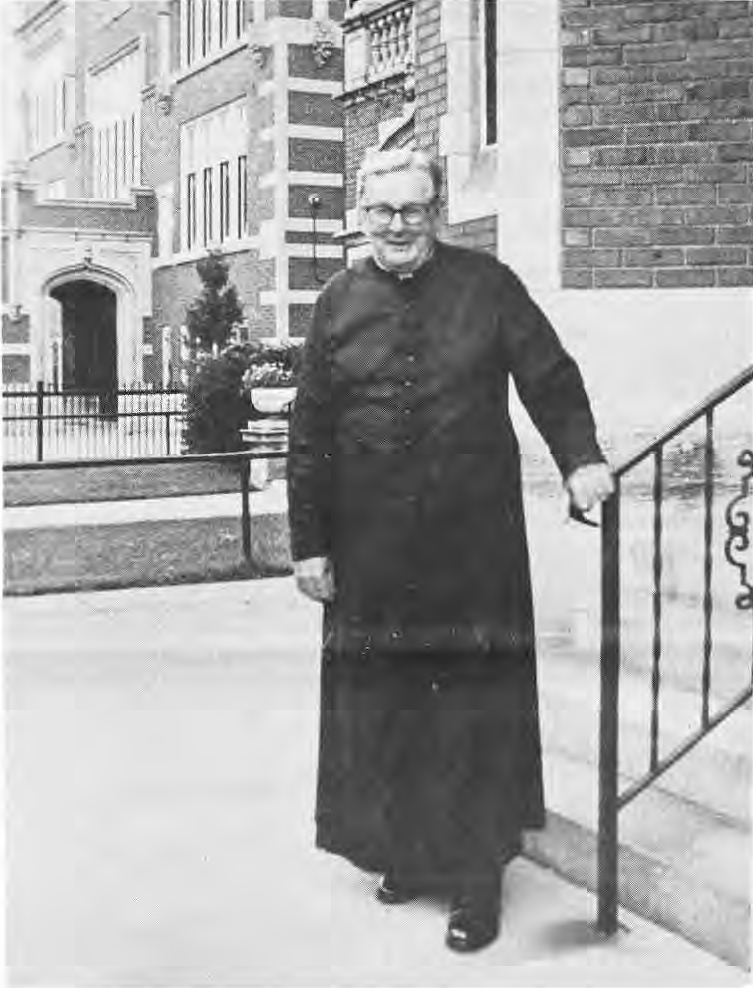
Monsignor Robert Peet, pastor of St. Roch’s for 19 years until his retirement in 1981, will celebrate his Golden Jubilee on Sun., June 10, with a special mass at St. Roch’s. Fifty years as an urban priest in St. Louis means Monsignor Peet has truly seen it all. Kathleen Hamilton wrote in the West End Word on the occasion of his retirement: “The genial priest has always had a pastorate in urban ministry, coming to St. Roch’s in May of 1962 from the old St. Patrick’s Church which was on Sixth and Biddle, where he had spent the previous 14 years. “The then-new pastor of St. Roch’s sought advice from George Wendle of St. Louis University’s department of urban studies on rebuilding city neighbors. Peet saw the Skinker-DeBaliviere neighborhood in the early ’60s experiencing a painful transition similar to what other urban areas were going through—deteriorating and disinvestment of housing as well as a rising crime rate. “He was one of a group of ministers of different faiths who, along with a group of lay people, were heavily involved with the civil rights movement in the early ’60s. Peet took part in the march for equality in Selma, Alabama. “It was also in the mid-60s that the Skinker-DeBaliviere Community Council was formed—consisting of the various churches, neighborhood association and Washington University.
He also aided in the continuation of the West End Town house, which was begun by the late Phil Lucier, a parishioner, to arrest the decay of buildings owned by absentee landlords. ‘I think we have been successful in helping the neighborhood turn around,’ Peet added.” Indeed he did play a crucial role in helping Skinker-DeBaliviere become a vibrant area again—actually better than before—able to hold on to the lively mix of races and economic groups it had always had and become a friendly neighbor to a nationally-acclaimed development effort east of DeBaliviere.
One action Father Peet took shortly after he came to St. Roch’s in 1962 was to support adding a wing to the school.
At that time, the “old school” was bursting at the seams with over five hundred students.
In the years that followed, it has sometimes seemed that the new school wing might not have been needed when enrollment decreased and stayed at a level below two hundred for several years.
But it was a stable number and attracted a loyal group of families, black and white, Catholic and non-Catholic.
In 1983, an increase occurred, the first in many years.
Now over two hundred students of several nationalities attend the school, which is a model of racial balance and cooperation between Catholic and non-Catholic.
And when so many parishes have had to close schools—or when so many have become irrelevant to the neighborhood in which they reside—it is timely to look back to a career which really has made a difference— for a school, for a neighborhood, for a city. Monsignor Peet now resides at Regina Cleri on Lindell in the Central West End and joins his friends at St. Roch’s several times a year. Whether it is St. Patrick’s or a less auspicious occasion, his good humor and cheer make him welcome company any time.
Congratulations to Monsignor Peet on his Golden Jubilee!
Original photograph caption
Monsignor Robert Peet outside St. Roch’s. The Times of Skinker-DeBaliviere, June 1984, page 1. Photographer not credited.
Originally published in The Times of Skinker-DeBaliviere, June 1984.
Read this article in the original newspaper issue.
Original source: SD_Times1984_06.pdf, printed page(s) 1; PDF page(s) 1.
