Historical November 1983 report or notice. Original dates, prices and contacts describe the source period; current availability has not been established.
Editor’s note: This article was submitted by Gabrielle DiLorenzo who is in the Peace Corps for two years in Honduras.
She is completing her first year in which she has been involved in coordinating art activities and teaching art to a variety of ages.
Her family lives in the 6100 block of Kingsbury. Anyone else who has traveled to unusual parts of this country or to other nations, is welcome to submit an article or story about their experiences. Friday night, April 1, is dark and breezy.
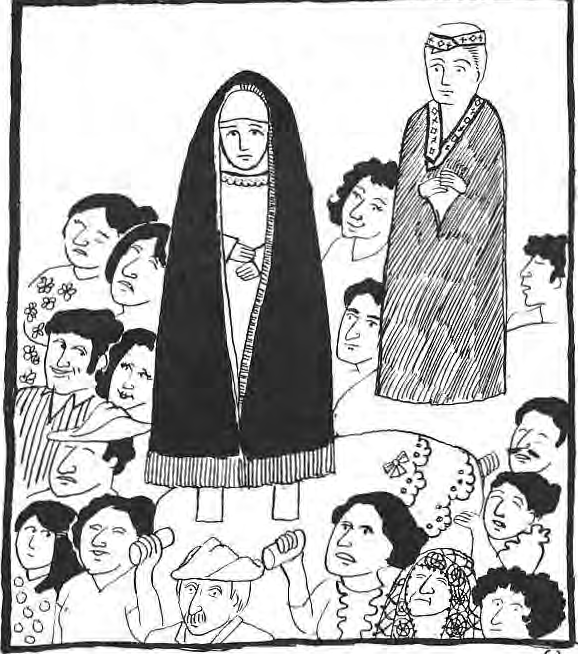
A quiet crowd waits in the central park of La Paz, Honduras.
My friend Soraya’s mother is forbidding in her black dress as she holds her daughter’s arm protectively; the park is full of men.
They are more interested in pretty young ladies than the Holy Week procession, and they lean against the concrete benches, watching and smoking cigarettes.
A sound of hymns signals the approach of the procession. Above the shadows of the crowd turning the corner glows a lighted glass box.
The Santo Entero is a statue of the dead Christ inside a glass-walled tomb decorated with flowers. Four men have carried it on their shoulders up to the main street near the President’s house (President Roberto Suazo Cordova is a native of La Paz), and down the hill past the police station to the bridge.
A crowd of three hundred walks in step with the Santo, chanting prayers and singing hymns in the high, strong ringing tone characteristic of Hondurans: “Perdon, 0 Dios Mio.” Behind the tomb women carry statues of the Virgin Mary, Veronica and Mary Magdalene, and men carry the litter with St. John.
Each statue is life-sized, painted wood, and attached to a litter covered with lace, flowers and streamers. Somber organ music plays — the taped Semana Santa marches are used here every Easter.
The line of statues float over the crowd of people walking, jerking stiffly now and then, past the park into the church.
A stream of worshippers disappears into the church, but still more Pacenos (residents of La Paz) stay in the park or in the street • to gossip, talk about the coffee crop or their pigs, or compare where they went swimming this afternoon.
There has already been a three-hour procession at 11 a.m., Las Via Cruzes. Twelve boys dressed as the Apostles, and a Christ draped in purple with a black wig, were accompanied by El Cirineo. Traditionally, El Cirineo helped Christ carry the cross. Teenagers were dressed as St. John, Mary Magdalen, the Virgin Mary and Veronia.
They walked behind a line of children with purple banners for each Station of the Cross, stopping every two blocks to kneel and pray.
A car rode with the microphone for music and prayers and all the statues followed: The Virgin, St. Peter, Veronica, and Mary Magdalene. Houses on the procession route had palm leaves fastened to the railings with flowers and garlands of purple ribbon. Mothers, grandmothers and small children watched from the windows. I looked over the crowd of people with their umbrellas to ward off the baking sun, and nearly fell into a deep hole.
There is a lot of construction here; the President ordered all the roads paved in La Paz. I did not go to the Holy Thursday procession — the Emprendimiento. Thursday night the men walked with the statue of Jesus, and one man dressed as the Cirineo.
This procession recalls the taking of Christ as prisoner. Holy Saturday night brings rain.
The procession of La Soledad is quiet and less crowded.
It is the commemoration of Mary going out to look for her son with St. John. Four women carry the Virgin Mary statue, and the men carry St. John in the opposite direction from Friday’s procession, praying the rosary and reciting the glorious mysteries.
We pass the billiard hall and a few men peer out of the window, holding their pool cues. Women do not play pool in Honduras. “Gabriela” my friend Trino calls and I feel embarrassed — this is a somber occasion.
We pass the tavern and loud Merengue music competes with the sound of chanting. Up the hill we pass the Evangelical Church, where the high-pitched voice of a preacher echoes excitedly across the street. Evangelicos peer out of the church door, and the people in the procession gaze back, curious about each other. I go home tired after this, but my landlady, the Profesora Isbela, tells me Sunday morning that the ceremony that followed was beautiful: There was a Fogata (ceremonial fire) on the church steps, then a youth group led prayers and Biblical readings, and Padre Jesus blessed the fire and Holy Water.
A mass lasted until midnight, when bells rang for the resurrection of Christ. Processions are held throughout Honduras —Semana Santa is the most important religious holiday of the year.
The small villages of the central city of Siguatapeque and Tela and Truvillo on the north coast all celebrate in their own distinctive processions, although the church rites remain the same. Semana Santa is also the time to swim, and while wealthier Hondurans migrate to the beaches of Tela or Truvillo for Easter Week, people from La Paz swim in the deeper parts of the Humuya River. Groups of bathers walk along the sunny highway between La Paz and Yarumela, and cars jammed with happy people and watermelons leave La Paz for the dry road to Cane. I spent Sabato Santo with the extended family of Chico Alemen, owner of the “Chico Aleman” bus line that connects Cane with La Paz.
We spent the day swimming in the bend of a shallow river, and eating watermelon, potato salad, red beans and fried meat.
The family had tied up two hammocks, and laid down big woven mats under a mango tree.
A strong wind rocked the mango tree, and everyone screamed with delight when the mangos ‘ fell.
The hard fruits came down like bullets, one smacking Luis Aleman in the stomach.
Original photograph caption
Semana Santa Procession drawn by Gabrielle DiLorenzo. Original source credit, The Paper, November 1983, page 5.
Originally published in The Paper, November 1983.
Read this article in the original newspaper issue.
Original source: SD_Times1983_11.pdf, printed page(s) 5; PDF page(s) 5.





