Historical May 1983 report or notice. Original dates, prices and contacts describe the source period; current availability has not been established.
One of the very active people in our neighborhood recently asked what I did down at the Arch and the Old Courthouse.
He hadn’t been to the Arch since about 1975 and heard nothing about the Museum of Westward Expansion. I began to think it was time to write a first-person article and talk about the front yard of St. Louis — Jefferson National Expansion Memorial.
The Memorial is the largest museum in the National Park Service.
Last year 6 million people came to the Arch at one time or another. Over 8 percent of those who come do not speak English as their native language.
It is not uncommon to hear Hindi, Arabic, Boharic, and Chinese along with the more common German, Spanish, French and Japanese. Jefferson National Expansion Memorial includes the Museum of Westward Expansion under the Gateway Arch.
If you have not been to the Arch since 1976, you have not seen the museum.
The space under the Arch is over 104,000 square feet — virtually a city block underground.
The museum is over 40,000 square feet. It, along with the exhibit space at the Old Courthouse, means the Memorial has nearly 90,000 square feet of museum exhibits. That total is approximately 10,000 square feet larger than the St. Louis Art Museum.
The Memorial is the first national monument dedicated to Thomas Jefferson.
The Jefferson Memorial in Washington, D.C., was built after the park in St. Louis was created by executive order of F.D.R. Indeed, one reason it took so long to build the Memorial is the fact that Congress thought something should be done in Washington first.
The Memorial will be 50 years old in 1984.
In April one of the most significant men in the creation of the Memorial and the building and design of the Arch died – Morton May.
He and Al Fleishman and Mayor Dickman and others brought to reality the dream of Luther Ely Smith. That first Memorial Association clearly changed the face of St. Louis with one of the most successful pieces of public sculpture ever made.
And the architect, Eero Saarinen, died before it was even under construction.
As you read this, Malcolm Martin and his board are planning the dedication of a flagpole on the eastern bank of the Mississippi directly across from the Arch signalling the plan to expand the Memorial eastward. Already plans are in place for performing and recreational activities complementary to the museum activities on the western bank.
Once both the east bank and the west bank reflect the quality of life in metropolitan St. Louis, then the full panorama of the Westward Expansion will emerge.
If you are among those very active neighbors who have not seen the largest museum in the National Park Service, come to the Arch any day of the week.
One more thing: The movie in the theater under the Arch is no longer free.
It now costs 50 cents to see the movie and the money from that fee pays for the operation of the theater and the Old Courthouse education program.
In other words, we are keeping the Old Courthouse open because we can now charge to see the movie under the Arch.
Original photograph caption
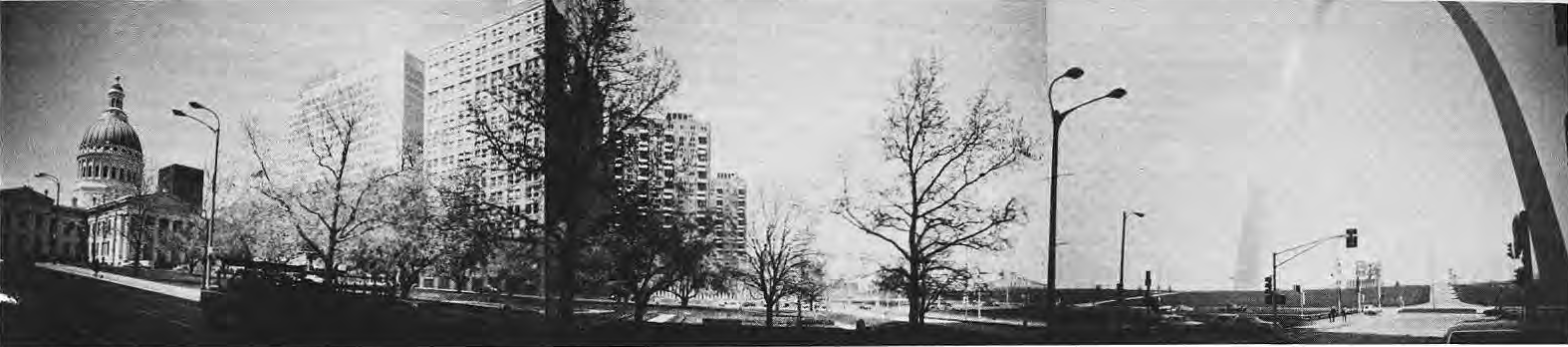
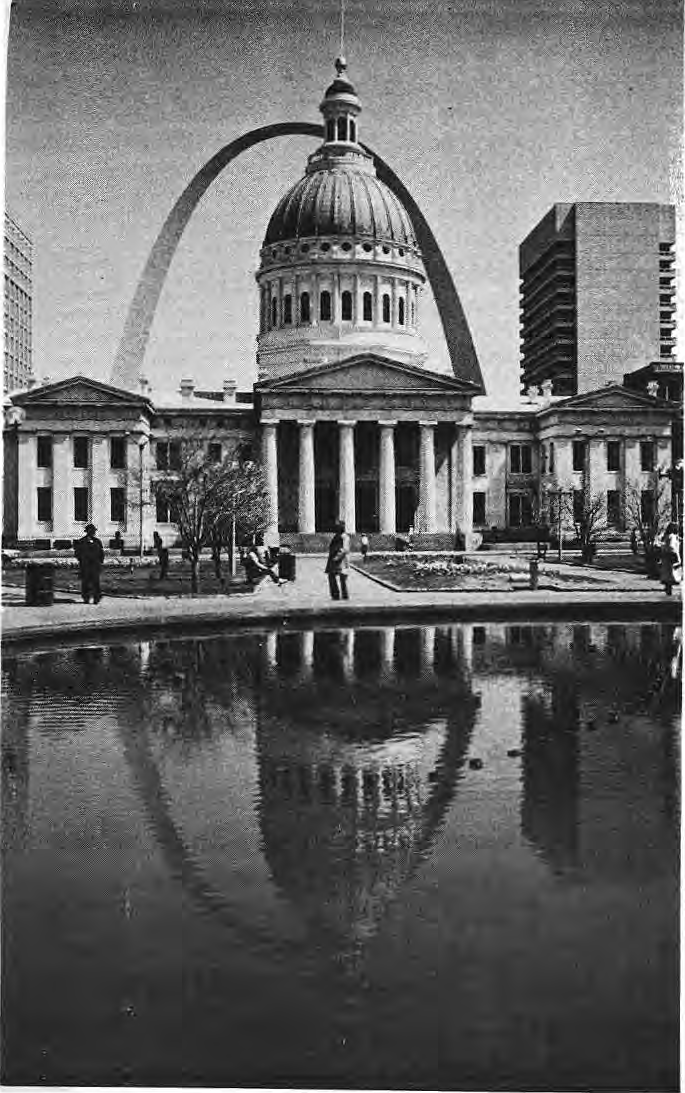
St. Louis riverfront and Jefferson National Expansion Memorial. Photo by King Schoenfeld. The Paper, May 1983, page 6.
Originally published in The Paper, May 1983.
Read this article in the original newspaper issue.
Archival transcription note: The claimed fiftieth anniversary in 1984 and other monument dates, attendance and area figures are Ray Breun’s contemporary historical account and require independent verification before factual reuse.
Original source: SD_Times1983_05.pdf, printed page(s) 6; PDF page(s) 6.
