Historical February 1983 report or notice. Original dates, prices and contacts describe the source period; current availability has not been established.
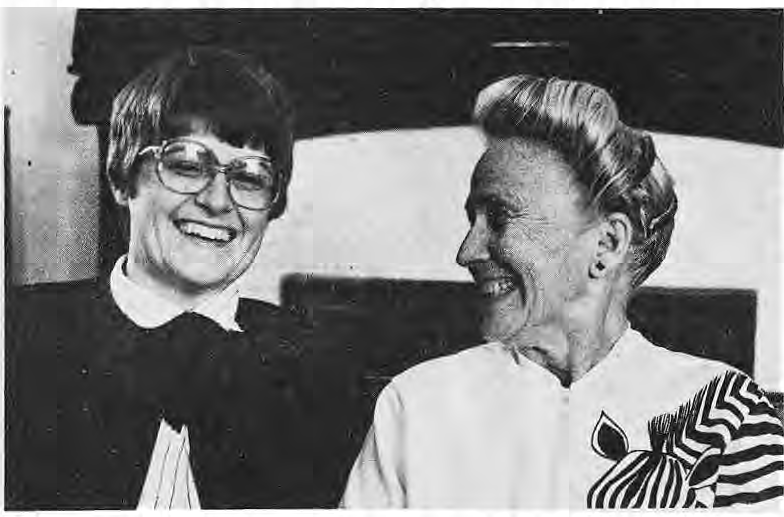
April 12, 1983, will mark the last School Board meeting for Marj Weir of the 6100 block of Westminster and Betty Klinefelter of the 6100 block of Kingsbury.
After six demanding years as members of the St. Louis Board of Education, Marj and Betty will not be running for re-election.
Since 1977 when both women were elected, the School Board has faced significant and even historic challenges in school desegregation, a teacher’s strike, budget reductions, selection of a new superintendent, revision of the corporal punishment policy and the need to upgrade the classification rating for the district.
With the imminent departure from the Board of two of our community’s finest citizens The Paper interviewed Betty and Marj to gain their unique perspective of the progress and hard times in the St. Louis Public Schools over the last six years.
Paper: What do you think were a few of the significant accomplishments of the Board during your term?
Weir: I would mention three areas in which I saw positive changes.
First, the school system was able to implement apeaceful and constructive desegregation plan which continues to focus on educational needs. Secondly, in the 1980–81 school year, we were able to regain the AAA classification rating from the state Board of Education, which is the highest rating given to school districts.
Another important change I felt very strongly about was the policy regarding corporal punishment, which allowed such punishment under certain conditions.
After six years of work on the issue, the policy was revised in 1982 and corporal punishment is no longer permitted.
Klinefelter: The adoption of a competencybased education plan which resulted in positive changes in the system was a great accomplishment.
As a part of that plan, we changed to a new standardized test – the California Achievement Test.
The purpose of the plan is to assure that the system graduates competent individuals who have mastered all the basic skills. Already we have seen marked improvements in test scores.
Another area is the expansion of pre-school academies for three- and four-year-olds.
In 1977 the school system had one, and we now have six programs.
As part of the desegregation plan, the school system has been able to expand the magnet school programs, and I think this expansion is very positive.
We have some of the finest programs around in our magnet schools.
Paper: What were your most challenging moments on the Board?
Klinefelter: When the Appeals Court reversed the decision in the desegregation case in 1980, we had to undergo a complete shift in our emphasis and work around the clock in devising a strong educational desegregation plan.
It was by far one of the greatest challenges before us, and we were pleased with the results of everyone’s hard work.
Weir: The financial blow to the District over the last few years through cut-backs in state and federal funds has forced the finances of districts to be considered a constant and major challenge. I don’t see any major changes in the future. School finance, in my opinion, will remain a very bleak picture and will have an impact on the basic educational necessities.
Another continuing challenge relates to the special needs and special problems of an urban district, which very few policymakers understand or recognize.
We have to worry about so many additional concerns such as the urban poor, health, security and attendance, as a few examples. I doubt whether these four items were a great issue in many suburban districts.
The St. Louis Board of Education spends an enormous amount of time on these issues, all of which have an impact on our ability to “deliver quality education to students.
Paper: What do you see as the greatest overall concerns to face the new Board over the next few years?
Weir: Again, I would emphasize the financial difficulties of public education as a great concern. Also, encouraging qualified individuals to run for the Board of Education seems to be a problem. People aren’t as willing to serve on the Board today primarily because of the time involved.
A good board member may end up spending 50 to 60 hours a month on Board business, not including the time spent reviewing materials and worrying about specific problems.
Another overall concern or challenge to the new Board is that of reviving a sense of public commitment to public education.
The general public needs to recognize the critical importance of public education, and the Board of Education can and should assume a leadership role in this challenge.
Klinefelter: Maintaining many of the programs and policies implemented over the last several years will be an enormous task for the new Board.
The desegregation plan and all of its educational components, competency based education, the new policy on corporal punishment:and the tightening up of the Discipline Code plus many other policy issues will require a strongly united and committed Board of Education.
They will have to be willing to invest extensive time and energy to maintain present policies and to look ahead to new challenges and problems which will face them during the 1980s.
Paper: What about the possibility of subdistricts for election of School Board members?
Klinefelter: I am strongly opposed to subdistricts. I believe that all School Board members should be responsible to represent all children. Sub-districts, in my opinion, would make board membership a political football and thus create a great amount of divisiveness among the members.
It is an insult to imply to present board members that they cannot represent all children.
Because of the unification of the board we have been able to move in a very positive direction over the last several years.
This would not have been possible under sub-districting.
Weir: The concept of representing just a portion of St. Louis through sub-districts is a dangerous concept. Sub-districting will make it very difficult to look at the “whole” and, in my opinion, may result in very overt control by political factions. Moving to sub-districts will politicize and divide the school system and will jeopardize the overall goal—that of a fair and equitable education for all children. I believe that continuation of the status quo is the main interest of regionalism. Sub-districts will make it extremely difficult to deal with the educational problems facing the schools and will make it almost impossible to deal with such issues as the closing of schools.
Paper: What are some of your final thoughts as you leave the board?
Weir: With the selection of the new superintendent, Dr. Jerome Jones, the board will be working with an individual with unique training in urban problems.
I have every confidence that the new board will work positively with Dr. Jones as we move into the 1980s. I hope that the board will continue to work in a unified and cohesive manner in solving educational problems and that they will be able to recognize that they cannot solve all the problems.
In their struggles to revive a sense of public commitment to the St. Louis public schools, I hope that the board will strive toward a good relationship between the city and the school system. Six years on the Board of Education is a long time, and while I know I will miss the challenges, I am looking forward to other interests within and outside of education.
Klinefelter: I am extremely enthusiastic about our new superintendent, Dr. Jones. What he needs now is a board, administration and community that will get behind him and work with him in solving some of the problems in education. Dr. Jones is child-oriented and has developed excellent relations with the business community in previous positions, which should serve as a benefit in starting out in St. Louis. I would have to say that the most enjoyable experience I had in my six years was knowing and working with Dan Schlafly and the other wonderful people on the board, in the administration and the community at large.
As I leave, 1 intend to keep in touch with the schools through special activities and through my grandson who is an enthusiastic eleven-year-old student in one of the magnet programs.
Original photograph caption
Marj Weir (left) and Betty Klinefelter. The Neighborhood Paper, February 1983, page 4. Photographer not credited.
Originally published in The Neighborhood Paper, February 1983.
Read this article in the original newspaper issue.
Original source: SD_Times1983_02.pdf, printed page(s) 4; PDF page(s) 4.





