Historical profile and interpretive essay by Ray Breun, October 1982. Broad religious and historical claims are the author’s period account and require independent verification before factual reuse.
A Festschrift is an all but unknown honor. Festschriften were common in the nineteenth century and remained in use well into our century. Scholars in a field write essays to express praise and adulation for a colleague, after years of service to a discipline.
These pieces are published together on some planned anniversary date. Thirty years after Rev. William Danker came to Japan, major Lutheran scholars of Japanese descent or Oriental extraction gathered essays in honor of a man whom they loved, the man who started the Lutheran Church in Japan.
It took a couple of years to get it all done, but by 1981 it was in print.
A delegation of Japanese Lutherans came to Rev. Danker’s house in the 6100 block of McPherson to present the book.
I was pulling weeds in my front yard at the time.
Two cars of Japanese arriving together to visit Bill next door was something of a surprise. Betty and Bill greeted them and later I met a couple of them. Bill is a friend and neighbor to me; I didn’t know him to be an international scholar, missionary and land speculator.
When Bill showed me his Festschrift, I’m sure he expected me to wonder what that German nutcracker of a word meant. That much I knew.
The rest of the story I didn’t. Japan after World War II was a burnedout case.
The leprosy of war and atomic destruction had reduced the people, their cities and their civilization to despair. Only the chimneys stood in the factories of Tokyo after the fire-bomb attacks of 1945. Rev. William Danker arrived in Tokyo 11 September, 1948.
He had been a Lutheran , minister of the Missouri Synod for 11 years. Ordained in 1937, he had grown up in Minnesota, Chicago and Iowa.
After the war he had signed on to go to Japan and was about to begin a Japanese language course in California when his permit to arrive in Japan came through. Within 40 hours he was in Tokyo.
When Bill got to Tokyo, he bought land for almost nothing.
Not being a professional land person, he simply figured the land near the center of the city would be the best to own. That’s what he bought.
It was bombedout wasteland yet in 1948, and he got it very cheaply.
He didn’t have much to spend, so he couldn’t get all the land he wanted: But he managed to buy some of the best pieces in the center of the capitol of Japan.
He started a radio station—the only one not owned by the government.
He started a publishing house, Seibunsha Press, and it has since produced the first Hebrew/Japanese lexicon.
It also produced a book called • Christian Presence in Japan, the title of the 1981 collection of essays in honor of Rev. William J. Danker. Bill is wont to point out that, when he went to Japan, he was first a Missouri Synod member, second a Lutheran and third a Christian.
When he got to Japan that reversed itself quickly.
He became one of a very small minority and learned that any Christian is all right. Bill was in Japan with his wife and children until 1955.
During that time his congregation evolved into one of the moving forces of the country. Its radio station and publishing services brought Japanese to the point of taking over their own Lutheran organization.
A seminary was founded on some of the priceless property in Tokyo. Men were ordained to the ministry from their own schools. Rev. Danker started a church in Japan, not a building-church but a people-church bent on bringing the best to its own use.
After World War II, the Japanese abandoned much of their shattered heritage.
It had led them to ignominy; something new was needed.
From that day to this, the Bible has been the largest selling book in Japan every year. Christmas is a major holiday in that still largely Buddhist and Shintoist country. Christianity has had its major impact in Japan in the area of ethics. Christian and Confucian ethics have synthesized in Japan to form an orientation which is, in a sense, superior to both.
It is this “new” ethics which has given Japan an edge in the Christian world. Bill has since started an organization called the Center for World Christian Interaction. Christians from all over the world come to St. Louis to be educated at Seminex or St. Louis University or wherever in the Christian traditions.
One of the recent students is a Catholic priest from Africa. Bill’s house is their entry point.
He orients these new students to St. Louis, helps them find housing, and acts as a sort of friend in a strange land. Just a couple of weeks ago a family from Sri Lanka arrived at the airport from Singapore and called Bill and Betty to tell them to come and get them—at 5 in the morning. Mr. and Mrs. Benjamin and their children had come half way around the world to find this house on McPherson, this home away from home. How many will come to the Danker house this year even Bill doesn’t know.
All of this is in continuity with his experience in Japan where he learned he was first a Christian and then a Lutheran and then a member of the Synod.
The Missouri Synod, of course, split out its “liberal’ wing a few years ago. Bill was among those ostracized.
Since then, a new Lutheran synod has been put together, largely through the work of the Seminex faculty. That faculty is leaving St. Louis this coming spring.
Most are going to Chicago, but some are going to Texas or California. Bill and Betty Danker are seriously thinking about moving to Chicago.
If and when that happens, a real Center will move with them. Their home is part of our neighborhood and part of a world neighborhood.
The Dankers are people who make world citizens feel at home in St. Louis.
To be honored from half way around the world for helping to rebuild a civilization all but destroyed in war and bitterness is to be noble in the eyes of those who know what a feast (fest) is all about.
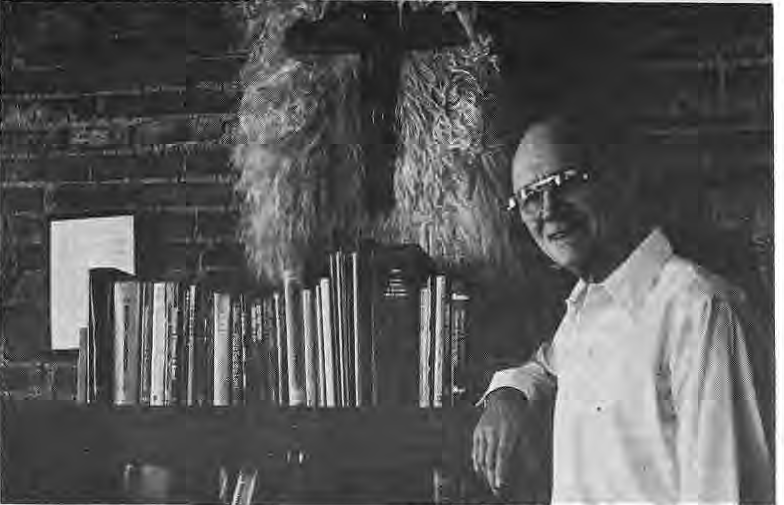
Original photograph caption
Rev. William J. Danker in his study, flanked by memorabilia from around the world and by books he has written, edited, annotated or introduced. Photo by King Schoenfeld. The Neighborhood Paper, October 1982, page 7.
Originally published in The Neighborhood Paper, October 1982.
Read this article in the original newspaper issue.
Archival transcription note: Broad claims about Christianity in Japan, sales of the Bible, and historical institutions are the author’s 1982 interpretations and require independent verification before factual reuse.
Original source: SD_Times1982_10.pdf, printed page(s) 7; PDF page(s) 7.
