Historical February 1982 report or notice. Original dates, prices and contacts describe the source period; current availability has not been established.
The new State Senate district map, unlike the remapping of the State House seats, places Skinker-DeBaliviere wholly within a single district. And, although the number of Senate seats in the City was reduced from 4½ to 3½, the popular central east-west corridor of the City will now be under one Senator.
The new Senate map was completed by the Appellate Judicial Commission on November 16, 1981. Redrawing the boundaries of Missouri’s 34 Senate districts became the responsibility of the six-member Commission, selected by Missouri Supreme Court Justice Robert Donnelly, when a redistricting body appointed by Governor Christopher S. (Kit) Bond failed to reach consensus on a plan.
The decision of the Judicial Commission has been described by political analysts as a fair method of division within the City ofSt. Louis.
Because of decreased population, the City has suffered the loss of one Senate seat and has dropped from 4½ to 3½ seats.
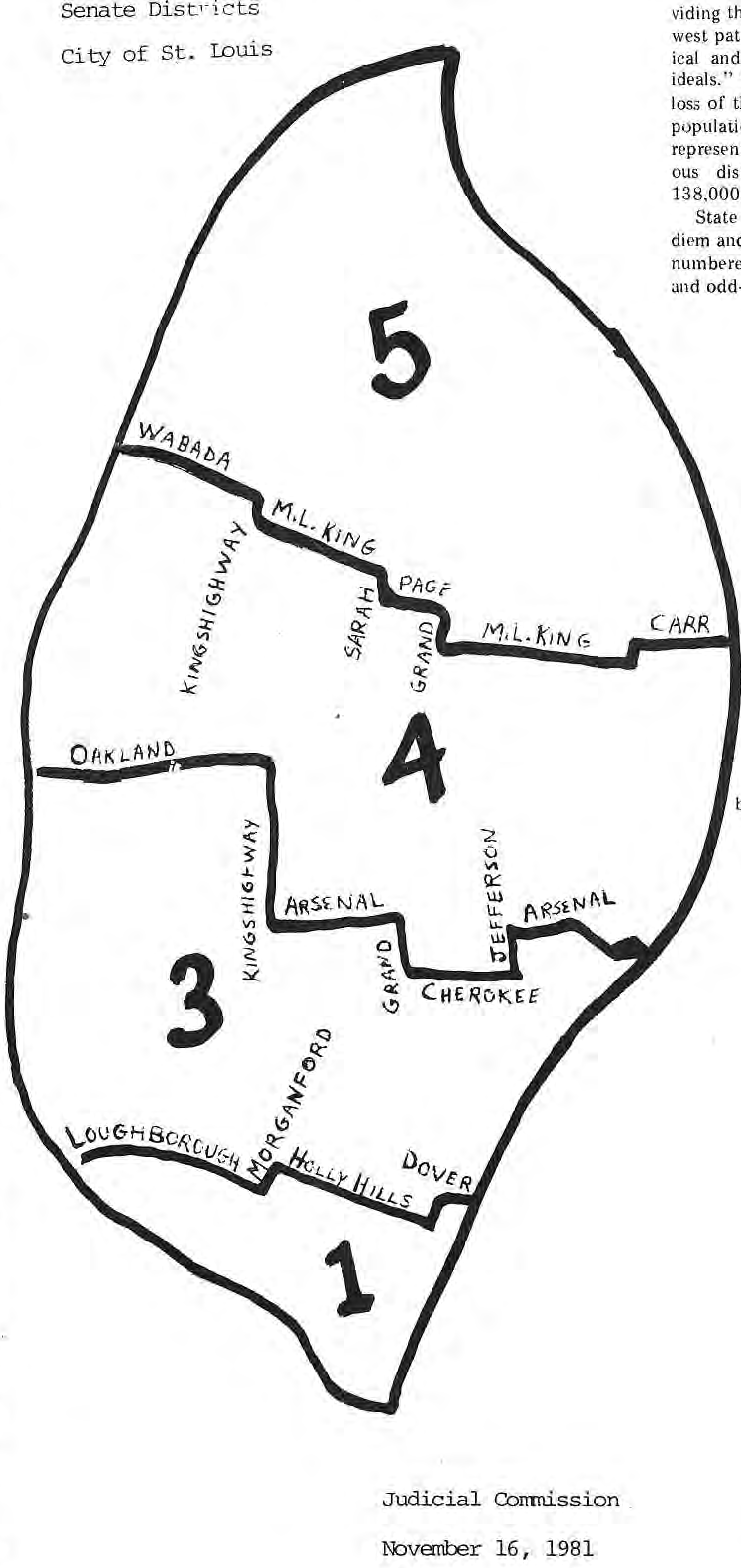
The lines (see accompanying map) created an east-west division which, according to Frank B. Avesing, Population Analyst at St. Louis University’s Center for Urban Programs, creates new districts which are “much more compact and contiguous than those drawn as a result of the census in 1970.” Avesing also felt that the Senate districts were more fairly drawn than the State House districts.
The Skinker-DeBaliviere area is contained totally within the new 4th Senate District which runs through the central corridor with the Mississippi River serving as the eastern boundary and the City limits as the western boundary.
The northern boundary follows Martin Luther King Drive and Wabada; while the southern line borders Forest Park, then travels south on Kingshighway to Arsenal and follows a fairly straight line east on Arsenal and Cherokee to the River.
The 4th Senate District is unique because it is racially balanced.
It also has no incumbent presently residing in the district. State Senators John Bass and Allan Mueller have expressed interest in the seat, which is up for a vote in the 1982 election. Mueller, however, has since decided to run for the 1st Congressional seat against Congressman William Clay.
To run in the 4th District, Bass would have to move into the District. State Representative Eileen McCann, from the present 84th District, has filed for the Senate seat. Representative McCann replaced former Representative Ed Sweeney . in the House. Sweeney’s name has also surfaced as a possible candidate.
No candidates from the Skinker-DeBaliviere area have filed to date.
The filing deadline is April 27. Alderman Dan McGuire, 28th Ward, commented that he felt the district was a good one and that he was satisfied with the central corridor concept.
According to Avesing, the new lines dividing the City into 3½ districts in an eastwest pattern “works well in terms of political and social realities and demographic ideals.” The most significant change is the loss of the one City district because of the population shifts. Senate districts now will represent 144,630 people while the previous districts represented approximately 138,000. State Senators earn $15,000 plus per diem and serve for four years, with all evennumbered seats up for re-election in 1982 and odd-numbered seats up in 1984.
Original photograph caption
Senate Districts, City of St. Louis. Judicial Commission, November 16, 1981. The Paper, February 1982, page 1.
Originally published in The Paper, February 1982.
Read this article in the original newspaper issue.
Original source: SD_Times1982_02.pdf, printed page(s) 1; PDF page(s) 1.
