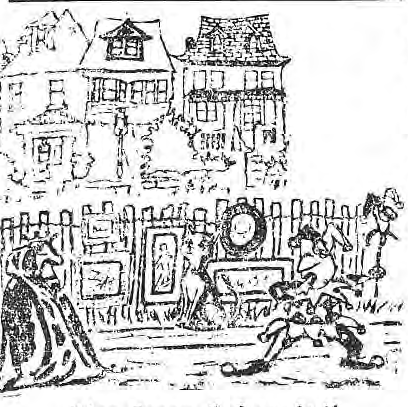
Historical satirical fable by Dan Shea. The imaginary villages, deed and proclamation are literary inventions, not a legal transfer or verified property history.
In a time out of time, in the village of the King’s Berry in the Land of Louie, there lived a people great in zeal and caring.
And these people did look about them and did see the Land of Louie in a sorry, yea even a blighted state, and they had concern lest the world of their children be dreadful past enduring and their property values a joke among men. Taking counsel amongst themselves, they did conceive of a ritual propitious in the heavens and on the earth, which would brighten one day each year and would cast a light throughout the countryside, and in this light all would see that the land about the King’s Berry was a good land and its dwellings pleasant to look upon and its cartpaths shady and of one way.
The dreamer of this dream was one Art and the ritual was named for him, Art’s Fair.
And the torm of the ritual would be in this wise: a call should go out to the farthest borders of the land, to the Groves of Webster and the Wood of Kirk, to the Broken Heart and the Place of Flowering, even unto the land of those that sweat not, in the realm of L’Ahdoo.
And these multitudes should be invited on that day of the springtime given over to the honoring of mothers that they should gather in the village of the King’s Berry, where they might eat and drink and stroll and take their rest. Musicians there would be and, above all, craftsmen, and the first among these should be decorated; let their craft be never so mean and contemptible, they would be beloved in the eyes of the villagers.
The village children, too, should play their part, having permission to daub skin and parchment with brightest colors in artless abandon, and to exhibit these, and even strangers could see that they were happy children, though humble in estate.
But the inmost intent of Art’s Fair would be this: the huts of the village should be swept clean and their linens aired and the fairest among them open to all the world, which should see beyond any gainsaying that this village was not accursed nor its prospects grim. “Here might live I!” the stranger should say, forsaking his but in the Groves of Webster for the merest shell, which yet the eye of the imagination and the skill of the master builder, called Conn Tractor, might render into something of charm and exposed brick and hanging plants.
And it came to pass as they had wished.
And springtimes came and went, smiling the while on Art’s Fair. Huts formerly forsaken and despised were dwelt in once again as strangers came from far and wide to taste of this good life in the King’s Berry and in the villages nigh unto it.
And all these generations, new and old, grew pleased betimes with their good fortune and were heard to say they would not part with their huts for less than two, and in the next year four, herds of kine.
To many it seemed as if these people and their annual Fair were beloved of the gods.
Each year, the sun shone more brightly on the day of mothers, the music swelled, the craftsmen came in greater numbers and enriched themselves by their trading, even in trinkets most whimsical.
But no tide remains forever high nor the clearest face forever without crease or blemish.
In time it came to pass that nearly all these huts, for leagues about, were dwelt in, and as for those few who wished to change their but for another in this land, east for west, north for south, it was impossible.
For hutting had become over-costly, and to this price was added yet another, the Interest.
By imperial decree, he who would buy a but perforce must say something of Interest to him who would sell.
And in so placid and complacent a time, few could pay this price. Now, as the day of Art’s Fair approached, there could be heard murmurings among those who dwelt in the King’s Berry. “What use this rite of spring?” some asked. “These huts are filled, and for the rest, we shall not see the moving of estate, however real, until the Interest is more manageable.” And another said, “I find no pleasure in the multitudes that do flock here on the day of mothers and do trash my hearth and make bold to use my closet of water.” Yet though they delivered themselves of uncivic sentiments, none would speak aloud to Art or to those who made his Fair, whose hearts were in the rightest place but beat on from merest habit.
Some wished to bring a petition to the leader of the Land of Louie that he would ban the Fair, for he was a young warrior of a nearby village and wise beyond his years. “He knoweth better than most,” they said, “where sits the wind and how to do this without offense to Art or to his helpers or to any mother.” “I caution thee, go slow there,” replied an old one. “For if he like not this idea he hath power to cut us off in our essential services.” “It is in the hands of the gods then,” they said.
And the winds of change did blow even as they spoke. That next day of the mothers was like unto none in the memory of man or woman.
For of warmth there was none, the sun withdrawing from them.
In its place came wet and chill and all manner of threat from the heavens, so that the craftsmen would not expose their gimcracks, nor would the surrounding villagers forsake their toasty huts.
In the King’s Berry, no one was to be seen abroad save for an ancient crone who wandered the cart-path in search of her beast of burden, one Burrito. But this animal some villagers did fall upon in their day of anguish, and devour, and for this sin of the stomach many did perish, or wish to.
Others, surveying the forlornness of the day and wary of the flesh of the Burrito did solace themselves with potions of deep forgetting. Still others were afflicted more grievously yet, for they had intemperate zeal, and shaking their fists at the heavens did say “We shall do this all over. Let Art’s Fair be held again, in the warmest of seasons, on the day of the fathers.
For the gods themselves must listen to a neighborhood association.” Once again, the call went out to craftsmen, and huts were swept clean and the fairest among these, though in diminished number, were thrown open to all the world.
And once again the heavens did speak, sending down torrents of water and chilling the air to an unseasonable low.
And their message, spoken in thunder, was clear to all save the most benighted: The Fair is a ripe fruit no more.
The rains have dashed it to earth. Eat it not again lest you sicken.
When at last the clouds parted and the sun shone, the villagers gathered together.
Loath were they to renounce forever Art’s Fair, for by this ritual had they come to measure their growth and their content.
Yet the heavens had spoken without let or stint, shilly or shally. Foolish tongues wagged of calling the Fair after Merv, the village idiot, so as to disguise its true nature from the gods.
But the wise ones of the village replied, “If the gods scorn Art’s Fair thus, making great water on our heads, what shall we look for by offering them the insult of a Merv’s Fair!” And even this witless Merv, his eyes lolling skyward, did sign assent. Once before in the history of the village its people had been sore perplexed even as now. That had been the time when a foreign chieftain, seeking a ransom, had made off with all the village dogs, all of them to the last cur. Few could bring themselves to pay the five crusts of bread demanded by the chieftain, but in partaking of the juice of that berry for which the village was named, which was the juniper, extra-dry, the villagers grew mellow and repented of their cruel rejoicing in the extinction of their dogs and did send the five crusts.
Now once again the berry beckoned, its savor holding forth a promise to unlock what sober heads unaided could not pierce.
And as these good folk sipped, the mists of their dilemma drew back.
To cling to Art’s Fair would tempt the gods to violence anew; to let it die was to lose a part of themselves. “We must give it away!” they cried in unison. “We must make a present of it to De Ball of Fur.” And turning to the East, they bethought them of that village not far off, once seemly and prosperous, and named for a cat whose pelt had been the blanket of the first child born there.
In its early days, days of glory, De Ball of Fur had lighted up the night-time sky with revelry.
The source of its wealth lay in a vast Treasure Chest, its contents past pricing in the eyes of men but valued at 50,000 noogies by those who had been entrusted with its care. Whether by perfidy or inattention or by the inevitable devaluing of its contents the Treasure Chest was lost, and with its passing passed the golden days of De Ball of Fur. Then one by one its huts grew vacant. Its lights surrendered to the night. Its music was the soughing of the wind through lonely trees.
All this in mind, and giddy with munificence and juniper, the citizens of the King’s Berry did call for a local scribe and dictate to him a proclamation of their charitable intent, by which the flush of youth and the ardour of prosperity would be restored to their neighbor in the East, and the instrument of this renewal would be Art’s Fair. Thus read their proclamation:
The proclamation
Much have we learned from sunshine but more have we learned from the rain.
The rain falleth alike on the just and the unjust, the rehabbed and the unhabbed.
And it hath whispered in our ears that there can be too much of a good thing and that the greatest joy is in giving. Over De Ball of Fur a new day dawns already and to its quickening life we bequeath Art’s Fair. Embrace it, our neighbors, and ye shall prosper even as we. Let the torch pass. Lest its flame be drowned a third time running.
Original photograph caption
King Berry Judges Art! The Paper, September 1981, page 5. Artist not credited.
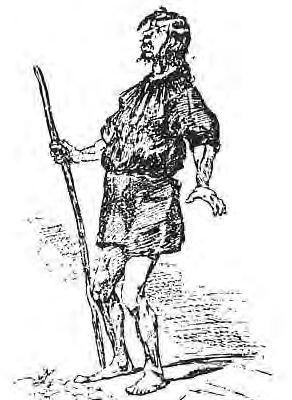
Originally published in The Paper, September 1981.
Read this article in the original newspaper issue.
Original source: SD_Times1981_09.pdf, printed page(s) 5; PDF page(s) 5.





