Book review and author profile by Jo Ann Vatcha (existing JoAnn Vatcha profile), June 1981. Original novel excerpts and appraisal are preserved.
On June 7 St. Louis mystery devotees have an opportunity to meet a local author whose first novel has just hit area book stores. Paul’s Books, 6691 Delmar, will serve as host for a 1-3 p.m. “book party” to which you’re all invited.
The novel is The Phoenix Nest by Margaret Hermes.
The setting is a small New England town, replete with summer residents of the distinctly odd sort.
In the classic detective novel tradition, the central focus of the story is the detective himself–a bright efficient sheriff, albeit of a small New England coastal town.
The real interest of the story is how he gets hooked on one case, to the chagrin, embarrassment, dismay of those closest to him. There’s the classic mysterious lady, too, who doesn’t seem to fit the situation and who intrigues the hero far too much for him to remain objective about the supposed crime she has witnessed.
Without revealing any details of the murderous deed, suffice it to say it’s definitely reprehensible and there is a plethora of suspects. Heavily involved are the members of an eccentric, rich, old family (summer residents, naturally), with enough references to a less than distinguished past history to make it an Adams family of definite interest.
Then, too, there is the mysterious Eve Galatea, who walks into the sheriff’s office and stays in his mind, a puzzle he feels compelled to decipher.
The mystery fan is always ready to succumb to Mary Astor walking into Bogart’s office (or Faye Dunnaway into Nicholson’s in the more recent Chinatown–not a bad choice for the movie role in The Phoenix Nest.) Here, the first impression is of “Grace Kelly playing the role of the English aristocrat’s lady” right down to the grey leather gloves she wears.
Hermes takes this relatively typical detective story situation and makes it truly her own.
The hero, for example, is not Bogart or Nicholson. He’s not even a loner. He’s married, has children and friends, a regular job. “Trout was inevitably catalogued by others as a nice man.
He accepted that assessment.” Instead of being greedy for the potential experience Eve Galatea presents, this hero wants to stay detached and has trouble dealing with Grace Kelly with gloves. “The events and his emotions over the last few days had made him feel raw and too vulnerable.
He wanted to anticipate nothing more thrilling than the outcome of the World Series.” Even more interesting than the hero Trout are the mystery women in the book: besides Eve, there’s the rich matriarch Mildred Hornsby Adams (love the names); Gretchen, the distinctly odd secretary, handled very deftly, a wonderful blend of clue and herring; and then there is Enid, the hero’s wife, a well-developed character who is easily the most genuine and real person in the novel.
Her preoccupation with finding out what we as readers have glimpsed of her husband’s fantasies not only complicates the plot, it makes one aware of the real talent for characterization not altogether developed in this first novel.
There are touches of an offbeat nearhumor, too, that one wishes had been more fully explored.
The hero’s recognition of falling into stereotype via his own fantasies (real as they have become), as in this thought-encounter: “It flashed through his mind that there was indeed something sensual about lighting a cigarette for a woman.” But moments later, he thinks, “I’ve got to stop gawking at the titles on the paperback rack when I’m standing in checkout lines.” The weave of fantasies and realities (both male and female) is intriguing, but occasionally, seems a bit too detached, bordering on wisecrack, as in this exchange between the diligent detective and the odd secretary: “In your state of semi-consciousness, you kept repeating the word abomination.”–her answer, “Yesterday, the whole world seemed abominable.
We all have our off days, Sheriff.” More often than not, the style works.
The sparseness has a kind of hardhitting nonviolent effect appropriate to a mystery with more suspense than gore.
The novel has the ingredients of a solid mystery, fast-moving and fun, and enough twists to make the ending quite improbable.
It has appealing characters, especially, as one might expect, the female characters.
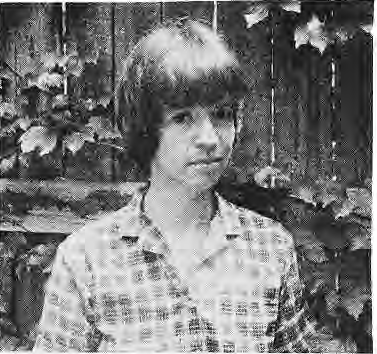
The author, transplanted to Skinker-DeBaliviere from Chicago, via Boston (details of which show up interestingly in the book), lives with daughters Sarah and Lucy and is a definite part of the Skinker-DeBaliviere scene. Indeed, she’s the Editor of these pages, Peggy Griesbach (nee Hermes and recently returned to that appellation).
The dedication of the novel to Chris Lange will evoke in many minds the juggling of job, school, children and, in Peggy’s case, the work of writing on a daily basis that, happily, resulted in the successful publishing of her first novel. Those of us also enamoured of writing may feel particular pleasure (envy) at her accomplishment and look forward to her next book. Do come to Paul’s Books on June 7, 1-3 p.m. and join the celebration!
Original photograph caption
Margaret Hermes. The Paper, June 1981, page 5. Photographer not credited.
Originally published in The Paper, June 1981.
Read this article in the original newspaper issue.
Original source: SD_Times1981_06.pdf, printed page(s) 5; PDF page(s) 5.





