Historical May 1980 report or notice. Original dates, prices and contacts describe the source period; current availability has not been established.
As a result of a $232,500 grant received from the U.S. Department of Health, Education and Welfare for an Urban Health Initiatives (UHI) program, the People’s Clinic will be offering expanded services to the public, beginning June 30. Plans are now in progress to offer services with full daytime hours, in addition to the present evening program.
The daytime clinic will be operated by a paid staff of doctors and other professionals, while the evening clinic will continue with its present volunteer staff.
The People’s Clinic, at 6010 Kingsbury, has existed as a volunteer operated facility, since 1972, when a group of Washington University and St. Louis University medical students opened it in order to offer an alternative form of health care to the surrounding community, which has only one doctor for 20,000 residents. Because of this apparent need, the clinic strives to be “the family doctor of the neighborhood,” according to Julie Hindmarsh, Administrative Assistant.
The original purpose of the clinic, according to Mary Faulk, who is Outreach Secretary, and has been with the clinic since 1974, was to offer free health care to the underprivileged as a basic human right. This philosophy is still important at the clinic today.
The clinic’s Board of Directors, known as the Community Health Council (CHC), and its administrative staff are responsible for planning the new daytime clinic.
Members of the staff, who now earn salaries as a result of the grant, are Project Director Betty Kerr, Administrative Assistant Julie Hindmarsh, Outreach Secretary Mary Faulk, and Coordinator of Volunteers Dawn Rubbert.
The 15 member CHC, responsible for planning and direction of the clinic, is elected by clinic members and volunteers in order to represent their needs. According to the by-laws, half the directors are replaced each year.
Of approximately 600 ballots sent out for the recent election, however, only 77 were returned in time to be counted.
This was a usual turnout, according to Hindmarsh, and a problem, since effective planning is dependent upon active participation and communication by people in the community who have immediate needs.
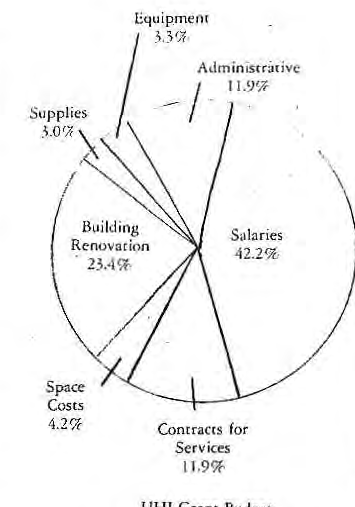
The budget for the UHI grant has been written. Plans to open the clinic five full days per week and a half day on Saturdays, to hire a professional staff, and to offer certain new services have already been established.
The largest portion of the grant, $98,204 is budgeted for salaries of the professional staff which will consist of two doctors, a nurse, a social worker/counselor, a receptionist, a secretary, a maintenance person, and an accountant.
The staff will operate the clinic with the assistance of some volunteers.
The administrative staff considers it “a priority to hire from within the neighborhood when qualified people exist,” says Hindmarsh.
A large portion of the grant, $54,318, will go to renovation of the present building.
Although the size of the facility is suitable, says Betty Kerr, Project Director, its physical condition, including electricity and plumbing, needs improvement in order to house new equipment.
Another $27,724 will be spent on contracts for services, such as x-ray and laboratory diagnosis, the former not available at present.
Administrative expenses, such as printing and auditing will use another $27,650.
Space costs, including rent and utilities, will be $9,820.
Medical and administrative equipment will use $7,730.
Another $7,054 will go for medical, administrative and housekeeping supplies.
In addition, the clinic budget requires $47,708 to be raised locally as in the past.
Normally this is raised in the form of donations of services and money, and payment for services at the clinic.
The recent April Fool’s Auction raised $1,900, a record amount, to buy an EKG machine.
The remaining $1,000 needed to buy the machine was donated by the Holy Communion Episcopal Church in University City.
The clinic will also offer some new services to enhance the primary medical care, first aid and referrals available now.
Most important, says Hindmarsh, will be the pre-natal and post-partum care since the clinic will hire a fulltime obstetrician.
Medical social services and limited pharmaceutical services will be new also.
Laboratory and radiological diagnosis, emergency medical, preventive dental, and other supplemental services are to be available by referral.
Specific plans concerning these services are still in progress.
Summarizing an essential part of the clinic’s philosophy, Kerr emphasizes that, “although it is a federally funded clinic, they still plan to keep warm, sensitive, quality neighborhood health services.” This has been the philosophy since the clinic’s beginning and it is hoped that it will, in this way, remain an integral part of the neighborhood even as it expands.
A Grand Opening Health Fair and Community Celebration will be held on Saturday, June 28, to initiate the new daytime hours to begin the following Monday.
Original photograph caption
Original UHI grant budget chart. The Paper, May 1980, page 5. Chart artist not credited.
Originally published in The Paper, May 1980.
Read this article in the original newspaper issue.
Original source: SD_Times1980_05.pdf, printed page(s) 5; PDF page(s) 5.
