Original byline: Anne W. Judy. Historical May 1980 education report; proposed changes and period racial terminology are preserved as printed.
By the time this issue of The Paper hits your door step most of the plans for desegregating St. Louis city schools will have been refined and made public. It is probable however, that the ramifications for our neighborhood schools, as well as the student population, will continue to raise concerns for area residents.
On Saturday, April 12, several members of the Neighborhood Schools Committee attended a four hour meeting at Harris College on an update on desegregation proposals.
At least one committee member was reluctant to be cooped up on a rare sunny day.
Therefore it was a pleasant surprise to witness an exciting presentation of new programs as well as discussion of the complicated task of their implementation.
Not only is the school district attempting to establish a successful and durable desegregation plan in order to meet the demands of the U.S. Circuit Court of Appeals to effect, where possible, a thirty-fifty percentage of black children in city schools; but it is also reorganizing the grade structure throughout the system in addition to adopting the “clustering” scheme for achieving integration.
Gary Orfield, national expert on desegregation, defines “clustering” as a technique for combining the attendance area of two or more schools on opposite sides of a ghetto boundary and assigning all the children from the enlarged zone to attend each of the schools for certain grades.
Clustering and busing go hand in hand with anxiety and fear on the part of parents and others.
In his book, Must We Bus?
Gary Orfield reports evidence that should calm parents who are more than a little reluctant to let a child board a bus headed for “the other end of town” to attend school.
Orfield believes that a negative public perception of busing has been reinforced by the way the national media covered desegregation in Louisville and Boston.
In the fall of ’75 these were the only cities experiencing violent protests, yet they received more than a third of the total news coverage on desegregation at that time.
Assistant Attorney General, Ben Holman, director of the Community Relations Service of the Justice Department, reported that most schools and many school districts carried out desegregation free of desegregation-related injuries.
In fact the Detroit school system experienced fewer racial incidents than before desegregation.
In 1976 Holman confirmed that students (particularly those of elementary school age) usually adjusted rapidly to desegregated schools.
Although Gary Orfield recognizes that violence in the schools is a serious national problem, he states that it is not exacerbated by the desegregation process.
Another hindrance to public support of busing is the objection to the loss of the neighborhood school.
Orfield challenges the objection by pointing out that “quite apart from desegregation the majority of American children do not walk to school; they ride, usually on a school bus.” Neighborhood schools were the exception rather than the rule by the late 1960’s.
It might surprise some to learn that fewer than half of all children in elementary schools and only about a fourth of the older students attend the neighborhood school where a mother can easily pick up a sick child or drop off the forgotten lunch box.
The public misconception of the consequences of desegregation has created what Dr. Orfield calls the “New American Dilemma.” He argues that the resistance to busing has little connection with actual findings of social scientists and the data supplied by cities where busing is already in operation.
There is clear evidence that busing does not affect the academic achievement of white middle class children.
On the other hand, Nancy St. John, author of School Desegregation, Outcomes for Children, believes that integration “in the long run increases the aspiration, self esteem and sense of environmental control for black youth.” An exciting feature of the desegregation proposals is the expanded option for students to attend a magnet school.
Plans for an Olympic Magnet would situate it at the Hamilton Branch III facility.
The concept for the school derives its rationale from the recent recognition by educators that certain cities have achieved considerable success in motivating students by providing a curriculum organized around interests in physical education and individual athletics.
Students would attend the Olympic magnet school full time.
At least one third of the school day will be spent in the development of individual physical skills such as track and field, swimming, tennis and gymnastics.
Hamilton III’s proximity to Forest Park, Washington University and other colleges makes it an ideal choice for implementing such a curriculum.
If all goes according to plan the annual Paper Run should attract some keen competition next spring!
The school district administration has presented proposals for many new programs which could be of special interest to area residents.
Disseminating all that information in addition to creating a voice for neighborhood concerns are projects undertaken by the new Neighborhood Schools Committee, organized by Skip Coburn.
The committee is composed of representatives from the various neighborhood organizations as well as from Hamilton and Hamilton III.
To date the committee has sponsored two public hearings where desegregation issues, concerns and plans were discussed.
It is anticipated that in the coming months the committee will help ease our neighborhood’s transition into the new system.
Skip Coburn hopes that the committee will arrange opportunities for parents from our cluster schools to meet one another, the faculties, and to visit the schools.
Several members of the inter-racial committee and the Board of Education have expressed deep concern over the difficulty in smoothing the way toward successful desegregation.
Even though the desegregation plans have been endorsed by one of the nation’s foremost authorities on the subject, eventual success depends on thorough understanding and support by the public.
One committee member has warned that it would be unrealistic for anyone to expect that the school district has the means to provide enough counselling to guide each student through the transition phase and on toward a successful academic experience within the new school system.
Hence, parents had better undertake that responsibility themselves.
A good first resort might be to call the Board of Education, 231-3700, extension 210, for an update on the latest developments.
Original photograph caption
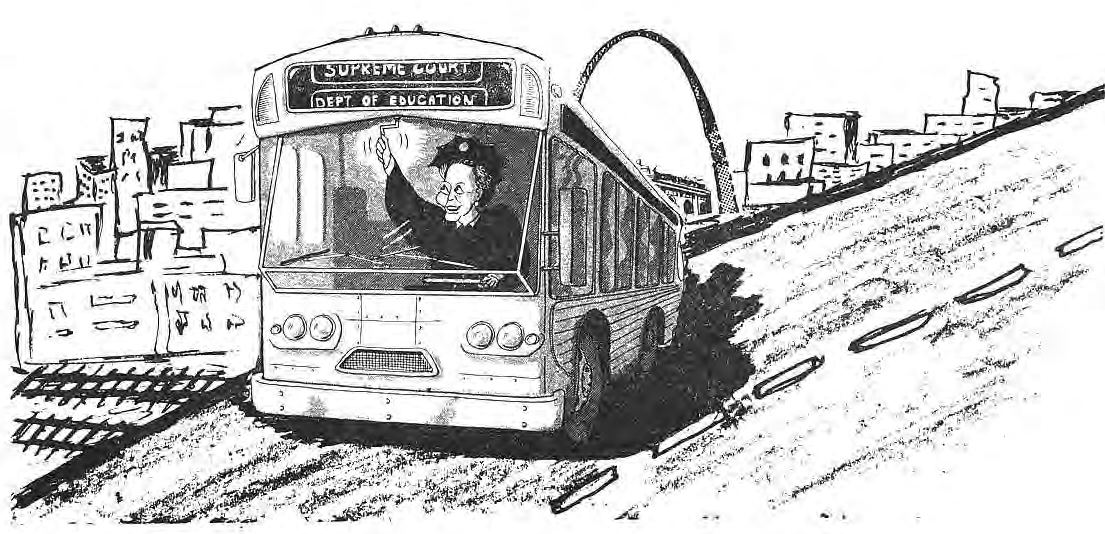
Original school-bus illustration accompanying the magnet-school discussion. The Paper, May 1980, page 6. Artist not credited.
Originally published in The Paper, May 1980.
Read this article in the original newspaper issue.
Original source: SD_Times1980_05.pdf, printed page(s) 6; PDF page(s) 6.





