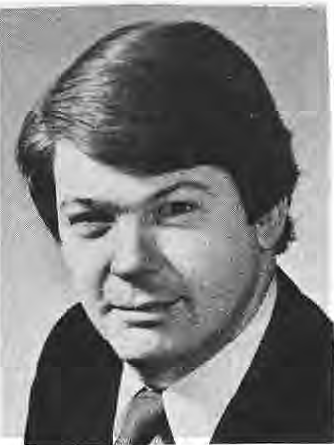
Original editor’s note: An interview with our alderman is newsworthy in itself and seemed particularly timely in light of his declared intent to vie for the mayoralty of St. Louis. Lest this feature be taken as an endorsement (which is against The Paper’s policy and traditions), Kenneth Kress was assigned to this interview. Mr. Kress is new both to our staff and the neighborhood.
What is your position on redeveloping the properties adjacent to Nina Place? Something has to be done to insure investment. We’ve done a pretty good job to secure reinvestment needs elsewhere, but Nina has been excluded because it has the highest density and is pretty run down. the degree of reinvestment needed is massive. Nina strikes its own environment and so investors have trouble getting loans. You have to find a way to get funds. On the question of eminent domain, I’m willing to try to do without an eminent domain clause, if there is a feeling against it. I’ll follow the advice of the Skinker-DeBaliviere Community Council: I won’t go down to the city council with a proposal that the SDCC is against. What was the study done at Nina Place, and how helpful was it The SDCC got a $21,500 grant from the Community Development Agency and used it to hire Team Four, a professional consulting firm, to do a study. The purpose of the study was to ascertain the physical condition of the area and to get an overview. It was a helpful study. They collected hard evidence and data. and did a lot of footwork just counting dwelling units. They also surveyed the people of the neighborhood. After the study the SDCC set up a special committee— half of whom were from Nina Place. This committee reported to the Council, and there is now a 5-member group assessing the report and its recommendations. This group is also putting together its own recommendations. They may recommend that nothing be done: or they may recommend that a private redevelopment effort be started. Whatever they and the SDCC recommend, I will do. Can you explain what is going on with the proposed park by Hamilton School? Sure. I assessed a need in this community for some open space where kids could practice baseball — have a place to play. So I hunted up some money left over from bond issues dating back to the 40’s and came up with $152,000 to buy property. I saw a genuine need for outdoor recreation space. My position is that this neighborhood is not the best planned as far as space. It was planned for the 20’s, but today we have different needs, and we need more space. We started buying up property and relocating people. Everyone being moved was given relocations funds from the city. and most people had been moved before the election came around. It wasn’t an issue until the campaign. I think that once people start using the park, the issue will go away. In fact I don’t think it’s an issue anymore. Right now we’re trying to create a situation where we can put to community use the buildings at Hamilton and Delmar. Perhaps we can move the Community Council. Then we’d have a park and community center in the Washington Heights area. That’s one possibility. The only thing that’s holding us up now is passage of an ordinance vacating equestrian, pedestrian, and vehicular rights. Whenever you are going to tear up a street, you have to vacate these rights so no one can claim that because it used to be a road they can drive on it. After that we can begin scheduling the work. We hope to get the streets torn up and graded this winter, so that by next spring there’ll be an open area — fenced in — for practice. They probably won’t be able to play their games there this spring, but they’ll have a practice field. What is the chance that the city will widen Skinker or make it a truck route? I’ve been opposed to both. That was part of the recommendations of a study trying to project traffic patterns into the 1990’s. But I’ve fought against widening McCausland, which would have to happen first, and the city has pretty much given up on it. I’ve also heard that the city’s source of funds for such a project, the Federal Aid to Urban Programs, has been used up. I think the issues have been resolved in the negative. As for making Skinker into a truck route, that cuts two ways. The people on Skinker will be against. but the people along Des Peres may be for it because it would remove trucks from their street. There’s no bill on it, though, and the recommendation is from a Traffic Commission plan from two years ago. The traffic Commission has been reconstituted since then. I heard that you wanted to ban motorcycles from Forest Park. What has happened with that? The Board of Aldermen passed that bill and it was vetoed by Mayor Conway. We on the board overruled him, passed an ordinance, and it was ruled unconstitutional. The whole idea was to stop motorcycle gangs from gathering in the park, especially around the Opera. They were intimidating people and sometimes it would get so loud with them revving their engines that they would have to shut down the Opera. Judge Ivan Lee Holt ruled it unconstitutional, and it’s being appealed right now. It should be in the Court of Appeals next spring. While it was in effect, it seemed to serve its purpose. We went through the whole summer without any problem. My thought has been to cut off all through access to Forest Park so that all you can do is use the roads to a specific attraction. turn around and come back. I noticed in the Post-Dispatch that you were among a group of aldermen that has proposed declaring the city blighted. Why would this help, and what would it do? What happens now when I want to make some improvements to my house is I have to get a permit. The building permit application is automatically sent to the assessor so that when I finish with the improvements, the assessor reasseses my whole building. A tax abatement means that for the term of the abatement, I would pay the same rate after rehabbing as I did prior. Tax abatement is available to groups, but not to individuals. On the South Side, people see that tax abatement for corporations is necessary to encourage reinvestment, but feel bad that it’s not available to them individually: if they put up a garage, they get reassessed. It discourages them from making improvements. I think tax abatement is a major incentive for reinvestment for a major part of the city: parts are not being redeveloped because of the threat of being reassessed. Tax abatement is defined by State statutes: Chapter 99 controls the taxing authority of municipal authorities. The definition on the books is very vague no specific guidelines. So we feel we could go ahead and declare the city of St. Louis, as a whole, blighted. It’s the opinion of the legal counsel for the Land Clearance for Re-utilization Authority that he would have no difficulty defending a city-wide blight. This would open tax abatement to everyone. If we had done this ten years ago in Nina Place, we wouldn’t be faced with the problems we have now. We’re trying to make this a palatable investment. Once an area is declared blighted, can’t people living there be forced against their will to sell their homes? Well, the authority to grant eminent domain is there [in the blight provision], but you can exclude it. We’ve done that in a number of cases. What about the city’s ongoing assessment of houses? Will that be affected? All we do is freeze the assessment of property improvements. The ongoing assessment takes place in the normal flow, but not for improvements. For instance. if you had a $50,000 house and added a $10,000 garage, when your property was reassessed, only the house would be considered. If the house and garage might have been reassessed at $70,000, but the house alone would be reassessed at $60,000. you get ‘assessed at $60,000. In the Post-Dispatch a while back, I noticed you said you would run for mayor if Paul Simon did not run. Mr. Simon was recently appointed to the Appeals Court, so it looks as though he won’t run. Where are you now? I’m running. What’s happening with the voter survey you were going to start on the 17th of October? We pulled the survey out of the field because three of the questions involved Paul Simon as a candidate. Now we’re changing it to include possible candidates for the president of the board of aldermen. When I get the results, I’ve promised to share it with them. What I’m doing now is just meeting people in business, labor, and neighborhood organizations. I meet about three or four people a day. It is premature. I was trying to position myself so if Simon didn’t run next June, I would be a candidate. Now I’m ahead of the game. Is that bad? Well, it subjects everything you do to scrutiny in light of your declared intentions. People become suspect of your motivations. What did you mean when you said [in the Post-Dispatch] that you would run as a better politician? Mayor Conway is a good planner, very smart. I think he understands the issues as well as anyone else, but Jim Conway would rather fight than eat. He has no capacity for understanding other points of view. He is cold, officious, and pompous. I’m not saying it because I’m running against him. I’m running against him because it’s true. I plan to be just much more of an ordinary kind of guy. I’m not brilliant, not as old— I’m sure he will go to great pains to say. I’ll come out as a reasonable, more open person. That kind of person is mandated by the city. By charter the mayor of St. Louis doesn’t control the money. And the power of patronage is spread out over the 28 wards. In this city the mayor can’t make people do anything. The person who runs it has to be able to compromise and bend: Mayor Conway is just too inflexible. One more thing, I’ve heard talk of changing the street cleaning times in the Skinker-DeBaliviere area. They are being changed to 8 or 9 [from 7 a.m.]. I have a bill in to change it throughout the city. The bill was up for passage when a new director of streets came into office. He promised to change the Skinker-DeBaliviere area, but asked for time to assess what this is going to do for the whole city. The reason for the change is that 7 is just too early. Lots of people who live in this neighborhood don’t get up that early. What do you consider your role as alderman as being? I’m different things in different parts of the ward. In Skinker-DeBaliviere I have very few service requests. If there’s a hole in the street, the people deal with the city directly, and only call me if it’s an exasperating situation. In other parts of the ward people call the alderman to fix things— it’s a tradition. In Skinker-DeBaliviere, I’m here to serve as a facilitator of community wellbeing. I see myself as working out neighborhood problems with an emphasis on physical improvement. I find investment money. find insurance loans, find people to invest in rehabbing, further the progress that is being made.
Original photograph caption
Vince Schoemehl. The Paper, December 1979, page 5. Photographer not credited.
Originally published in The Paper, December 1979.
Read this article in the original newspaper issue.
Original source: SD_Times1979_12.pdf, printed page(s) 5; PDF page(s) 5.
