Original editor’s note: This article is one of three funded by a grant from the Missouri Endowment for the Humanities, Inc., a state based arm of the National Endowment for the Humanities.
This final article of the series offers a technique for implementing what was stated in the previous articles. Our children need to appreciate literature for its mythic and folk content in order to better understand themselves. Michael Lowenstein said, “Because they deal powerfully with being human, poems and stories always offer openings into ourselves that students and teachers can learn to explore.” In supporting and expanding this idea of the importance of imagination, Dan Shea discussed the importance of humanities to living a life of meaning and quality. Humanities, he said, “encourage a child of the present to belong to the past and the future as well.” Knowing how others look at their worlds helps children to know how to remake their own. It is only when a person can put together what many people see that he/she begins to get a fuller grasp of the whole of reality.
Hopefully readers were convinced that these were worthy ideals, but are they attainable? Our local schools are aware of the need to sustain and develop imaginations through the use of words. For example, the Hamilton Branch 3 newsletter noted that the school is having children maintain composition folders and are creating an anthology of the best stories and essays. The Paper has recorded that St. Roch’s has the Great Books Program and is expanding the library’s holdings, and Neighborhood School children played musical instruments and mimed as accompaniment to a dramatic reading of an African folktale, and annually the big kids’ class also writes and performs a Christmas play.
There needs to be a sense of celebration of what it means to be human and a pride in others’ humanity. As Robert Coles has said recently, “The humanities demand that we heed the individual — each person worthy of respect, and no person unworthy of careful, patient regard. The humanities are blues and jazz; gospel songs and working songs; string quartets and opera librettos; folk art and abstract impressionist art; … the sayings and memories and rituals of countless millions of working people; the blunt, earthy selfjustification and avowals of desperate but determined migrant mothers; the wry, detached stories handed down on Indian reservations, in Eskimo villages, generation after generation; the cries of struggle and hope of Appalachia … put into traditional ballads and bluegrass music; … the confident, qualified assertions of scholars; the frustrated, embittered social statements of ghetto teachers or children who at all costs want to get a grip on this puzzling, not always decent or fair world.”
All of these are available through the arts and living fully, but books can make more them accessible and from different perspectives; consequently books play a special part in enlarging the mind and demanding things of readers that movies, television, and live performance usually do not. Lloyd Kropp, a novelist and teacher, has pointed out, “The reader discovers something of himself through that which is not himself, and he creates something which has already been created, and he is conscious of something he cannot see, hear, or touch. It is no wonder that within these labyrinthine paradoxes a good poem or a good novel can often be surprising, painful, beautiful, or dangerous. It is an experience that no one ought to give up merely because watching is easier than imagining.”
The role of the humanist, according to Eric Weil, “is to question unceasingly not values … but the value of cultural objects. He is constantly discovering and eliminating, proposing and rejecting; he elicits new meanings from old works and looks for an understanding of greater depth and wider horizon. He maintains a dialogue with his own cultural past so that he can grasp what is characteristic of his tradition as it lives in his present. His problem is to understand this present by comprehending the presence of the past that has molded him before he started remolding it. He incarnates the cultural consciousness of his time.”
But what of students’ inability or unwillingness to enter into the adventure of education, the quest for knowledge through which one can fruitfully engage in a life of change? Students can be taught how to confront what they read and hear, to perceive in new ways; they need to learn to read for content, intent and utility. Schools already teach various methods for attacking words to expand vocabulary, for understanding what is explicit and implicit on the page, and for applying learning to life. Integrating interdisciplinary concepts and approaches through planned units and experiences has been a popular method for helping children to synthesize what they learn. Yet students become so concerned with right answers and the form of expression that their personal spark of imagination is lost. Every English teacher has seen many students write dead, safe English, what the student thinks is impressive to the teacher. As a consequence, a major dilemma for the teacher is how to teach correct grammar, rhetoric and logic while keeping the individual child’s response original and fresh.
One way is to separate the regular composition work from the daily writing connected with reading. When the students read, they should keep a reading journal, what they liked, disliked, understood, did not understand, felt, and thought about the total story. What is being written down is his/her individual response to the work. And of course in so doing, the child is participating in the creation: a work of art is not complete until it touches a responsive audience. In writing one’s thoughts and feelings down, the individual often discovers what he/she really believes. And that is why so many of us are fearful of writing; its finality and sense of truth is more than most people want to confront. It is too much responsibility, too naked a revelation, requiring a greater trust in ourselves and others than many have.
The beauty of this written confrontation with what one reads comes in the children’s growing acceptance of themselves and ideas as natural, unlike those who see writing as exposure, who expect their ignorance to be found out and laughed at. This acceptance of differences in ideas is accomplished by the children reading to the class what they wrote; this mutual sharing of individual ideas enriches the work of art and provides valuable insight to the teacher as well as additional material for discussion. All the children should participate either daily or at least twice a week, depending on class size, and be a part of mutual discovery of each other. There is no real competition since there is rarely a totally right or wrong response to what is being done. Their honesty is rewarded by the other students’ growing awareness of the richness of the diversity of response.
A way of varying the method is to have the upper grade students discuss their responses, feelings and ideas, gained from the intellectual stimuli presented for discussion — through using Norris Sanders’ six levels of questions or some other full approach — after which they synthesize their ideas with those of their classmates through journal writing while they are excited and in the flush of experience. Thus they break the barriers of fear of writing; they often want to hold onto what is so exciting and stimulating. After some practice they can pull their thoughts together merging what they hear, think, feel and read. The ungraded written results can be used as study notes for later assigned papers or tests, as the teacher desires, or as sufficient in their own right to be shared with the class, expanding the learning experience to its fullest. The student has confronted ideas and merged them with his/her experience and weltanschauung, without the fear of the red pen. And if the reading concerns a different era or country’s way of living, so much the better.
Because this technique is flexible, children can verbally paraphrase poems, stories, plays, movies, TV shows, discuss sporting events, life experiences like field trips or family outings, or observations about scientific experiments; then when the discussion is at its peak, the children should confront the barrage of information through writing, thereby sorting out the experience. Stilted language and blank looks are less likely to appear: instead, there are responses to stimuli. Also as some of the above activities suggest, parents could extend the school’s teaching if they have family meetings where issues could first be written and then read. Or family discussions could also be handled in this way.
This technique is adaptable to the lower grade students as well; these children draw or paint what they hear read to them or what they read; then after explaining their paintings, they might be asked to create another painting, act out, or dance what they painted. Whatever method a teacher can use to encourage the children to experience in mind and body the concepts and experiences confronted in the lesson will help children to begin to learn to synthesize and continue to enjoy their contact with the new.
A person does not truly know what he/she thinks until he/she writes it down. What a person writes, is the result of a confrontation with isolated thoughts and feelings which is also true of artists and performers as well; students are compelled to come to terms with the ideas through organizing them, assessing them, feeling them, integrating them, interacting with them. Thus the students find it difficult to remain detached from what they read and observe, and all learn better when motivated.
Children need to be taught how to confront what they read, see, hear and feel. No longer can it serve merely to have all of them learn how to read and then provide them with popular escape literature to suit the lowest common denominator in order to woo them away from TV. (This approach has helped some students and should be continued for those who benefit thereby.) Greater challenge can be provided to those who can accept the challenge through encouraging them to confront more significant ideas about life as, for example, those which are presented in the masterpieces, the best that is known and thought in the world. And, as a consequence, humanities will do justice to the richness and diversity of cultural life in a nation where people have the courage to say, dance, sing, paint or write what is in their minds and hearts.
Original photograph caption
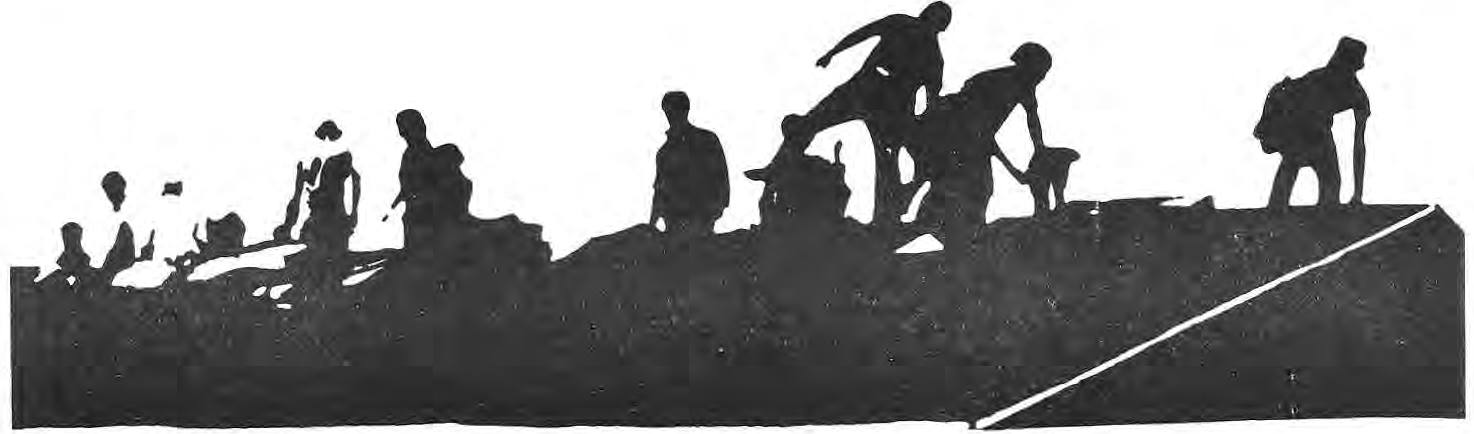
Original silhouette illustration beneath Engaging the Whole Person. The Paper, May 1979, page 9. Artist not credited.
Originally published in The Paper, May 1979.
Read this article in the original newspaper issue.
Archival transcription note: Source prints “books can make more them accessible”; retained as printed for editorial review.
Original source: SD_Times1979_05.pdf, printed page(s) 9; PDF page(s) 9.
