Historical legislative report published in April 1976; describes a proposal and the law of that period, not current law.
The following article by Steve Vossmeyer could serve as a lesson in Modern Govt: Legislative Branch. After Steve wrote it in February he was successful in getting his substitute to the committee version passed in mid-March. The sequence of events occurred thusly: 1) Vossmeyer-Buechner bill 1327 introduced. 2) House committee adopts weakening amendments and sends House Committee Substitute to full House for vote. 3) Steve offers substitute for House Committee version. 4) Steve’s substitute passes. 5) HB 1327. restored to full strength, goes to Senate.
One of my major areas of concern during this session has been in the area of rape law reform.
Rep. Jack Buechner (RepublicanKirkwood) has joined with me in introducing a Resolution in the House which calls for adequate training for dealing with rape victims in emergency medical facilities and to relieve them from the burdens of paying for the accumulation of evidence resulting from such examinations. It would also ask that police specialist be trained in the area of rape investigation and prevention.
But the key proposal deals with the admissibility of evidence in rape trials. The current law allows abuses which prejudice the jury and intimidate the victim.
The Vossmeyer-Buechner Bill, as originally introduced would limit defense examination of the victim’s past sexual activity to activity with the defendant. However, the House Committee adopted the view of defense lawyers that just about anything in a victim’s sexual past is relevant. The Committee thus reported out a bill that may be worse than the present law.
Indeed, the House Committee Substitute for H.B. 1327 on rape evidence reform which is on the Calendar fails to go to the heart of the problem. The sad fact is that a rape trial becomes a terrible ordeal for the victim when defense counsel is permitted to drag out before the Court and public her prior sexual conduct:that juries free rapists not because they have a reasonable [word ending unclear in source] as to their guilt, but because they disapprove of the victim’s private sexual conduct; that a majority of rape victims fail to report the crime to avoid the public humiliation, knowing that there is little chance that the guilty defendant will be found guilty.
The House Committee Substitute for House Bill 1327 offers itself as a “reform”. It is not. It allows the defense to probe “the reputation of the complaining witness for promiscuous sexual activity”. What will be the definition of “promiscuous sexual activity”? Won’t the complaining witness’ reputation… for promiscuous sexual activity” vary from community to community? What relevance is there between what the community thinks of a complaining witness and the question of whether the defendant committed rape? If rape victims still must submit to the humiliation of opening up their private sexual lives to the public, won’t the victims still refuse • to report the crimes? Simply requiring a preliminary hearing in the judges chambers to determine admissibility of the evidence, without changing the rules of admissibility; fails to respond to the basic problems with the existing rules.
Criminal trials are frequently reduced to the contradicting testimony of the complaining witness and the defendant. Numerous procedural and evidentiary safeguards exist to protect the defendant from erroneous conviction, including: liberal cross-examination of prosecution witness’ character for truth and veracity; placing on the prosecution the burden to prove the defendant’s guilt beyond a shadow of a doubt; requiring a unanimous jury verdict. In the vast majority of criminal trials, this is considered adequate to sift out false charges. In a burglary trial, where a defendant claims that he had permission to enter the premises, he may not support his claim by showing that the owner has permitted others to enter on his property. Some say that in a rape trial juries will sympathize with the victim and therefore special safeguards are necessary. To the contrary, studies of jury behavior indicate that juries almost always sympathize with defendants in rape trials, especially when there is evidence that the victim had previously engaged in nonmarital sexual activity with other men. The effect is that women who have engaged in [damaged word in source] sexual activity are not [word ending unclear in source] by the law against the crime of rape.
In this era, that leaves a majority of women openly vulnerable; that leaves a rapist on the streets until he is unfortunate enough to rape a virgin or married woman whose only sexual activity was with her husband. Such a condition is intolerable. House Committee Substitute for House Substitute 1327 will do nothing to remedy this deplorable condition.
When this bill comes to the floor of the House for debate and vote in the next several weeks, I intend to offer a substitute for the House Committee version to restore House Bill 1327 to its initial form. It represents a substantial reform in rape evidence and does much to protect the victim of rape withour hindering the right of the defendant.
Steve Vossmeyer
State Representative
86th District
Original photograph caption
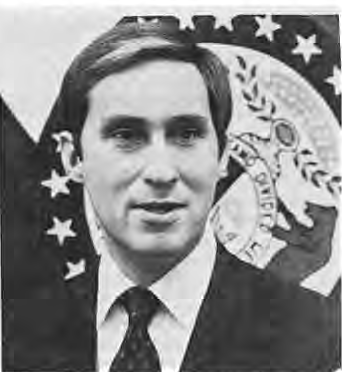
Steve Vossmeyer, State Representative, 86th District. The Paper, April 1976, page 4. Photographer not credited.
Originally published in The Paper, April 1976.
Read this article in the original newspaper issue.
Archival transcription note: Two damaged word endings and one damaged word in the right-hand column are marked explicitly; no text inferred. Printed “beyond a shadow of a doubt” and “withour” retained.
Original source: SD_Times1976_04.pdf, printed page(s) 4; PDF page(s) 4.