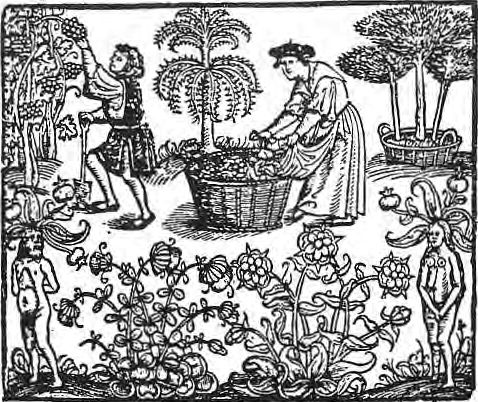
This month we’re not going to write about vegetable or flower gardening, but about herbs and the kitchen. Over the last three or four years, we have established a fairly sizable garden of herbs. Right now we have sage, chives, rosemary, pineapple mint, spearmint woolly apple mint, lemon balm, bee balm, caraway thyme, English thyme, lemon thyme, woolly thyme, and oregano. These are all perennials which come back every year. In addition to these, shortly we will start parsley, dill, and basil from seed.
Herbs are relatively easy to grow and very little space can provide enough plantings to provide fresh herbs through the growing season and a surplus to dry for use in the winter. All of the above are planted in less than 20 square feet.
Herbs are plants whose leaves, seeds, or roots are used to add flavor to other foods. They generally have a long history of cosmetic and medicinal uses as well. But the most important thing about herbs is not growing them, but using them. Here are some of our favorite “recipes” using herbs.
One of the things nearly everyone likes on a hot summer day is iced tea. Plain orange pekoe tea is improved enormously by steeping a few fresh leaves of lemon balm, which smells like lemons, or basil with the regular tea.
Or experiment a step further and try a brew of hot or iced herb tea: Use one teaspoon of dried herbs or two of fresh for each cup, add boiling water to the pot, and steep for five minutes. Try basil, rosemary, balm, sage, or mint for a start.
By the way, the rule of one measure of dried herbs equals two of fresh applies to the recipes in your cookbook as well. In almost all instances, the author assumes you are using dried seasonings with the possible exception of parsley.
Everyone knows the curly parsley that restaurants use as garnish. (It can be eaten as a “breath freshener.”)
Much better than the curly is Italian or flat leaf parsley. It has a superior, and somewhat stronger, flavor, and around our house we add -parsley to soups, eggs, meat sauces, and to the turkey stuffing at Thanksgiving, along with sage, rosemary, and thyme.
If you like Italian food or tomato, basil is a must in cooking. One of the best and simplest summer salads is sliced tomato sprinkled with chopped basil, parsley, salt, pepper, and finally a little vinegar and oil. Again, experiment with 1/2 cup oil. 1/4 cup vinegar or lemon juice, 1/4 tsp. each salt and sugar and 1 or 2 tsp. of whatever fresh herbs you care to try combining to create your own salad dressing at a fraction of the cost of Good Seasons.
If your taste runs to meat and potatoes how about some “grown-up french fries”? Peel and quarter medium-sized potatoes. Pour about 1/4 inch of olive or vegetable oil in a large baking pan, add potatoes, one or two cloves of garlic cut in half, and 3 or 4 leaves of sage. Bake in a 400° oven, turning potatoes once or twice till done. Add salt as desired.
As a final suggestion, try herb butters to use on baked potatoes, steaks, fish, toast; or hot breads. Soften a stick of butter and add one or two teaspoons of minced fresh or dried herbs such as chives, parsley, basil, dill, marjoram, oregano, thyme, or savory in whatever combination sounds or smells right to you. Salt, lemon juice or crushed garlic may be added as well. Allow to stand at room temperature for at least two hours to season well. Herb butters stay fresh in the refrigerator for longer periods than the individual ingredients seem to— that is, if you forget to use them. But then, you may accidentally try to fry an egg in some, or put a dab in the vegetables, or who knows? (We’d like to hear what your favorite use is.)
Would you like to trade-an-herb?
We are interested in finding out what other herbs are being used in the area and perhaps we have some you would like to trade. Most herbs can be easily grown by dividing clumps and they multiply rapidly.
Let us know if you are interested . in trading with, others in the neighborhood.
Original photograph caption
“Gathering herbs from the Grete Herball by Peter Trevies, London, 1526.” Caption as printed in The Paper, April 1976, page 10.
Originally published in The Paper, April 1976.
Read this article in the original newspaper issue.
Original source: SD_Times1976_04.pdf, printed page(s) 10; PDF page(s) 10.





