Historical April 1976 article with period plant-toxicity claims; this archive is not current poison-control or medical guidance.
With the coming of Spring, most people give some attention to their yards and gardens, the planting of flowers and vegetables. Children sometimes don’t understand the difference between an edible and an ornamental plant, with dire results, for many of our common “pretty plants” are also poisonous.
“Play cooking” with fruits from the hedge, or casually chewing a twig, may be dangerous. People’s Clinic has compiled a list of plants not unknown in the neighborhood which are definitely dangerous beauties to be admired or used, but never eaten.
Aloes – all parts Arbor vitae (red cedar, yellow cedar) twigs and leaves Azalea – all parts Bittersweet-green berries or leaves; ripe berries are harmless. Bloodroot – all parts Blueberry – leaves Blue Lupine – flowers, leaves or stalks Boxwood – all parts Calla lillies – all parts Camellia – seeds Castor bean – the large, red attractive seeds Cherry – bark, leaves and pits, especially of wild black cherry and ‘chokecherry Clematis – all parts Cyclamen – stalks, and leaves Daffodil – bulbs Delphinium (larkspur) – all parts Elephant’s ear – all parts Four O’Clock – roots and seeds Foxglove – all parts Grape hyacinth – bulbs Iris – mostly the underground stems, but all parts contain some poison Jonquil – bulbs Laurel – all parts Lilly of the valley – flowers, leaves, stalks and roots Magnolia (tulip tree) – seeds
Mistletoe all parts, but especially the berries, are poisonous Mock Orange – the fruit Narcissus – bulb Oleander – leaves, flowers or bark— poisoning has even resulted from eating food roasted spitted on Oleander sticks. Pansy – the rhizomes Potatoes – seeds, sprouts,leaves and berries Privet – leaves and berries Pyrocantha (fire bush) – berries Rhododendron – foliage and shoots Spanish bayonet (yucca) – all parts Star of Bethlehem – all parts Sweet peas (and ordinary peas) stalks and stems Tulips – bulbs Violets – rhizomes Yew – both Japanese and English varieties – the leaves and berries
Nobody would want to give up a handy kitchen-window “burn plant”, the aloe, on the off chance that it might be eaten by mistake. The remedy to life in a pretty, but dangerous, garden is not to uproot the garden, but to teach children not to eat ANYTHING (from plants to marbles) that has not been identified to them by an adult as being specifically a food.
Original photograph caption
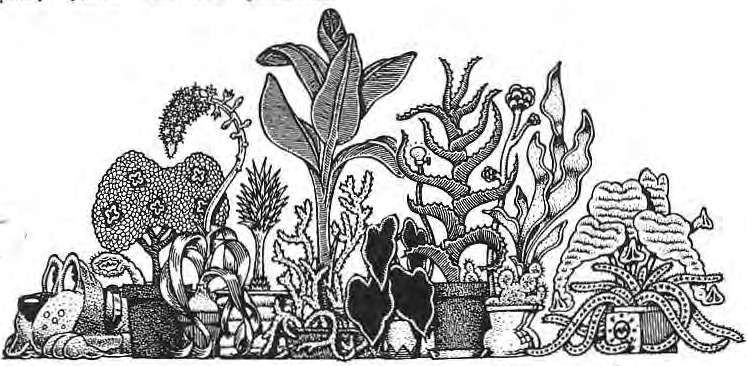
Plant illustration accompanying “Dangerous Beauties.” The Paper, April 1976, page 9. Illustrator not credited.
Originally published in The Paper, April 1976.
Read this article in the original newspaper issue.
Original source: SD_Times1976_04.pdf, printed page(s) 9; PDF page(s) 9.