It was the best of times and it was the worst of times. Thus went our garden in 1975. Some things produced very well and others were near or total failures. Green beans, tomatoes, and peppers produced extremely well. The peppers especially were loaded with fruit and blooms when we got the first killing frost. Broccoli produced some, but it was not outstanding, and I discovered once again that you can’t grow much of anything in total shade and poor soil. Win some, lose some—and last year, a lot got rained out. One of the interests of gardening is that each failure produces some new learning to apply next year.
Now is the time to get ready for the gardening season, whether it’s flower, herb, vegetable, or some combination of these. This year I have a good supply of well-rotted compost which will be applied liberally to flower beds and garden plots.
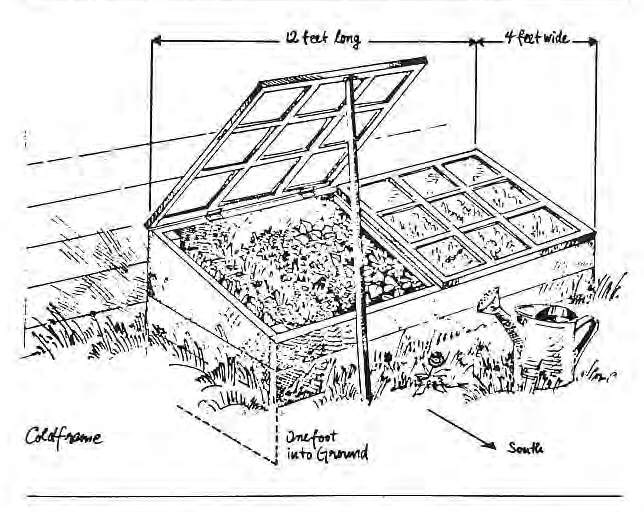
The major new garden project for this year is to build a cold frame. A cold frame is a sort of miniature green house without artificial heat. Cold frames rely on the heat of the sun to raise soil temperature during the day and release it slowly at night. By using a cold frame, you can start seeds for flowers or vegetables outside well before they could be started without the boost of heat a cold frame provides.
By March the cold frame would be a good place to start marigolds, petunias, salvia, other summer annuals, and herbs, which can be moved to their permanent location in late April and early May. The frame is also a good place to harden plants, such as tomatoes, you started inside back in February. In the fall the frame can be used to grow lettuce, radishes and other small, cool weather vegetables for several weeks longer than is possible without it.
A frame can be built from scrap lumber because it isn’t high or especially wide or deep. The basic dimensions are set by the space, materials and needs you have. The sides need not be over 12-14 inches high, no higher than 24, with a slope from back to front so that water will drain. The front to back measurement should probably not exceed 3-4 feet. Remember, you have to be able to reach the back. The length depends upon what you cover the frame with. I found three old windows with the house which don’t belong anywhere. These are great for cold frames. A good cover can be made from fairly heavy clear polyvinyl sandwiched between a thin wood frame.
The location of a frame is very important. The best location is where the frame receives direct sun most of th day and faces south with protection from the north or windy side. In my case, this means up against the garage.
Now for soil preparation. The best soil would be a sandy one. (Remember how warm beaches are.) Next best is any good garden soil with lots of compost. Clay makes a very poor soil because it doesn’t drain well and warms very slowly.
The frame can be a permanent installation or a removable one. This depends on the space available and carpentry skills of the builder. Mine will probably be removable for both reasons.
Now that you are all enthused and going out to garden in a cold frame, don’t forget some things which can be planted right now, or as soon as the ground is workable, directly in the garden. Lettuce, radishes, carrots, spinach, and most relatives of the cabbage family like it cool, so now is the time. Lettuce, radishes, and spinach are especially good, because they grow fast and let you use the space again for another crop like beans during warm weather.
Next month: some more on my gardening efforts and the “trade-anherb” plan. Anyone interested?
Original photograph caption
Cold-frame sketch. The neighboring Green Guides column credits The Organic Gardener by Catherine Osgood Foster (Knopf, 1972) as its source. The Paper, March 1976, page 5.
Originally published in The Paper, March 1976.
Read this article in the original newspaper issue.
Archival transcription note: The source prints “most of th day”; apparent printed error retained.
Original source: SD_Times1976_03.pdf, printed page(s) 5; PDF page(s) 5.