Just before Christmas seems to be the right time to discuss imprinting sex role stereotypes on children. Psychologists tell us that in the first seven years of life the child’s core of personality is formed and that 50% of a person’s intellectual capacity is developed by age four. These two facts dramatize the importance of early childhood experiences. It is my contention that a boy who is made ashamed of his interest in playing with dolls will have difficulty adapting to fatherhood. A girl who is never allowed to use toy tools or help with repair jobs will probably never learn the difference between a wrench and a hammer. Both men and women are severely limited by the kind of mental baggage they carry out of childhood.
The answer? Let kids be themselves. Let them pursue their interests without imposing restrictions like “Girls don’t play with that” and “Boys don’t do that.” You needn’t worry that your children will grow up with confused images. They will have parents and teachers as models. They will be bombarded with messages of masculinity and femininity from the mass media: They will get the idea all to clearly of our society’s expectations for them! But they may be able to throw off some of the more extreme stereotypes if their early experiences have ones of acceptance. And, if Mom and Dad are secure in their roles, chances are that the kids will be.
Often pre-schoolers without sex role stereotypes have difficulty dealing with the comments made by chauvanist playmates. The best defense (and a good exercise in assertiveness training) is to teach your daughters and sons the reply “Girls can do anything they like to do and boys can do anything they like to do.” Teach it to them by rote. Give them the proper inflection of child-like scorn so that it is spoken like a truism! Use this phrase yourself when the children are around you. (Once two little boys for whom I babysit told my daughter that she couldn’t play army with them because it was “for boys only.” When I told them she could play if she wanted to, they decided to quit. That turned out to be the perfect solution as I was not thrilled by the game in the first place!) Children around my house play dolls, jump rope, build clubhouses, play monsters, and do all the things kids do without regard to boys’ games and girls’ games.
Another verbal exercise I practice is to avoid the suffix “man” on job titles. It is not fair to imply that all the work done in society is done by men. Also, girls may want to grow up to do those jobs. We have given all the “Community Helpers” non-sexist titles: letter carrier, fire fighter, police officer, trash collector, sales clerk, gas station attendant, to name a few. Besides enlarging your child’s vocabulary, these are actually the correct titles for some of the professions.
I try to choose non-sexist books and materials for my children. Toy manufacturers are beginning to put both boys and girls on packages or leave off the children and simply picture the toy. Check books to see if girls are always sitting down and pursuing ladylike activities and boys are shown having great fun and adventures. If a toy is blatantly sexist, write the president of the company (you do not need to know his name), and tell him that you would have bought that tool chest if it had not had a picture of three boys on the box. I have done this often and gotten very friendly replies from company presidents saying they were concerned and were turning my complaint over to their advertising agency or packaging department. If enough people write, things get changed.
A good gift for Christmas in a house with young children is “Free To Be. . .You and Me” either the record or the book. We have both and they are great favorites. The stories, songs and poems are really classy and my kids have many memorized. Moms, you will adore the poem “Housework” yourselves. The Des Peres Library will have the movie (which was made from the Emmywinning tv special) during the first week in January. It will be shown after school on Wednesday, January 7 and during the Story Hour on Friday, January 9. Come by and see it.
Have a good Christmas and use this opportunity to help your kids to avoid stereotyping.
Original photograph caption
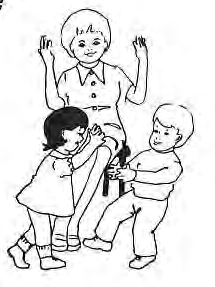
Original illustration accompanying Unisex in the Nursery? The Paper, December 1975, page 2. Illustrator not credited.
Originally published in The Paper, December 1975.
Read this article in the original newspaper issue.
Archival transcription note: The source prints “all to clearly” and “experiences have ones of acceptance”; apparent printed errors are retained.
Original source: SD_Times1975_12.pdf, printed page(s) 2; PDF page(s) 2.





