In June 1972, the People’s Clinic began in response to a growing demand among some neighborhood people for accessable, primary health care services. The project was initiated by neighborhood people, who then enlisted the support of medical professionals. Why did the consumers take the initiative in meeting the problem? If there was a need then where was the regional health department? Where were the regional health planners, the hospital administrators, or the doctors? When in 1972, the Clinic’s founders were trying to enlist support for the project a local doctor argued, Look, if there really were a need for a neighborhood clinic, the Board of Directors of nearby St.—Hospital, being informed and concerned people, would start one. Well they haven’t started a clinic so there must not be a need for one. His argument, aside from being illogical, is an example of just how out of touch the health care establishment is with people’s primary medical needs.
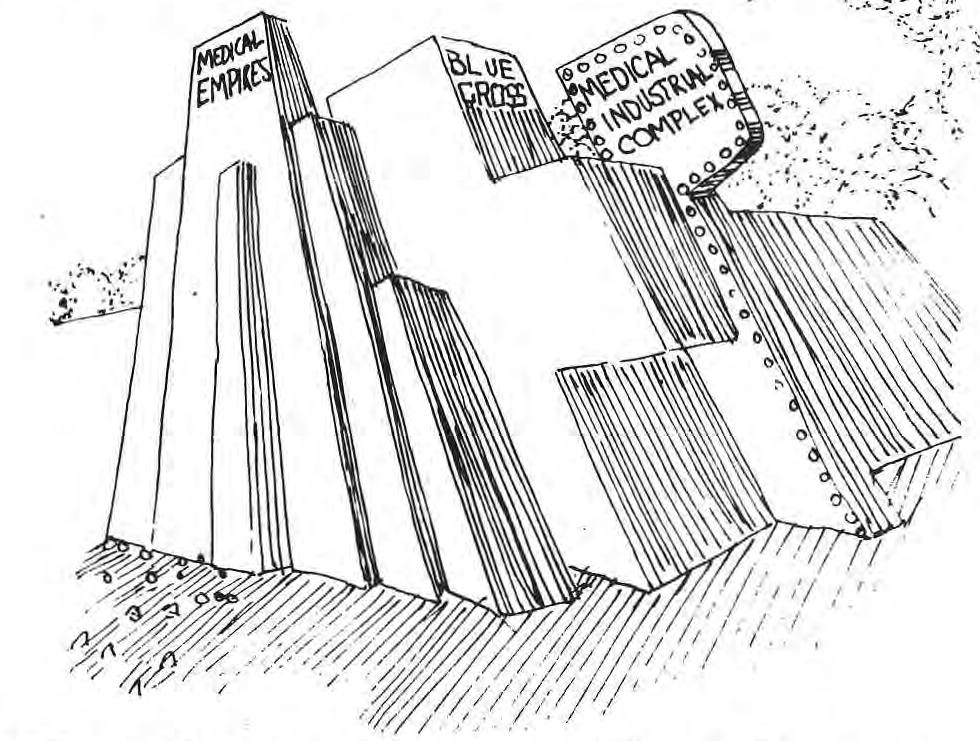
With an annual budget that is rapidly approaching $100 Billion, the American Health Empire is caught up in future shock of its own. The central issue of this future shock is that the system has become increasingly specialized, fragmented, and costly to the point where it can no longer keep up with the changing health needs and demands of our citizens.
The American health system is deeply in trouble and is frantically trying to figure a way out of the mess it has created. There seems, these days, to be an almost endless proliferation of new proposals for reorganizing the system, and among these are proposals for returning the focus for services out of the big medical centers and back into the neighborhoods. These proposals are almost invariably initiated by consumers who are demanding reforms from a health care system which appears, to many people, to be more concerned with its own well-being than with the public’s health. This article will trace the historical development of the process by which the system got itself in the mess it is in today.
In 1910, the Flexner Report exposed the largest problem facing medicine at the time–the incompetence of its practitioners. As a result of this report, a large portion of the diploma mill medical schools and apprenticeships were closed down and surviving medical schools were integrated into the universities, where medicine could take advantage of the knowledge of modern science.
The resulting explosion in knowledge caused new problems. One outcome was that it has become impossible for any one person to learn everything known about medicine. So medical students had to specialize.
Another outcome was an increase in the need for medical care. New knowledge saved lives, so people now tended to live long enough to experience chronic diseases. Also, new knowledge meant that more diseases were now treatable instead of being in the, Gee, that’s too bad department.
Also, since the physician is more knowledgeable than he was fifty years ago, people now seek medical care for things that earlier would have been left untreated.
The growth of technology has resulted in highly sophisticated diagnostic equipment, and new, skilled medical personnel. One result of this intensified work has been to increase the scale of organization.
The typical location of medical practice has shifted out of the home and into the office; and out of the office and into the hospital and large clinic. The main reason for this shift in location is greater efficiency for the doctor. In the hospital, he wastes little time traveling and has scores of technicians, with elaborate equipment, to assist him.
From the standpoint of the person seeking care, a by-product of the increasing complexity of care has been the fragmentation of service. Getting medical attention is no longer a simple task of seeing a physician. Now, the client often has to be able to make a preliminary diagnosis of his problem and be pretty knowledgeable of the system so that he can be able to determine the most appropriate place to seek help.
All this is to say that in spite of greater technical knowledge and more sophisticated organizations for mass processing patients, medical care has become more and more remote for the public.
Another problem is that costs have skyrocketed beyond belief, especially hospital charges. Hospitals, as the centers of diagnostic expertise, compete tremendously with each other for your (and your doctor’s) business. How do they compete? By building luxurious new buildings and installing elaborate equipment to keep ahead of the hospital down the street. So, instead of cooperation with each other by sharing equipment and services, the hospitals are caught up in wasteful overconstruction and duplication of services. Vast amounts of your health dollars are wasted in this way. And your cost of running from specialist to specialist, and then waiting for hours, is probably considerable.
Medical costs are rising so rapidly that even the insurance mechanisms are threatened with bankruptcy. As long as the people who run the health care system insist on keeping the system competitive instead of cooperative, working Americans will continue to bear the heavy burden for this waste.
But the consumers are becoming increasingly unwilling to support a health care establishment which is too slow in responding to their needs.
We have seen that the focus of health care has shifted out of the home and neighborhood and into the hospitals. The resulting fragmented and expensive hospital-based services are becoming less and less appropriate to America’s changing health care needs.
Can we expect the providers of care to lead the way in developing neighborhood-oriented health care services? Many people feel that the providers, preoccupied with their status in a competitive health care market, have already lost the initiative to consumers.
People in thousands of communities throughout the country are beginning to vigorously demand that the health care providers either serve the public’s needs–or get out of the way.
In many communities, such as our own, people have started their own health services. These neighborhood clinics are not adequate for ALL our health care needs. They ARE a realistic place to start, however, and they can provide an organized base for educating hospital administrators and Boards of Trustees about their responsibility to society.
The health care system exists under the pretext that it is a social institution created by our society to serve our people’s health care needs. Instead, it has developed into a costly (and highly profitable) business which protects its self-interest behind a veil of mystique. And the mystique is wearing thin.
If we are to remold this social institution to serve people’s needs, perhaps the first step for us as health workers is to continuously dispel the myth that medicine is difficult.
The most fundamental task of any health worker should be the education of the client.
In the People’s Clinic, by encouraging the patient to actively participate in his own treatment and to ask questions, it is more likely that the problems which CONCERN him will be treated and that the treatment will be understood.
Best of all, the person learns what he has a right to expect from people whose job it is to serve his health care needs, whether that occurs in our neighborhood health service or in a hospital.
An awareness of our health rights leads to demanding our rights. And its going to take all of us pushing from all sides to turn this wayward health care system around.
Original photograph caption
Original medical-system illustration. The Paper, February1975,page4. Artist not credited.
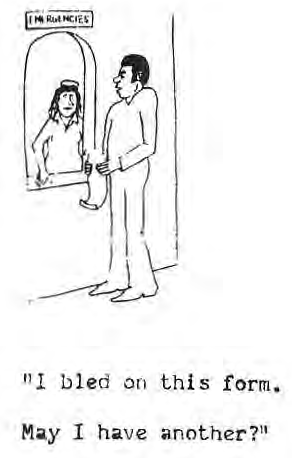
Originally published in The Paper, February 1975.
Read this article in the original newspaper issue.
Archival transcription note: The source prints “more diseases were not treatable”; the apparent printed error is preserved, not silently changed to “now”.
Original source: SD_Times1975_02.pdf, printed page(s) 4; PDF page(s) 4.