The state of the economy has nearly everyone wondering what to do to reduce expenses. A necessary expense most of us would like to cut is food. One way is to grow your own. Moving to the neighborhood from southern Illinois, the only sacrifice we felt we made was giving up a large yard and garden. At first it looks like a city lot is too small for growing food, but it’s not. For those of you who have been thinking about a garden (and those who haven’t), we would like to share some ideas on what can be grown in a limited space.
Let’s start with sidewalks – not to tear them out, but to border them with something good to eat – like strawberries. the plants are low-growing, green the year-round, require a minimun of care, and the year after they are planted will produce about one quart of berries per plant. Strawberries planted 18 inches apart on both sides of a 10-foot walk will produce about 14-15 quarts for less than one-fourth the cost at the supermarket. Mulch the plants with grass clippings during the spring and summer and cover with leaves after the first freeze; strawberries then will bear year after year.
Another fruit that costs only slightly less than gold in the stores is the blueberry. But if you have a place where you have been thinking about a hedge, why not think about a blueberry hedge? The plants are attractive and may grow as high as seven or eight feet. Blueberries like an acid soil, so mulch them with pine needles and in three or four years pick blueberries.
Everybody likes tomatoes, and, although you can’t plant enough to make ketchup (we made it once and figured the cost at over $1/pint.), three or four plants will produce lots of tomatoes. The plants like sunshine and will grow pretty tall! The back edge of the flower bed might be a good place for them. There are a couple of varieties that produce smaller tomatoes that will grow in large pots. Patio is one which produces smaller than average tomatoes, and Tiny Tim is an easy-to-grow cocktail tomato.
Green peppers will grow just about anywhere that a tomato will, but the plant will only get 2’/s to 3 feet tall. It is a beautiful dark green, and four or five plants in a flower bed will give lots of green peppers. If you have too many, freeze them and use them for stuffed peppers next winter.
If you are a rose fancier and would like to reduce the insects that attack roses and grow something to use in the kitchen then try garlic. Insects hate garlic! The bulb, you buy in the grocery store is fine for planting. Plant the individual cloves, not the whole bulb. While it is growing, it looks like an onion, though not quite as tall. After the tops turn yellow and dry (about August), dig up the clove you planted in March, and there will be a whole bulb of garlic.
How about salad? Radishes and lettuce both like cool weather, grow fast, don’t mind shade, and taste delicious. Plant them anytime after March 1 (They will stand a frost or two.), and thirty days later, they should be ready for harvesting. Along the fence, the edge of a flower bed, or that little square of ground by the back steps that is hard to get the lawnmower into are good places for either of these crops.
If your yard is fenced, you might try pole beans (snap or lima) or cucumbers. Pole beans are supposed to climb, and with just a little encouragement and an occasional piece of string, cucumbers can be convinced to climb. Chain link fences are perfect, but a wooden privacy fence with nails and heavy twine to form a trellis will do just as well.
Fresh herbs add a lot to flavoring to a meal and take up very little space. Out favorite is basil, the lettuce-leaf variety, which can be grown in a flower border in full or partial sun or in 12-inch clay pots. Try it in spaghetti sauce, pizza, green beans, or brew in iced tea for a start.
Another herb that grows well in pots is parsley. Set the pots on the porch steps or anywhere else you might put ornamental plants and ship fresh herbs all summer and fall. We also grow thyme, chives, sage, marjoram, oregano, and borage which, if permitted, all produce blooms in shades of blue or purple.
In addition, mints and lemon balm can be grown in pots or borders. A square foot or less for each will probably produce enough for most families and possibly enough to dry for winter. The aromas are at least as appealing as most flowers, although for some reason, insects dislike the scent and stay away.
Now is the time to do the planning. Look at the back, front, and side yards, the front porch or balcony for those little odds and ends of space where a lettuce patch or two or three tomato plants could go. Think about your fence covered with beans or cucumbers. Think about your lowered grocery bill. Strawberry shortcake for everyone!
Original photograph caption
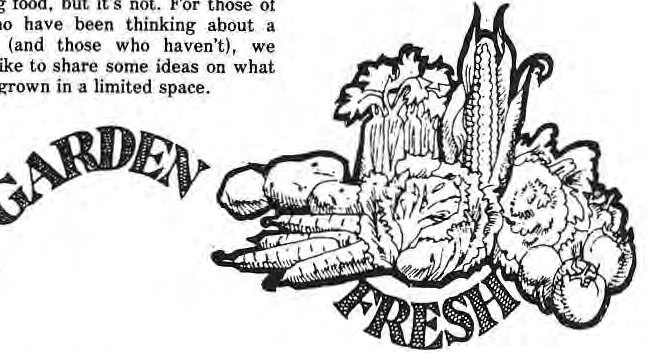
Original Garden Fresh illustration. The Paper, February1975,page7. Artist not credited.
Originally published in The Paper, February 1975.
Read this article in the original newspaper issue.
Original source: SD_Times1975_02.pdf, printed page(s) 7; PDF page(s) 7.





