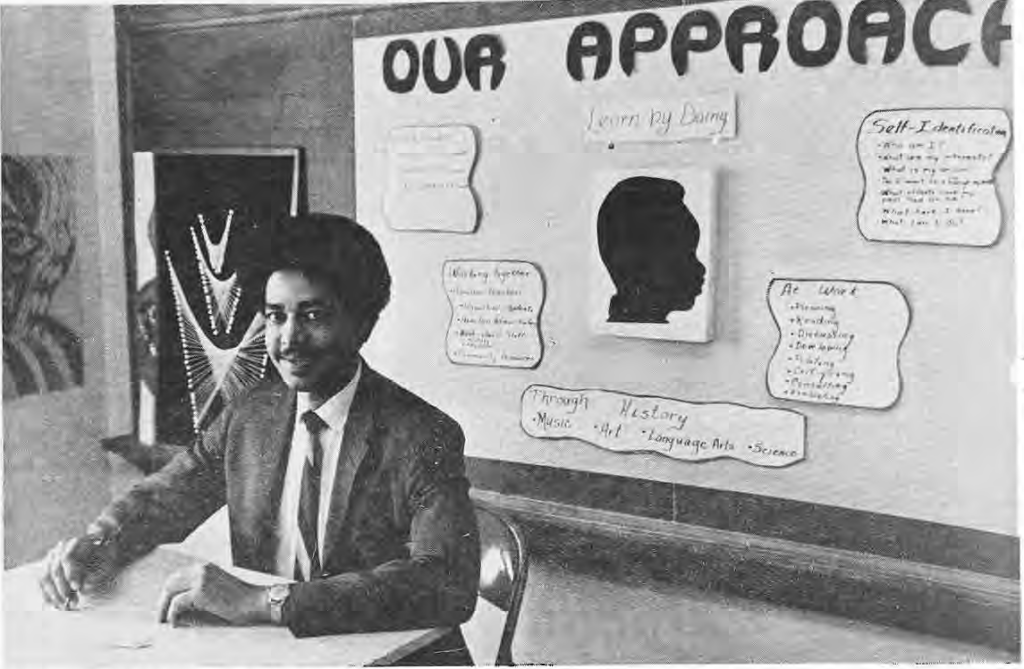
People's School, Experienced Teacher Fellowships, Black Studies Curriculum. These phrases are bandied back and forth in our neighborhood, and may bewilder some people. A good way to learn what they mean is simply to meet one of our neighbors in whom many of these words and phrases find a resting place.
Tall, strikingly handsome, with a middle-sized Afro-cut, a trim moustache, and an engaging way of talking, Shellie Jordan plays several key roles in our community as an educator.
Originally from South Pittsburgh, Tenn., educated at Hampton Institute, Tennessee State University, and most recently, at Washington University, he began his work in these several capacities at Hamilton School last summer.
As Coordinator of the People's School, an all-volunteer community school that meets week-day nights at Hamilton School (main branch at Westminster and Hamilton), Mr. Jordan serves as "a resource and contact man", trying to set up requested courses by matching resources available with the indicated need. He is also a representative for Trainers of Teacher-Trainers (TTT), a program offered at Hamilton School to improve the quality of elementary and secondary teaching.
In addition, he is Projects Director for the development of a junior high-school level Black Studies Curriculum, which is also housed at Hamilton School.
On a recent frigid Monday night, Mr. Jordan talked with me about these various roles.
We started with his role in developing the black studies curriculum at Hamilton School. "The basic objective," he said, "is to encourage a sense of identity and pride in black culture. The curriculum is being developed to supply materials that have been lacking, to correct stereotypes, and to dissolve myths."
"Africa, as a continent, for example," he continued, "isn't one solid jungle, but a land of considerable geographic variety and with a great diversity of peoples. Everybody should know this, but black people especially, since that's where their ancestors came from."
Mr. Jordan works with four seventh grade social studies teachers at Hamilton School in the preparations for the new curriculum, which he plans to have completed by the end of the current school year. The program is part of the History Education Project set up by the U.S. Office of Education. In the "TTT" program, two teachers at Hamilton are currently doing graduate work, part-time, through Experienced Teacher Fellowships from Washington University, which sponsors the program. The purpose of "TTT", Mr. Jordan explained, "is to show how a local university and a local community school can evolve a better way of training teachers."
Mr. Jordan's most open-ended role, however, seems to be coordinator of the people's school. So far, he said, courses like typing and sewing have been getting regular attendance, but added that supplying the necessary machines has been a problem. "We inherited seven sewing machines, but five need repairs," he notes.
A different problem concerns the storage of the typewriters. While twelve typewriters were pledged by potential donors, the school was unable to get insurance on more than three of the machines while they would be housed at Hamilton. "It's a nuisance," Mr. Jordan added. "A lot of us carry our own machines to and from the building."
Other courses, like black literature, enjoy a steady attendance. The black history course was in progress while Mr. Jordan and I were talking.
"We're hoping to get our art course (drawing-painting-sculpture) going for the second semester," he said, "but it's hard to get teachers who can stay for the whole sequence. One problem is filling in for the nights when the teacher can't show up."
Some of the proposed courses have been highly specific. Two courses that didn't survive were, "Welfare Rights" and "Tenant-Landlord Responsibilities." A new service anticipated for the People's School is a baby-sitting operation which could be set up in a classroom while the parents go to class.
The main problem for the People's School, Mr. Jordan said, was "to locate people in the community who will serve as a leadership group."
As we ended our talk, I mentioned that he seemed tied down by all these commitments, putting in days plus several week-day evenings.
Clutching his typewriter, which he'd lugged from the building, he said, "No, I manage to keep week-ends pretty clear. But you know, what really makes it all worth it is the people I work with. They're really great. And it's exciting to be involved with new projects that seem to be fulfilling a real need."
And with that I finally let Mr. Jordan relinquish one of his many roles — at least till the next morning.
Original newspaper source
Originally published in The Paper, February 1971.





