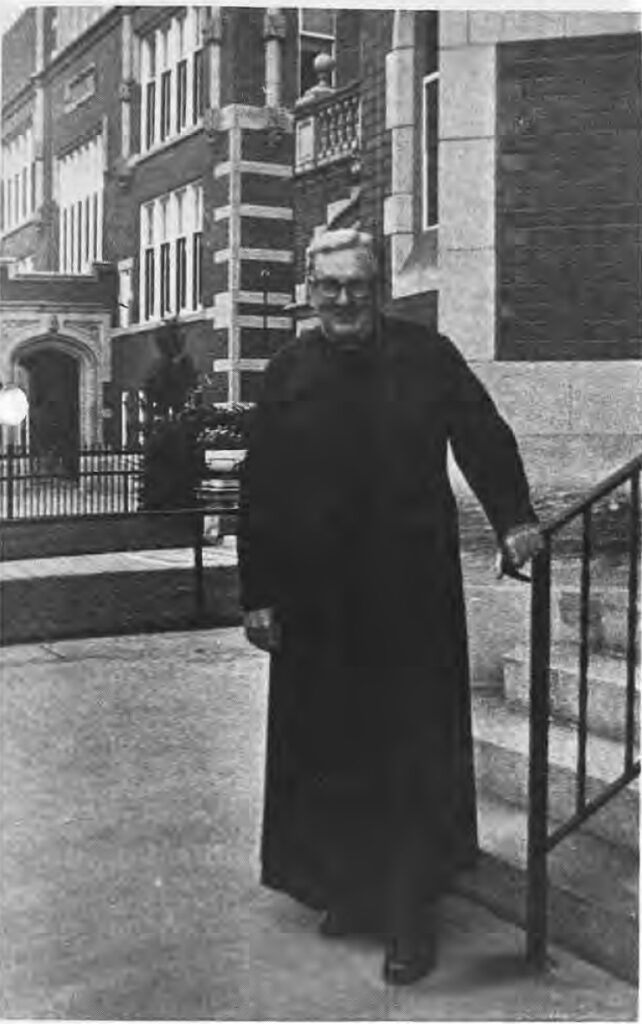
"If we don't win here, St. Louis will be shot." To those who know him only slightly, this metaphoric mixture of riverboat gambling and firing squad drill might seem a bit harsh coming from Father Robert Peet, pastor of St. Roch's Church. Eminently congenial, a lover of song and an occasional game of golf, frequenter at parish fests, he may seem to be what his name often suggests to those who first hear it: "Father Pete," friendly vicar from this end of town, a throwback to Bing Crosby-Barry Fitzgerald movies of yore. But this image only expresses a fraction of the man. A St. Louisan all his life, from a family of nine children, thirty-six years a priest, Father Peet has found his last eight of these years, at St. Roch's full of the kind of challenge represented by his sober motto at the top of the paragraph.
Father Peet may well have brought to St. Roch's the kind of temperment that is suited to "the problems of a changing neighborhood." Soon after arriving at St. Roch's, he issued a declaration condemning racism which was apparently upsetting to some of his people. There were those who later accused him, a veteran of Selma, of "bringing colored people into the neighborhood." There were also those who don't find the liturgy at St. Roch's quite "hip" enough, yet Father Peet has permitted an experimental mass to be regularly scheduled in the school basement. A member of the original ecumenical committee for the diocese, Father Peet has actively sought to develop ties with neighboring Grace Methodist and Delmar Baptist churches. He commented recently on the possibility of "ecumenical parishes in the future, working as a unit, in which the worship could be different, but with some common prayer." While such talk might not thrill the pulse-beats of the SDS, the social implications for the neighborhood seem significant.
Father Peet's interest in getting people together is reflected in his operation of St. Roch's. An executive committee of lay men and lay women helps him supervise the whole parish through a network of committees, for finances and liturgy down through the various parish activities and organizations. The school committee, for example, has recently inaugurated a policy of open enrollment, partly as a result of a dip in the parish population. Although Father Peet feels that the tuition involved may make such education prohibitive for many, the new plan will be something to watch.
The biggest worry in the neighborhood, Father Peet unhesitatingly says, is fear of robbery. "If people's homes are in jeopardy, they get worried. Older people, especially, get scared," he stated. However, Father Peet counters this grim reality with hopes for continuing dedication and commitment: "This can be solved by a spirit of community, by people watching out for each other. People who care have added the interest that helped resist decay." He finds a great source of hope not only in the active people in the parish and neighborhood, but also in the Skinker-DeBaliviere organization, cooperation between the churches, the interest shown in the neighborhood by Washington University, and in the recently formed West End Townhouse, Inc.
Father Peet's most serious words concern his hopes for the future: "We need a sense of commitment on the part of the young. We need missionaries in our own parish, and we've got to get the young people to make the effort. We've got to get the black in with the white. And we've got to take care of the older people."
Original newspaper source
Originally published in The Paper, September 1970.
Read this article in the original newspaper issue.
Original source: SD_Times1970_09.pdf, printed page(s) 5.
