A nine-year-old boy is reading only at a second grade level even after a year in an expensive private school. As a long shot, his desperate parents send him to Hamilton Branch 3, a school of 20 rooms designed to rescue children from failure in school.
In this case the long shot paid off. The boy is now reading at a Fourth grade level after only a year.
For him and 153 other children from second through sixth grade levels, from all economic strata, from all races, from parochial and private schools, Hamilton Branch 3 is a second chance to make good in school.
All of the children in Hamilton Branch No. 3, a federally financed Title I project at 450 Des Peres Ave., are more than a year behind in either reading, language, or arithmetic (sometimes all three), and have average or above average intelligence.
They stay in the school sometimes a year — as long as needed to help them catch up to where they should be.
“Too, too many times it’s a case where the children were absent or not paying attention when a particular skill was taught,” the principal, Mrs. Geraldine Johnson, explained, “So they go along, experiencing only failure in school and gathering a huge backlog of unlearned skills. This is where we come in.”
TEACHERS WHO MOTIVATE
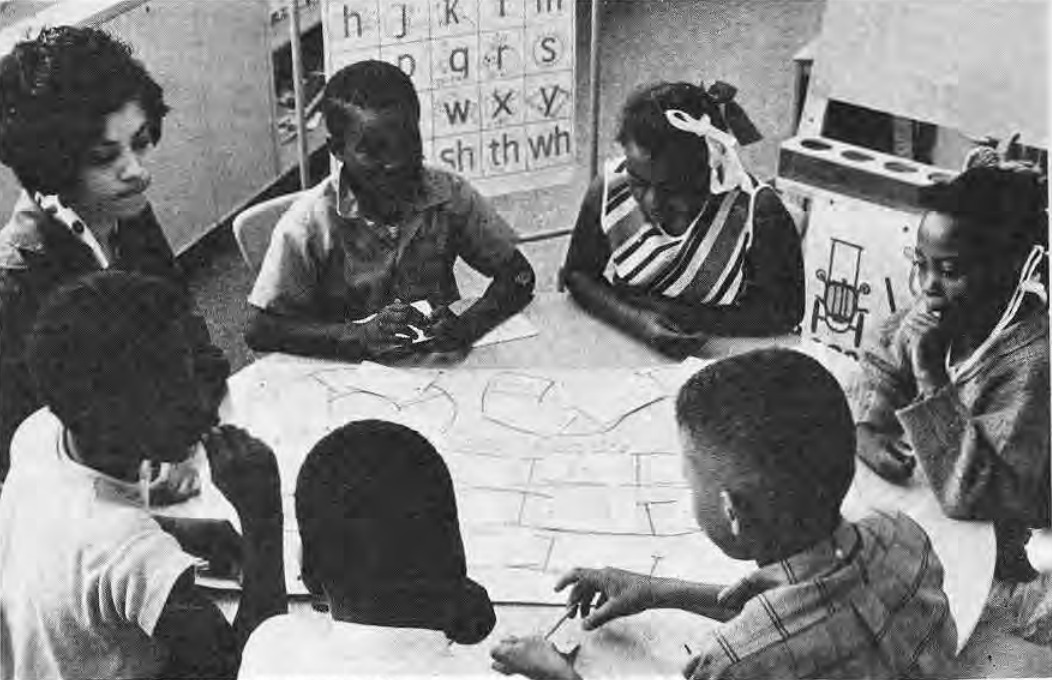
“We have here eight teachers who bend over backwards to motivate these children,” she states. “Don’t get me wrong, we don’t softsoap them. Like alcoholics anonymous, we first get them to understand that they have a learning problem. You see, they’re used to hiding out in a class of 35 children, letting the smart ones answer the questions. They’ve never spoken out. Here it’s different. They soon realize there is no place to hide. Everyone is in the same boat so they eventually try things they never would have before.”
Mrs. Johnson attributes much of the success of the school to its small class size, as well as the inspired teachers. “I can stand in the hall and call every child by name. How many principals in our overcrowded schools can do that?”
Her opinion is borne out by the children, one of whom wrote, “I like Rooms of 20 because my teacher knows who I am.”
BASIC SKILLS WITH NEW TWIST
All the activities are geared around learning the basic skills but with a new twist. Math may be an auction with each student given a certain amount of money which he must keep track of. Another teacher may use relays with teams to learn math tables. Easter is an occasion for eggs which contain verbs or numbers for the primary children.
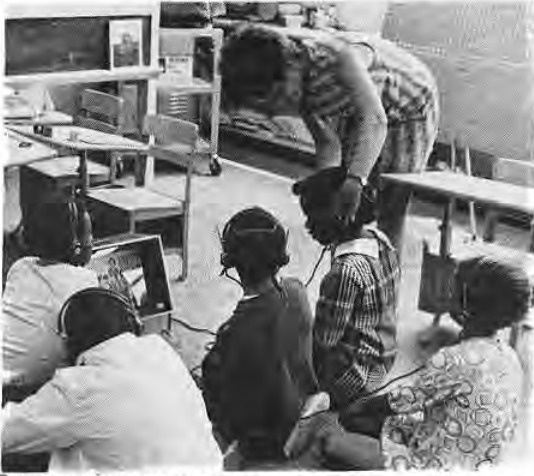
Because the federal money provides the latest in equipment, the teachers are able to use numerous learning machines such as a Dukane projector and a listening laboratory, controlled readers, and cyclo-teachers.
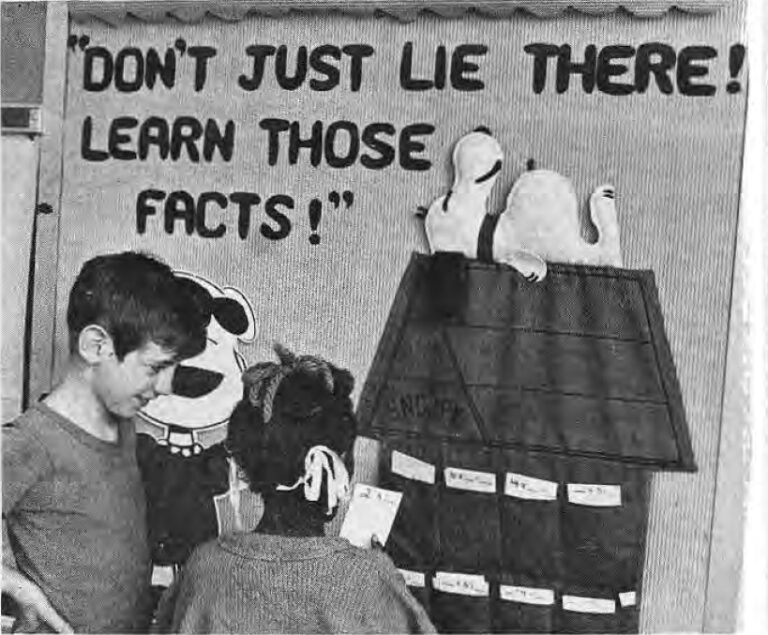
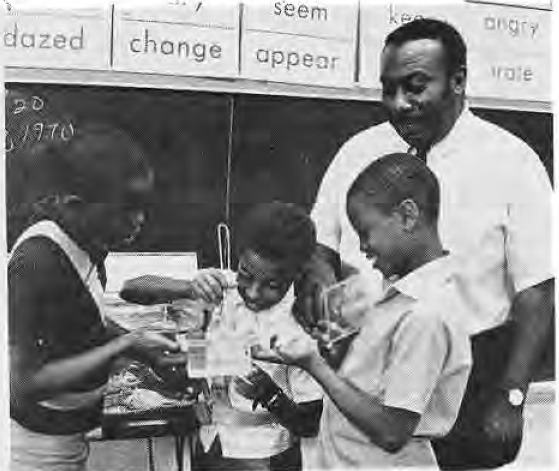
However, some of the best games are those made up by the teachers or purchased with their own money, such as one on black history where each fact advances the student further, a Snoopy dog house where the children pick out arithmetic facts out of various compartments, imaginative games of math monopoly; a time clock which helps the children learn how to tell time, and an aquarium where the children learn both language and science by keeping a log on each fish in the tank.
OUTSIDE THE CLASSROOM
The outside world is also subject for investigation. Not a week goes by that the children aren’t involved in some kind of field trip from Planting trees in front of the new library to the usual Zoo tour and Shaw’s Garden. All classes have had 11 field trips this year.
Parents often find themselves supporting the school with enthusiasm they never felt before for a regular school.
Around Christmas each year they arrive at the school and eagerly pick out educational toys for the children at a “learning festival” planned by the principal.
She explains, “They are going to buy toys for the kids anyway so we’ve devised the learning festival as a way of showing the parents that good toys and games which help the children learn can be as much or more fun than the usual plastic junk.”
Each child makes a list of the toys he likes best and talks to his parents. The toys are provided by companies which give the school a percentage of what is sold. The money goes to provide extra field trips for the children.
Another money-maker is the book fair where the children buy books given to the school for 25 cents to a dollar thus helping the school and taking the first important step to book ownership.
Since, in some cases, the reason for a child’s failure in school can be attributed to his attendance, Mrs. Johnson works closely with the parents to nip attendance problems in the bud.
“The very first time changes occur in a child’s attendance, I call the parent even if he’s at work,” Mrs. Johnson states, “and not once have I ever had a parent complain. Most thank me, even when I call them at 7:30 at night.”
“Being small like we are, we can do a lot of Sherlock Holmes stuff,” Mrs. Johnson says, recalling the time, she with the help of some parents tracked down a gang of boys to an empty apartment and indirectly helped break up a n extortion ring.
Another time she took some embarassed would-be hooky players over every step of their errant route one day. “I learned a lot,” she said laughing, “I learned where the kids hang out when it’s cold and I alerted every store manager on the route to call me when they see a school-age youth at their store.”
As an incentive to the students those with perfect attendance each month get to have a sock hop in the gym on Friday.
STUDENTS COME BACK
Perhaps the best advertisement for the school was a 16-year-old boy who came into the principal’s office and stood politely waiting until the principal recognized him. “Hi, Jim” Mrs. Johnson said, Come back to see Mr. Brown., again?. He’s teaching now, but he’ll be on the playground in 15 minutes.”
Laughing, she commented, “I hear kids consider school a jail. If it is, we sure have a lot of inmates wanting to get back in!”
Original photograph caption
IN MISS LYON’S CLASS even Snoopy helps the children learn in a display which Miss Lyon set up for the children to use when they finish a class assignment. They pick cards with math problems on them from the pockets on Snoopy’s house.
Originally published in The Paper, June 1970.





