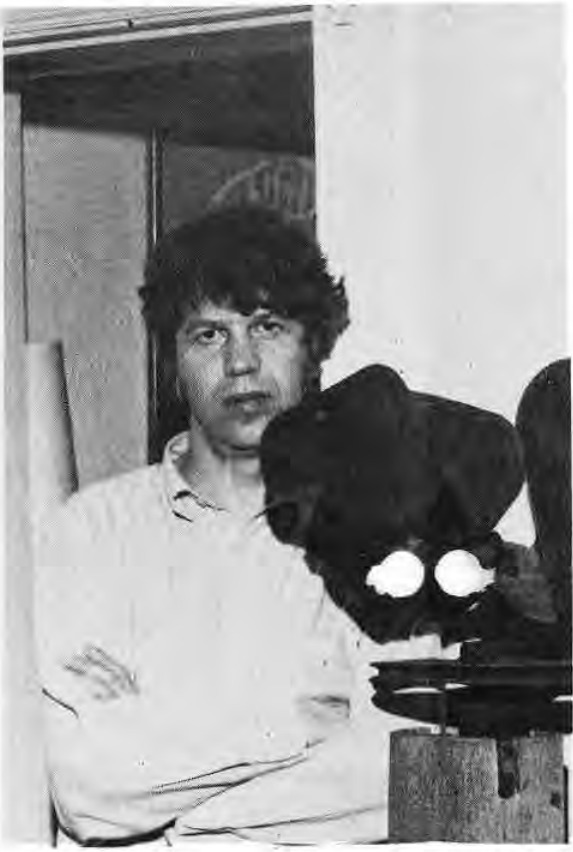
H. Stewart Thompson, at 38 a highly successful architect and a partner in his own firm, expresses what must be called extremely cautious optimism over the preservation of our neighborhood as we know it today.
Stew, who lives the the 300 block of N. Skinker with his wife Judy and four month old daughter, Maris, is a graduate of Dartmouth and the Harvard Graduate School of Design. He came to St. Louis as a designer for the architectual firm of Hellmuth, Obata & Kassabaum. Four years ago he became the Thompson half of Scott-Thompson Architects, Inc., a business which has grown from the original two man operation to the point where it employs a staff of 23 and has nearly $20 million in work in the design or production stages.
As an architect he has formed some definite opinions about the desirability of preserving the integrity of neighborhoods such as ours. And how will our area fare in the coming years? He puts it this way: “First, we all have to realize that we’ve got problems. It seems that, accidentally or otherwise, neighborhoods like ours have been more or less written off by the people who control the money. Bankers are extremely reluctant to loan a young couple money to buy or refurbish houses. I suppose the general state of the economy and many other things enter into it, but even if someone is lucky enough to be granted a loan, the lending institutions want it repaid in full in ten years. That’s kind of tough on a young married man.
“Then, too, it appears that a good many people are caught up in the idea the the bulldozer is the ultimate answer to aging buildings. I don’t think many of the houses around here will ever be called supurb examples of architecture, but they do have an air of solidarity and permanence about them and they present a pleasant picture to the eye. It hurts me to see them destroyed to make room for a service station or a Jack-in-th-Box. I think the most recent controversy over the drive-in and the resulting action by the neighborhood is an excellent example of what can be accomplished when people decide to take a hand in deciding what is being done in their area.
“Revenue for the city is lacking, too, causing most of the services we depend on to be curtailed or cut off. Money is one of the biggest factors and, unfortunately, it doesn’t look like it will be available.”
Stew believes that the preservation of a neighborhood’s life style is just as important as keeping its beauty intact. “The modern urban dweller finds it reassuring when he can wald out of his house in the morning and see the same vista — it’s psychologically important for him to be able to take the same pathwaysto the stores near his home. Our firm tries to do this whenever possible. When we designed the Denverside housing project in E. St. Louis we photographed the area from the air and made the buildings and their arrangement conform to the existing neighborhood.”
Washington University, he thinks, cuuld also do much better fo the neighborhood than it has in the past. “The University has a good architecture School, but it doesn’t become involved enough in the surrounding area. I think it would be a tremendous step forward if they would establish a clinic, staffed by students, which could provide low cost surveys for local residents and help them with the design of their remodeling efforts. There’s certainly a lot of work to be done.”
To sum it all up, Stewart Thompson believes that this kind of neighborhood can survice, but only if its people care to take on the long, uphill struggle to keep it healthy. “Cities are in trouble all over the country,” he said, “and there doesn’t seem to be any outside help coming for a long time. Crime, the tax structure and the attitudes of bankers and government officials all tend to reinforce the current trend towards a mass exodus to the suburbs. But I am encouraged by the number of young people who are sensitive enough to see the beauty of the city and want to keep it alive, If it can be saved, they will do it.”
Original photograph, PDF page 6: Bob Moore.
Originally published in The Paper, June 1970.





