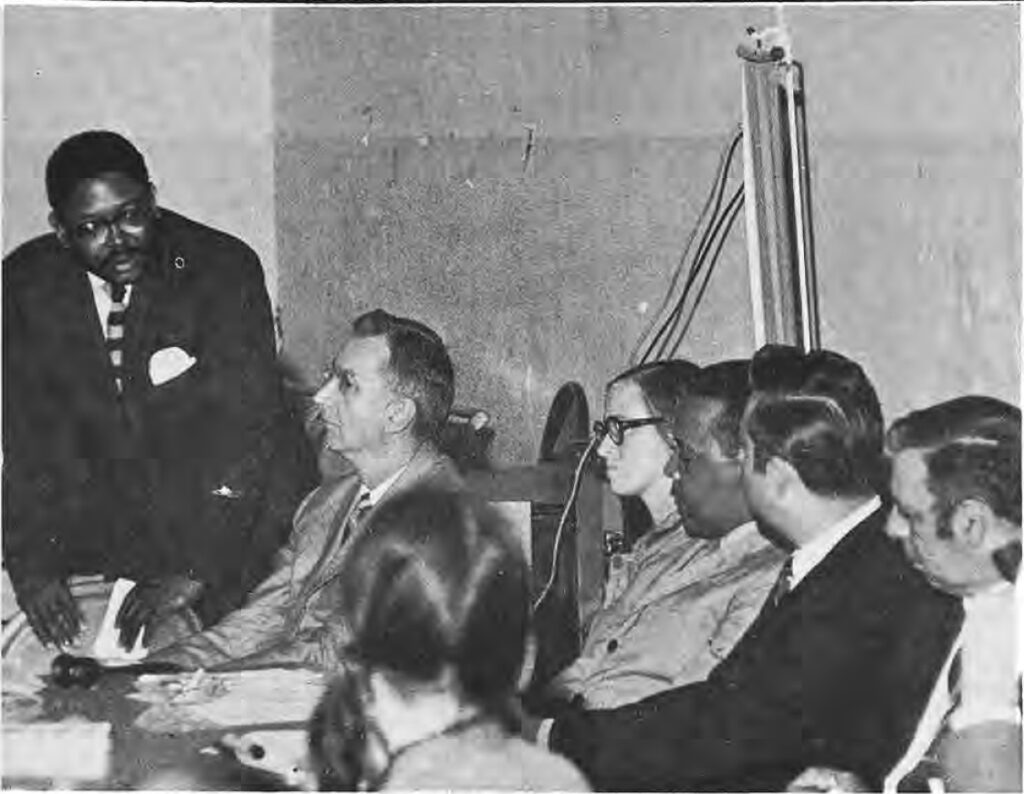
Neighborhood issues, such as clean up campaigns, beautification, even the lingering Jack-in-the-Box problems, took a back seat to the panel discussion on real estate practices in the Skinker-DeBaliviere area at the joint meeting of the Rosedale-Skinker and Washington Heights Neighborhood Associations, April 14 in the St. Roch’s Assembly Hall.
Mr. Rimmel countered that if Title 1, FHA loans were made available to property owners on a long range basis with the amount limited per building rather than per landlord, more could be done to keep property in good conditon.
He also stressed the need for a landlord-tenant ordinance which would make a clear cut agreement of responsibility between tenant and landlord a valid contract.
Mr. Bill Thomas, of the local FHA office which serves the eastern half of Missouri, explained the background and current standing of the locally controversial 235 program. He gave the guidelines and criteria for applicants and emphasized its basic thrust toward new standard housing units. In 1970 only 10% of the available funds can be used for existing properties.
Virgil Wright, of the Neighborhood Citizens Committee expressed concern about the effect of the 235 program in this neighborhood. Despite the noble purpose of the 235 program to make home-owners of the financially depressed, he douted the value of the program when it placed them in drastically overcrowded housing, giving the examples of 13 people jammed into a 3 bedroom home.
Mr. Wright’s questions were echoed in many ways by members of the audience when the discussion period opened.
Why are landlords suddenly not screening tenants so that unemployed are crammed into privately owned apartments? Why are rents higher now that Negroes live in the area? Why are the FHA 235 real estate ad all in currently Negro neighborhoods, with not one in the county, much less near any of the large employers in the county? Is someone in the FHA making arbitrary decisions as to where people can live? In our neighborhood why are there not FHA loans to upper limit families under 235, both Negro and Caucasian?
These questions were put to the panel by Mrs. Susie Roach, co-chairman of the local residential service, Mrs. Joyce Warren, Mrs. Loretta Lewis, Mr. Mike Wilson, Rev. Cal Stuart, Mrs. Jane Davis and Mr. Doug McKee and others continued to be discussed even after the visiting panel members left at 11 p. m.
Mr. Streadal explained that the Real Estate Board could interest itself in these problems but would have no particular authority to act. Mr. Feigenbaum urged that those present consider the moral responsibility of someone beside the real estate industry.
He strongly stated that in residential property under the $25,000 price level, the FHA is practically the only source of loans. The FHA appraises and sets a value on the property, sets the amount of the laon and the amount of the down payment.
He expressed enthusiam for the experience of home ownership but not under a give-away program which made homeowners of citizens unable to maintain the property, to repair it, or to raise their children at a level of living comparable to that of their neighbors.
Mr. Walter Streadal, executive secretary of the St. Louis Real Estate Board, urged that residents with complaints concerning realtors who are members of his organization, bring these complaints to the attention of the Real Estate Board which has its own grievance procedures.
Mr. Aaron Feugenbaum, 1st vice-president of the Real Estate Board, who grew up on Nina Place, saw overcrowding as the great stumbling block to the neighborhood’s potential. Speaking as a private citizen, he observed that in the 5700 blocks the answer to the problem was large scale demolition to provide off street parking and play space for children. The immediate response from the audience was where would tenants go if such a program began.
Where few new buildings have been added to a neighborhood yet the local school population doubles, Mr. Feigenbaum saw little for anything but a downhill path. Much of the area from the track wets, he saw as basically stable, though prompt rapid redevelopment on a large scale would greatly enhance neighborhood stability.
Mr. Henry Lewis and Mr. Al Rimmel, local property owners, had differing approaches to the question. Mr. Lewis said out right that he considered the 5700 blocks as cancers sending tentacles throughout the area. Crime and vandalism far outweight any other problems in his mind. He said that certain blocks are almost blacklisted by organizations like the Washington University Housing Officer because of crime against student and faculty tenants.
Original photograph caption
Virgil Wright, area resident and co-chairman of the Neighborhood Citizens Committee, asks Mr. Henry Lewis, a local pro-owner, “Who put them there,” referring to the number of tenants crowded into small apartments. The occasion was a panel discussion on neighborhood real estate problems. (See page 8 for story on the meeting’;)
Originally published in The Paper, May 1970.





