Historical May 1985 report or notice. Original dates, prices and contacts describe the source period; current availability has not been established.
By now, all property owners should have received a notice of change in the assessed value of your real property. I am very happy to report that I have only received one phone call concerning these reassessment notices. I would like to think this indicates everyone believes they were reassessed fairly, but I don’t know if I am that much of an optimist.
As you probably know, the courts forced all counties in the state to reassess all real property.
The intent was to insure that everyone in the state was assessed in the same way in order to pay their fair share of the tax burden. Your impact notice is only a statement of the new assessed value of the property and is not a tax bill.
The notice shows both the new appraised and the new assessed values of your property as of Jan. 1, 1985.
As a comparison, the notice also gives the assessed value as of Jan. 1, 1984.
The appraised value is defined as “the price which a property would bring when offered for sale by one willing, but not obliged, to sell it and is bought by one willing or desirous to purchase it, but is not compelled to do so.” In other words … fair market value.
The assessed value (the basis for your tax) is 19 percent of the appraised value (what you could sell the property for). That rate, which was set by the state legislature in January, shifts the tax burden from residential and agricultural property owners onto businesses. Previously the assessed rate was 331/2 percent of the appraised value for all types of property. (Multiply your old assessed value times three to get your old appraised value, which is not shown on the impact notice.) The new ratio calls for residential property to be assessed at 19 percent of market value; commercial, industrial and utilities at 32 percent; and agricultural at 12 percent. Unfortunately, the state legislature defines “residential property” as buildings with four or less family units. So, apartment buildings with more than four units will be assessed at the new 32 percent commercial rate, rather than the 19 percent residential rate.
In addition, apartment and business owners will be hit with a new state-mandated surcharge on their real estate bills to replace the old Merchants & Manufacturers Tax, which has been eliminated.
As a result, residents of these apartments should expect a substantial increase in their rents to cover this increased tax burden.
A court suit has already been filed by a group of apartment tenants and owners challenging this commercial classification of apartments.
The key to understanding your impact notice is the second box in the “Total” column marked “Appraised value as of January 1, 1985.” This is what the Assessor thinks your property is worth today!
If you disagree, or have a question, contact the Assessor’s Office immediately at 622-4185 and make an appointment to talk with your appraiser.
The appraiser will tell you how the value was determined. You should be able to show proof that the value has been overestimated if you disagree.
If the meeting does not reach a satisfactory conclusion, the next step is to request a formal appeal with the Board of Equalization, which will start conducting meetings on May 20. DO NOT DELAY!
The final date for filing formal appeals is May 13, 1985.
While I am certain that almost all of your appraised values have increased, we must remember that last year’s valuation in all parts of the city was based on 1973 property values. Thankfully, our property values here in Skinker-DeBaliviere have risen more than in other parts of the city over the last decade. I do not have to remind you that the future of our neighborhood then was really quite questionable. Through your good faith and hard work, we now have one of the strongest and most desirable residential neighborhoods in the city. That’s the good news.
The bad news is … we now have to pay more taxes.
As I said above, the key to understanding reassessment is your new appraised value.
If you feel you could get at least that amount if you sold your house, you really should not complain. You will only be paying your fair share.
But I am sure you are still wondering how much more tax your “fair share” will be this year.
The city did not print an estimated tax on the impact notices. “We don’t want to give false hopes to the taxpayer,” Assessor Gwen Giles said recently at a meeting with the Aldermen.
She said the true tax rates would not be known until September and any information before that time would only be a guess. “Rather than give a questionable rate now, I would rather wait until all of the figures are in,” she said. Under state law, the city cannot receive a financial windfall from reassessment, so rates must be rolled back.
The city can collect no more than 4.2 percent (which allows for inflation) more than it collected overall last year. “The rollback depends on a lot of numbers that we just don’t have yet, so we could not put an accurate tax on the notices,” Giles said.
Last year’s tax rate was $6.45 for each $100 of assessed value.
So if you multiply .0645 times the total “assessed value as of January 1, 1984” on your impact notice, the result will be the real estate tax you paid last year.
Since we do not know what this year’s rate will be, we can’t say for certain what the tax will be.
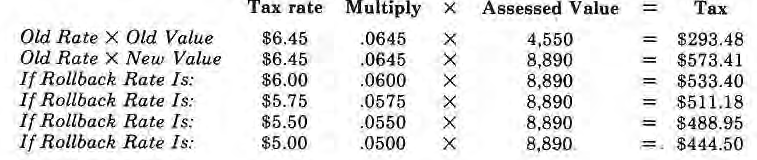
However, using my house as an example, we can multiply various rates to get some idea. Yes, your taxes will go up.
But remember that the new tax rate has not yet been determined and there will be some rollback.
We must wait until September to see the real impact of reassessment. Like everyone else, I am not thrilled about paying more taxes, even if it is “fair.” But rather than complain about the increase for the next few years, I choose to think about the savings I realized over the last few years when our property was under-assessed. It’s kind of like asking, “Is the glass half empty or half full?” With that in mind, how would you like to be the guy whose taxes were finally reduced after “paying through the nose” all those years?
He should complain!
Tax-rate examples, as printed (rate per $100 of assessed value; multiplier × assessed value = tax):
Old Rate × Old Value: $6.45; .0645 × 4,550 = $293.48.
Old Rate × New Value: $6.45; .0645 × 8,890 = $573.41.
If Rollback Rate Is $6.00: .0600 × 8,890 = $533.40.
If Rollback Rate Is $5.75: .0575 × 8,890 = $511.18.
If Rollback Rate Is $5.50: .0550 × 8,890 = $488.95.
If Rollback Rate Is $5.00: .0500 × 8,890 = $444.50.
Original photograph caption
Original 1985 tax reassessment example table. The Times of Skinker-DeBaliviere, May 1985, page 3. Rates and examples refer to the historical report.
Originally published in The Times of Skinker-DeBaliviere, May 1985.
Read this article in the original newspaper issue.
Original source: SD_Times1985_05.pdf, printed page(s) 3; PDF page(s) 3.
