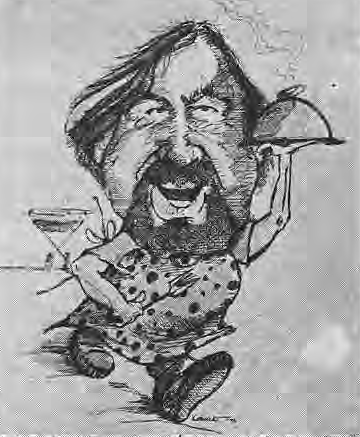
Historical recipe and humor by Jesse Horstman, October 1983. Part One is an invented comic account of pasta’s origins, followed by the original recipe.
Editor’s note: The writer of our second column is Jesse Horstman. Jesse lives on Kingsbury Place and is a member of the city’s Heritage & Urban Design Commission.
He is a financial real estate advisor. I hope to provide not only a recipe for fun cooks but help in a small way to take the mystery out of cooking and separate fact from fiction or whatever.
There are two distinct parts of this article: Part one: Fact or fiction; Part two: The recipe.
Part One: There is a belief amongst some of the scientific community that many, many years ago beings of a higher intelligence walked amongst us humankind.
This is evidenced in very ancient Egyptian, Mayan, and Inca civilizations. Their purpose was known to but a few and that purpose was to find the center of the universe.
This was accomplished, and a small colony settled in Cracow, Poland, where after eons of time and many generations later, what call pasta (originally known as Pastonoveriski) was invented by a humble but brilliant decendant of a computer processor of the fifteenth century B.C.
His name was Julius M. Polozorek.
He took his invention to King Cashmir II who sent Julius to spread his invention to the seven corners of the Earth (a mystery still debated in some circles of the corners). Eventually, his travels led him to Italy. Upon immigration, Latin-speaking officials who were not familiar with the genius of man and the complexity of his tongue, changed his name to Julian M. Polo. Julian settled down and married a young, wealthy, almost vestal virgin. Their decendant is known in history today as Marco Polo. Yes!
There are many unanswered questions.
Part Two: The Recipe — Saffron Pasta with Scallops
Ingredients 1. Friend (name brand not necessary.
Look for intelligence, if possible, good company, and willingness to share. 2.
Two bottles good red wine (any alcohol may be substituted: The purpose of the ingredient is to clarify thinking and to enhance creative juices and discussion). 3. 4 tablespoons butter and 2 teaspoons olive oil 1 clove garlic 1/2 cup shallots 1/4 cup mushrooms 1 pound small bay scallops 6 quarts boiling water 1 cup chicken broth 1 cup white wine 2 saffron bullets per pound or as desired 1 teaspoon salt 1/2 teaspoon white pepper — freshly ground preferred 1 pound fettuccine 6 lemon wedges 1/3 cup Italian parsley 1/2 to 1 small bottle clam juice (amount depends of type of pasta)
Putting It All Together 1. Heat olive oil and butter in 10- or 12- inch saute pan. Peel garlic, crush it into hot oil to impart garlic flavor to oil. Be careful to singe slightly. 2. Coarsely dice shallots; saute them over low heat in garlic oil and butter until transparent.
In another pan, combine one cup white wine and one cup chicken broth and reduce liquid by one-half. Set aside. 3. Slice mushrooms and add to heated garlic butter and oil and saute lightly.
In same skillet, add scallops and lightly saute them. 4. Add sauteed mushrooms and scallops to the reduced chicken broth. Add salt, pepper, and saffron and heat. 5.
To six quarts boiling water, add 1 teaspoon olive oil or butter and one tablespoon salt. Add fettuccine to boiling water. Cook until somewhat starchy to taste (begin tasting after 3 to 5 minutes to test for doneness). Remove from heat and drain. 6. Place clam juice in pot with drained fettuccine and cook until clam juice is absorbed by the pasta. Add sauce of wine, broth, scallops, etc. and cook approximately 2 to 3 minutes until pasta is chewy to the bite (al dente). Mix well and pour mixture into warm serving dish. Sprinkle lightly with Italian parsley. Serve very warm but not hot — hot offends the taste buds. Squeeze lemon as desired over pasta.
As it is said in the CWE, “This here Pastonoveriski is real good!” And that’s a fact. Note: For a truly decadent effect, Poland water may be used to cook pasta.
It is available at 9-0-5.
Original photograph caption
Jesse Horstman as sketched by Koheret. Original source credit, The Paper, October 1983, page 5.
Originally published in The Paper, October 1983.
Read this article in the original newspaper issue.
Original source: SD_Times1983_10.pdf, printed page(s) 5; PDF page(s) 5.
