Original editor’s note: This article is one of three funded by a grant from the Missouri Endowment for the Humanities, Inc., a state based arm of the National Endowment for the Humanities.
There is this about riding a pendulum: It never goes far, and you know you’ll get back where you started.
Looking back on my own education, I realize that I have had three swings so far. I am beginning to learn the route.
In the fifties, the Russian launching of Sputnik jarred American complacency and put us to work tooling up to be the kind of country that could put a man on the moon. In the period of Vietnam, we reacted against our own technological superiority. Guilty about the coldness of our power to devastate, we learned warmth and sensitivity and how to let it all hang out.
We seem now, in the aftermath of that emotional time, to be getting hard-headed again. It has begun to seem no small task to make sure that our high school graduates have a basic competence in mathematics and the writing of the English language, and parents are rightly concerned that schools be held to that fundamental standard.
When inflation makes it difficult just to stay even, it is not a time to confuse sensitivity sessions with Reading and Writing. And it is difficult any longer to appreciate the theory of the New Math against the reality of figuring a tax return.
But there is a cost to riding the pendulum in this way. Propelled hard in one direction, we can lose sight of the other. There is the danger, in narrowing attention to a no-nonsense curriculum, that much will be lost.
Humanities subjects, like art and history and literature, are no hedge against inflation, and in a storm we want to trim sail, not worry about aesthetics. I would be happier about the children of this generation returning to basics if I were more certain that all the basics would be there when they arrived. In fact, the Humanities are undergoing a steady erosion in the seventies. They cost too much, and they promise no jobs.
It is possible that, with two hundred years of maturing behind us, we might begin to chart a truer and straighter course, less at the mercy of swings of the pendulum. The aims of a sound education in fundamentals are not opposed to the aims of education in the humanities. They are, in fact, closely linked to one another. I think, for instance, of the comment of A. Bartlett Giamatti, the president of Yale, who recently observed that young persons lacking basic skills in language can never adequately discover themselves, or others, “and thus never have to leave the child’s garden of feeling and enter the city — that is, become citizens.”
No one would argue against the importance of literacy for citizenship, though in practice we do less about our illiteracy rate than countries like Cuba. Democracy depends, we are told, on voters who can read. But so, in its way, does a monarchy. As the runt king in The Wizard of Id might ask, what good is a royal edict to the illiterate? And in a dictatorship, what is the use of a propaganda ministry if no one can read propaganda?
Citizenship has to involve more than reading and writing and ciphering. It calls for voting, as Thoreau said, not just with the ballot, but with the whole person. The Humanities come in here. In a variety of ways, they encourage the child to be more than the sum of his or her skills. They quicken the child’s imaginative experience. They encourage a child of the present to belong to the past and the future as well. And they make questions of value as important as answers in algebra.
The things I do not know about conveying all this to children make a long list. I would not trade a really good primary school teacher for three bank presidents and a future draft choice. But I have a general idea of what I hope for when the good teacher and the Humanities and the child all come together.
The teacher would love language, not just the rules that keep it straight, but the sound and color of live words.
The teacher would be on good terms with the great story tellers, like Washington Irving and Isaac Bashevis Singer, and they would be dropping in all the time and saying in their own way that words not only make statements, they make worlds. And there would be some joy in all this. A piece of ruled paper would be space for play, at least sometimes as inviting as the school yard, and as with games in the school yard there would be energy obeying a fundamental order.
Long after, the children become citizens would be able to tell when someone else – a president or a promoter — seemed to like best the words that could mean anything or nothing. And they would be curious to know why.
Behind the words in a poem or story, behind the paint and canvas, behind the musical notes, the teacher knows, there lives the imagination of the maker of the work. The maker’s imagination can be an extraordinary one, dazzling, shaming our ordinariness. But the teacher also knows that the child before him deals in imagination as an ordinary thing. The child and the artist may have more in common than the child and the parent. The teacher must wonder whether the death of the imagination, like the end of belief in Santa Claus, is inevitable to the child’s maturing.
I would like to encourage a healthy disrespect for that certitude, not for the sake of Santa Claus but for the sake of citizenship. The imagination never takes the world at face value and likes to give the world back to itself in a way the world never expected. The politics of the imagination do not stand pat. Like a bold peacemaker, the imagination takes risks. If the Humanities have something to do with forming a citizen who will make creative responses to problems in social justice, and city planning and the conservation of natural resources, it would be difficult to figure their value in dollars and cents.
If they are doing their job, the Humanities should tell children that there is a citizenship of time as well as place. The child owes much to the centuries but is apt to forget them, like grandparents dead before his birth. Living, especially among the young, is arrogant, as if we had created ourselves and could hold the next generation at ransom for their lives. History makes us humble citizens by giving us a small part in a long story whose plot is not clear. I will not care, for a while, whether my children know much history, by the pound. But I care a great deal that they know how a Roman or a medieval Englishman or a nineteenth-century feminist looked at their worlds — if only so that my children will look twice at their own.
I do not want to argue that there is salvation in the Old Masters. We all know how the Nazis loved art. If it took only books to change lives, there would by now be no more burners of books. The Humanities are not likely to be much better than the flawed and vulnerable men and women who have made them and passed them on. But they have cost too much to be set aside in a rush to balance the budget. Without them, I think, we shall find our children quietly signing on with the Unhumanities taught by mass culture in an age of technological titillation. There is nothing human about being turned on. A light bulb can do it. Education as an electronic display of lifestyles makes values decorative, as though lives were under the authority of fashion. In a trendy time, saints and hermits are thought of as vegetarians who were into religion.
I want my children to be able to read and write, yes, but even more to be able to add sense and subtract silliness because of what the Humanities have given them. The Humanities are not a clue to the millennium. They are a profound resource for the largest and strangest of any neighborhood’s projects — the education of our children for a world we have made, and which they must learn to remake.
Original photograph caption
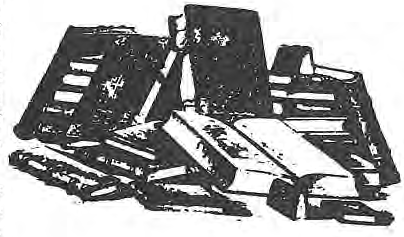
Original books illustration beside the humanities essay. The Paper, April 1979, page 3. Artist not credited.
Originally published in The Paper, April 1979.
Read this article in the original newspaper issue.
Original source: SD_Times1979_04.pdf, printed page(s) 3; PDF page(s) 3.





