Historical April 1977 fire-prevention series by Jo Ann Vatcha, Marj Weir and Chris Lange. Device recommendations, prices, materials and installation methods are period source material, not current building or safety guidance.
Devices you might consider purchasing to help in making the detection and fighting of fire more likely include: escape ladders, fire extinguishers, and smoke detectors.
Fire Extinguishers are helpful in combatting small fires, in the kitchen or perhaps the fireplace, but they should not be depended on for complete protection, because their usefulness is limited. There are several types available, including some that are called Tri-Class. This means that they can help to extinguish all three classes of fire: A (paper, wood and cloth), B (gasoline, grease, oils, paints), and C (electrical fires). Since water is effective in fighting only Class A fires, a fire extinguisher of the Tri-Class variety might be a worthwhile investment. Of course, it would be more effective to have one of these in each potential danger spot, e.g., the kitchen, the basement, etc. And one should always recognize the dangers to self in attempting to combat a fire. In most instances, it would be safer to leave the premises and call the fire department rather than risk your life attempting to put out a fire which could easily get out of your control.
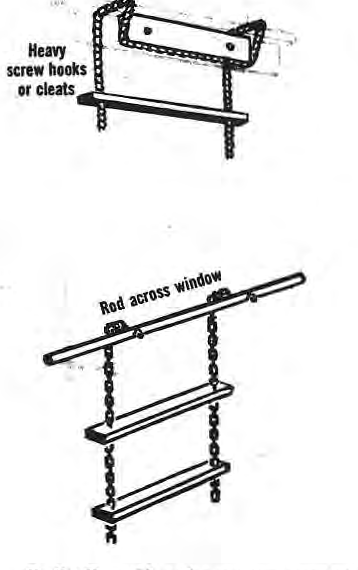
Escape Ladders are one means of escape from upper floors. There are several kinds, a portable rope or chain ladder that simply hooks over the sill, or anchors in several other simple ways: by a rod across the window or with heavy screw hooks or cleats, for example.
Trellis Type:If you’re not too worried, about intruders, you can attach a homemade ladder, or trellis strong enough to serve as one, to the side of the house near a likely escape window. Or you can have installed a permanent foldout ladder that looks like an ordinary drainpipe until you work a button or lever near the window. The rungs pop out and it’s a fire escape.
But remember — a ladder may be too difficult for young children, older people, and the handicapped. And a ladder should not be used where flames from a window directly below could cut off escape.
Because 75% of deaths due to fire occur between the hours of 9 p.m. and 6 a.m., when most people are sleeping, smoke detector alarms should be a part of your total home fire safety prorgam.
There are two types of smoke detectors for home use: ionization devices and photoelectric units.
The ionization type can be run with batteries. They do respond well to smoke generated by flaming fire, but are less sensitive to smoke from smoldering fires. Also, batteries must be changed periodically (frequency will depend on brand of detector and batteries, so check instructions).
Photoelectric models must be connected to electrical outlets, therefore limiting placement and, of course, making them inoperative in the event of a power failure. This type of smoke detector is particularly sensitive to smoke from smoldering fires but responds more slowly to flaming fires.
For maximum protection, the Consumers Union of Washington, D.C. reccommends the best system of protection should consist of the use of both types of smoke detectors. But if this is impractical and a choice must be made, then a good, battery operated ionization model should be the first consideration, perhaps with the intention of supplementing it with a photoelectric model at a later date.
PLACEMENT
An additional consideration is the placement of these devices for maximum protection. This presents special problems in our large two and three story homes. For adequate safetly, several devices will be required.
One detector should be placed on the ceiling in the hall near sleeping areas on second and third floors. It is preferable that these be the ionization type (battery operated). Where walls or doorways seperate the hall, use two devices on either side of the partition, if possible.
Another detector, preferably photoelectric, should be placed near living areas on the first floor. It should be mounted on the wall, away from a corner between 6 and 12 inches from the ceiling. NOTE: If there are members of your household who, unwisely, smoke in bed, install an ionization detector directly over the bed.
When purchasing a smoke alarm, consider the following:
SAFETY: Both types of detectors should carry the listing or approval of either Underwriters” Laboratories, Inc. (UL) or Factory Mutual System (FM)
BRAND COMPARISON: With few exceptions, most of the devices on the market are within the same price range. Because there are more than 25 manufactures of such devices, we will not list them here. But if you with to make an informed purchase, we recommend you refer to the following magazines, available at your library.
CONSUMER’S RESEARCH MAGAZINE
March, 1975 (p. 25)
CONSUMER REPORTS
October, 1976 (p.555)
PRICE: An adequate alarm can be purchased in our area, at department stores, discount and hardware stores, for less than $40 each. A better device can be purchased for about $50.
SOUND OF ALARM: Always test the alarm before you make this investment. Be sure the sound of the alarm will wake one when sleeping.
Because these alarms can sometimes be set off by heavy cooking smoke or a smokey fireplace, it maybe desireable not to place them too close to these areas But when this does occur, use the opportunity to implement and practice your escape plan.
Original photograph caption
Original escape-ladder illustrations: heavy screw hooks or cleats; rod across window. The Paper, April 1977, page 6. Artist not credited.
Originally published in The Paper, April 1977.
Read this article in the original newspaper issue.
Archival transcription note: Printed prorgam, safetly, seperate, with to make and desireable retained.
Original source: SD_Times1977_04.pdf, printed page(s) 6; PDF page(s) 6.





