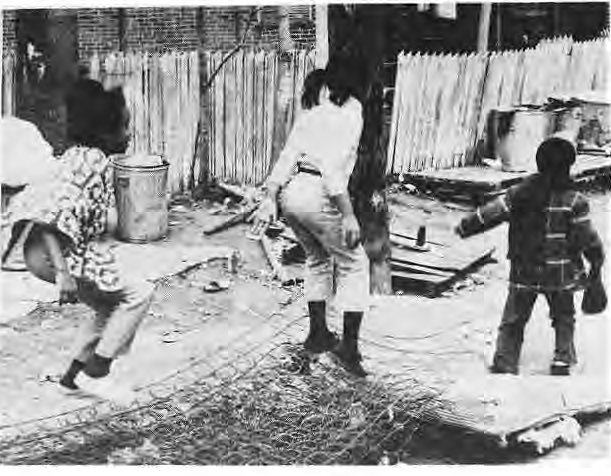
Within the Skinker-DeBaliviere area there are approximately 2,500 children ranging from ages six to thirteen (the combined enrollment of Hamilton and St. Roch’s schools.) Perhaps there are half again that many in the fourteen to nineteen age group; no figures are available. Whatever the exact amount of young, growing-up individuals that live in the area may be, we do not lack for children. For many of these youngsters, summer vacation offers “nothing to do” and little space to do it in.
Our area is rich in various sit-down programs (see schedule) but we are poor in adequate play areas that are roomy enough for ball games and various impromptu running, jumping and leaping activities. Churches and schools provide four large asphalt lots for this kind of play, but without special equipment and adult supervision, these areas accomodate a limited amount of children.
Where do children go to play then? The streets, the alleys, vacant lots, and any place that the strong urge to exercise growing muscles may lead them. But playing in the streets and alley ways is dangerous and private lawns are often trampled by players leaping for liners and diving for shoestring catches. Vacant lots are sometimes considered too remote or too near traffic to be safe. Owners of the lots are reluctant to lease their land to neighborhood groups and allow them to become trashy, full of holes and weed ridden. Most lots are simply too small without some kind of special design to bolster the play potential, such as the plan worked out at the Tot Lot on Pershing and DesPeres Avenues. Most parents are reluctant to send their children to Forest Park without supervision.
The problem of finding a place for children to play in the neighborhood is not a new one. From time to time some interested group begins to plan for a recreational facility; location and finances usually the stumbling blocks. With the blighting of the area near DeBaliviere, the problem of location could possibly be solved. No specific plan for obtaining a Community Center has been devised at this time, although surveys indicate community concern is high.
Cal Stuart, Executive Director of the Skinker DeBaliviere Community Council, feels that a Community Center would be a positive element in the area, but that financing the project would be difficult. The 353 blighting bill does not give incentive to developers to build recreation centers, and public funds are not available for our particular neighborhood.
If a capital expenditure could be found to build a community center, then individuals using the facility would have to support it financially. Some form of endowment would probably be necessary, depending on the type of support the community could offer.
What would a community center give to the area? Would it be worth the effort that would be needed to acquire the facility? How many people could it really serve?
A nearby county YWCA reports that it has a membership of approximately 1,500 – with room for more. It provides meeting space for community groups and a variety of programs and classes including; swimming, pre-school dancing, tennis lessons, crafts, oil painting, tumbling and many more. There is something for every age group and interest.
A community center is needed in the Skinker-DeBaliviere area. Apathy will not bring it here, and the tried and true handful of hard workers in our area are already overburdened with projects that demand their continued effort. If a Center is to become a reality, more people must become involved.
A community center should be high on our priority list, If you are interested call Cal Stuart at the Council Office, VO 2-5122, so that he can arrange for a meeting of interested people – adults and teenagers. Let’s get moving.
Original photograph caption
Inventive children use materials at hand to make a trampoline before it is hauled away. Photo by Doug Muxlow.
Originally published in The Paper, June 1971.
Read this article in the original newspaper issue.
Original source: SD_Times1971_06.pdf, printed page 2.





