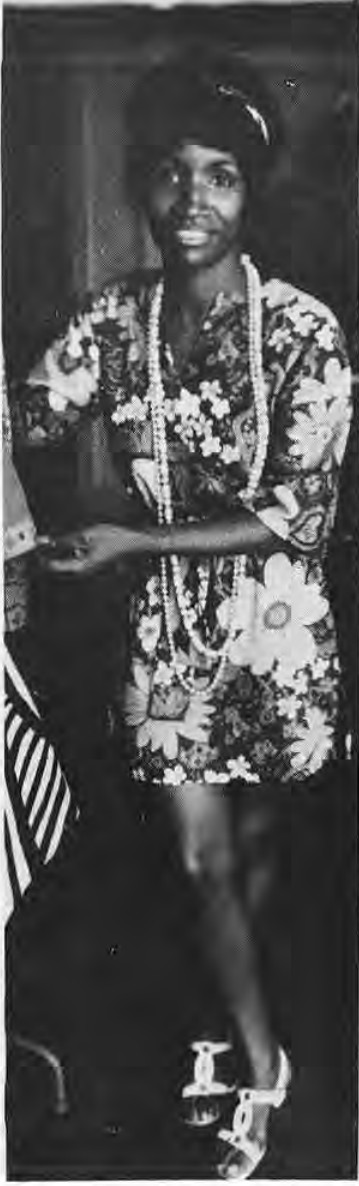
Mrs. Dorothy Coleman Garrett has been, for a long time, a hidden power in the community. The teens and adults who know her, think that it is definitely time for the rest of the community to have the pleasure of knowing a little about this tiny woman, who can hollor louder about injustices and the much needed improvements for this community than those three times her size.
Dorothy Garrett started working with the Skinker-DeBaliviere Community Council in 1967, as a volunteer worker, helping to contact interested youth to set up youth programs in the S.D.C.C. area.
She developed a group called the United Neighbors, to facilitate communication between the residents of this area. She won the presidency of this organization by election. This group became a liaison for the eastern part of the S.D.C.C. area to the council.
She was elected as vice-president of the Executive Committee of the S.D.C.C. Board, in March of that year. In the coming summer she was hired as Assistant Director of the Summer Programs. This, incidentally, was her first paying job connected with direct service to the Skinker-DeBaliviere area. In the coming fall she was hired as Community Organizer for the Council. She had accomplished more in one year than some people even attempt to do in their entire lives.
In 1968, she was given a scholarship to attend the School of Community Development at Washington University. After acquiring the official title of Community Developer she helped to meet the many needs of the Skinker-DeBaliviere area. Mrs. Garrett soon acquired skills in fields such as Health and Welfare Worker, Housing Specialist, Summer Program Proposal Writer, Program Specialist, and as a liaison between Black militants and other groups, to bring about better relationships between them. She also was instrumental in making available to the Skinker-DeBaliviere area, St. Mary's Mobile Clinic. This mobile clinic provides prenatal and G.Y.N. services for the residents of this area.
She also organized a group of male residents in the 5700 block of Westminster to build a vest-pocket park, but due to financial difficulty, the park was never completed.
She worked with the Legal Aid Society to work out the legal problems in the area concerning slum landlords and eviction. Speaking of slumlords and evictions, Dorothy Garrett was one of the few people in St. Louis to successfully complete a rent strike.
She helped to organize and became a member of a West-End group called the Committee of the Whole. This committee submitted a package-summer plan which was unanimously voted for, by the youth and the N.A.C. of the West-End area.
Mrs. Garrett was responsible for obtaining summer funds for the programs of the Committee of the Whole, which included funds for the Skinker-DeBaliviere summer programs (Day Care and the Manufacturing Programs).
Mrs. Garrett strongly feels that the attitudes of many people who want to help develop communities have to be changed to "What can I do" rather than "This is what I want to do." She goes on to say that you don't become a helper by imposing an individualistic will or want upon the needy object, for then you become an obstacle that handicaps that community. You can only be of use if you can provide services that are needed for the betterment of the community. She also feels that the militants are going to have to take a longer and better look at themselves and learn self-identification so that they can be an asset to their organization and not make their organization a vehicle for their own purpose. Mrs. Garrett also feels that in order to stabilize a community more emphasis and self-commitments have to be placed on the economical, educational, social, and physical structures of the area. This can be done by starting from the base of families and extending outwards toward the different and complex life styles and social values in the area.
Mrs. Garrett will be taking a leave of absence, due to illness, starting August 21, 1970.
**Note from the author: This account of Dorothy Garrett's accomplishments sounds dry and factual, it was purposely written so. The intense emotionalism and personal conviction that Dorothy employs in all her undertakings cannot be interjected into this "success" story by a mere pen or typewriter. For behind each action accounted for in this article, whether it was when she first volunteered her services to the Skinker-DeBaliviere area, or her last action before taking her leave of absence, there lies another story to be told. A story of warmth, of love, of tears, of joy, of humanity… in short another Dorothy Garrett. I know that even with the full eloquence of words, those of you who have not worked with her, and talked with her will not feel even a glimmer of the great warmth that fills that pint-sized woman. We teenagers salute you, Dorothy Garrett.
Original newspaper source
Originally published in The Paper, September 1970.
Read this article in the original newspaper issue.
Original source: SD_Times1970_09.pdf, printed page(s) 5.





