Original printed byline: Stephen A.Brammeier
Historical September 1996 article. Dates, prices, services and contacts describe the source period; current availability has not been established.
Hip dysplasia is a condition affecting primarily large or giant breed dogs.
The condition is basically arthritis of the hip joints.
A dog may be affected as early as six months of age, or the signs may not be evident until the dog is older than one year.
Some dogs do not show any evidence of the condition until they are geriatric. Affected pets show a stiffness of the rear limbs; they are slow to get up and down from a sitting, or lying, position; they may “rabbit hop” when they run; they are reluctant to navigate stairs; and they may show pain with increasing amounts of exercise. Since the 1960’s the veterinary profession has recognized the heritable nature of hip dysplasia.
However, the mode of inheritance is not simple, or easy to “select” away from in a breeding program.
A bitch could have normal hips, but still produce puppies that develop hip dysplasia.
The Orthopedic Foundation For Animals (OFA) evaluates radiographs of dog’s hips providing a grading system for the degree of hip dysplasia. Breeders can consult with the OFA getting assistance in breeding away from families of dogs known to have a. high incidence of hip dysplasia.
The program has assisted breeders and prospective pet owners in reducing the chances of having dogs with crippling hip problems. Over the last 30 years other theories have suggested that hip dysplasia is somehow associated with vitamin C levels and could be averted by feeding puppies large doses of vitamin C – a fact that scientific studies have been unable to document.
Another theory proposed that a small groin muscle, the pectineous, possibly exerted too much outward pull on the upper leg causing the hip joint to deform. Again, studies have been unable to document this fact. Too much exercise and too little exercise have also been proposed as contributing factors to the development of hip dysplasia, but conclusive evidence is lacking to support either theory. Recent studies have shown that we may be contributing to large breeds developing hip dysplasia by feeding “growth” diets to puppies that make them overweight.
The excess weight may cause the growth plates in their bones to close prematurely. a possible factor in the development of hip dysplasia. Also, excess calcium can contribute to developmental bone disease.
The newest feeding recommendation for large or giant breeds is to feed puppies on a “food-limited” basis. Their caloric needs should be calculated, and the food measured by the amount of calories it provides.
The pup should be evaluated every two weeks to determine body condition and the amount of food altered based on the pup’s condition.
It is still recommended that a puppy type food be used. just not allowing the pup to overeat.
If an adult food is used the puppy may actually get too much calcium compared to the amount of calories the adult food provides.
There are at least two new puppy foods on the market designed especially for the large or giant breed dog that goes through a tremendous growth period from 12.weeks to 12 months of age.
These foods are available through local pet supply stores.
However, the calorie intake and amount fed should still be closely monitored to keep the pup from becoming overweight.
A veterinarian can help an owner evaluate the status a pup’s body conditioning to help maintain the optimal weight as the puppy develops.
Original photograph caption
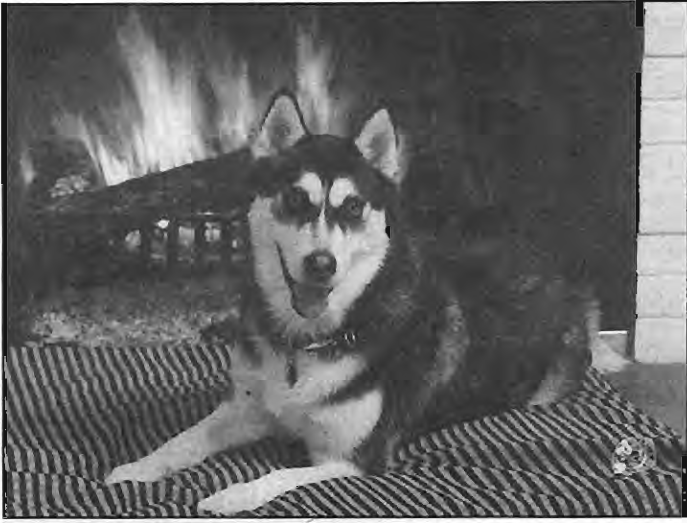
Dog accompanying Pet Talk. Individual name and photographer not credited.
Originally published in The Times of Skinker-DeBaliviere, September 1996.
Read this article in the original newspaper issue.
Original source: SD_Times1996_09.pdf, printed page(s) 6; PDF page(s) 6.





