Original printed byline: Stephen A.Brammeier
Historical March 1996 article. Dates, prices, services and contacts describe the source period; current availability has not been established.
I am delighted to take up a subject at a reader’s request: the possible transmission of parasites from pets to people.
I know it doesn’t seem like a topic to discuss amongst a genteel readership as has The Times, however I shall keep my wits about me, carefully avoiding descriptive language of the harsh or graphic nature. Although people own pets of various species, and parasites are often specific to a particular species, I will confine my discourse to to the potential hazards posed by canine and feline pets; partly because of space; partly because the dogs and cats are the most common pets; and partly because I don’t know much about lizard parasites, or bird parasites. Puppies and kittens are often “infested” – rather a harsh term, let’s substitute: carry. Puppies and kittens often carry roundworms.
These parasites live in the small bowel of the pet; the “pot-belly” appearance of young kittens and puppies can be caused these roundworms.
A mother unfortunately passes these worms to her young in her milk, and in the dog, while the pups are still in the uterus.
The adult worms develop within the first three weeks of the newborns’ life and the parasite’s eggs are released into the stool. Adult dogs become hosts to these worms by ingesting the eggs. Literally thousands of eggs can be released into the environment every time a puppy or kitten passes a stool.
The eggs are very resistant to the environment and remain infective in the soil for years. People who inadvertently ingest an infectious roundworm egg will not get roundworms as such; but can have problems from the young roundworm, generally known as a larvae.
These larvae, finding themselves in a body they were not designed to inhabit, sort of wander around looking for a home.
In the process they “migrate” through human’s insides, otherwise known as viscera. Hence the term: visceral larva migrans. Anyway, the most damage done by one of these homeless larvae is to a child’s retina, and can cause blindness; the infestation due to the child’s eating dirt previously contaminated by stool containing roundworm eggs.
As odd as it might seem, I have also heard of people using a dog’s droppings to fertilize their gardens: not a good idea, and not good fertilizer either. Hookworms are another intestinal parasite of dogs that are passed to the pups through the mother’s milk. Dogs can also be infested by ingesting the eggs, or by the larvae entering their body through the foot pads.
In people, the larvae migrate through the skin causing irritation, leaving a tortuous track: a cutaneous larva migran. Recent evidence indicates that people can also develop adult hookworms that live in the intestinal tract causing chronic intestinal problems. Again, children are most often infected by walking barefoot in soil contaminated with hookworm eggs. Control of these parasites, and prevention of human exposure involves keeping the pet free of parasites and limiting the contamination of the soil by picking up any stool from pets.
A pet’s stool should be checked regularly for parasites, at least on an annual basis. Because the parasite eggs are very resistant to the environment, all stool should be picked up and disposed of, both in a yard and out on a walk.
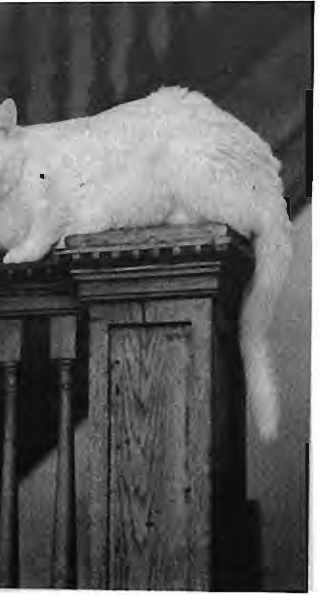
Original photograph caption
Cat accompanying Pet Talk. No individual identification or photographer credit printed.
Originally published in The Times of Skinker-DeBaliviere, March 1996.
Read this article in the original newspaper issue.
Original source: SD_Times1996_03.pdf, printed page(s) 6; PDF page(s) 6.





